
Ciudades medievales, iglesias fortificadas, monasterios pintados, obras maestras de madera y antiguas ruinas dacias son sólo algunas de las atracciones que conforman el excepcional patrimonio cultural de Rumania.
25 of its beautifully preserved architectural gems have been included by UNESCO in the World Cultural Heritage in acknowledgement of their natural, scenic and monumental appeal. A tour of these sites is a good way to discover Romania's history, artistic wealth and popular traditions. Each and every stop on this route will reveal a unique and stunning location.
The western half of Walachia (Southern Romania) is endowed with spectacular monasteries, thermal-spring spas, and charming villages set at the foothills of the Carpathian Mountains. Continue your trip along the Olt River Valley and discover Transylvania's forest-covered slopes, unspoiled landscapes, quaint villages, and fortified churches. In northeastern Romania, make time for Bucovina's painted monasteries, with their magnificent 15th-century frescoes, which are unique in the world. Cross the Prislop Pass into Maramures, famous for its hand-hewn wooden architecture and its unique tall-spire churches with double roofs.
Sitios del Patrimonio Mundial de la UNESCO en Rumania:
Monasterio Hurezi (Monasterio Horezu)
Iglesias fortificadas medievales de Transilvania
Centro histórico de Sighisoara - Ciudadela de Sighisoara
Monasterios Pintados de Bucovina
Sculptor Constantin Brâncuși Monumental Ensemble – town of Târgu Jiu
Iglesias de madera de Maramures
Sarmisegetusa Regia capital del Reino Dacio en las Montañas Orastie
Roșia Montană, zona minera histórica
Las fronteras del Imperio Romano de Dacia
...
Monasterio Hurezi
Manasterea Hurezi
Ubicación: Región de Valaquia – Sur de Rumania
Ciudad grande cercana: Ramnicu Valcea (27 millas al este)
Estación de tren más cercana: Ramnicu Valcea
Telephone: (+4) 0250 860.071
Fundado en 1690 por el príncipe Constantin Brancoveanu, el monasterio de Horezu
Es uno de los estilos renacentistas rumanos más representativos (Brancovan o Brancovenesc estilo).
Reconocida por la riqueza de su detalle escultórico, el tratamiento de sus composiciones religiosas y sus obras decorativas pintadas,
El monasterio alberga preciosas colecciones de frescos e iconos que datan de finales del siglo XVII y principios del XVIII.
Escuela Hurezi de pintura mural e iconográfica establecida en el monasterio en el siglo XVIII. Tuvo una profunda influencia en el arte y la arquitectura religiosos de la región de los Balcanes.
El museo del monasterio, ubicado en la residencia principesca, presenta obras maestras de Brancovan style icons, books, embroideries, silver collections. The library contains over 4,000 volumes including Homer’s Odyseea (printed in 1541), Euripide’s Tragedies (printed in 1551) and Novellae Constitutiones - one of the four major units of Roman law initiated by Roman emperor Justinian I (printed in Paris in 1568).
El monasterio de Horezu fue incluido en la Lista del Patrimonio Mundial de la UNESCO "
por su pureza y equilibrio arquitectónico, la riqueza de su detalle escultórico, el tratamiento de sus composiciones religiosas,
sus retratos votivos y sus obras decorativas pintadas".
Alojamiento para pasar la noche, con capacidad para 20 personas, disponible en el monasterio.
(rooms with two, three and four beds).
El primer trineo jamás fabricado en Rumanía se fabricó en la Escuela de Artesanía de Horezu.
para el equipo de trineo de cuatro hombres de los Juegos Olímpicos de Chamonix de 1924 de Rumania.
The bobsled is today on ehxibit at the Museo del pueblo del condado de Valcea en Bujoreni (Muzeul Satului Vâlcean)
(32 miles east of Horezu / 4 miles north of Râmnicu Vâlcea).
...
Las iglesias fortificadas medievales de Transilvania
Transilvania alberga casi doscientas aldeas con iglesias fortificadas built by the Saxons between the 13th and 15th centuries. Having to withstand constant invaders, the villages' central areas, where the church was located most of the time, were fortified with defense walls, having the capacity to shelter a large number of people. Seven of the fortified churches have been designated by UNESCO as World Heritage Sites. A visit to these quaint villages, placed amidst lush farmland and green rolling hills, will give travelers a taste of the long-gone medieval times.
Iglesia fortificada de Biertan
Ubicación: Transylvania – Central Romania
Pueblo grande cercano: Sighisoara (18 miles east)
Estación de tren más cercana: Dumbraveni
Más información sobre la Iglesia Fortificada de Biertan
Iglesia Fortificada de Cálnica
Ubicación: Transylvania – Central Romania
Pueblo grande cercano: Sibiu (30 millas al sureste)
Estación de tren más cercana: Miercurea Sibiului
Más información sobre la Iglesia Fortificada de Calnic
Iglesia fortificada de Darjiu
Ubicación: Transylvania – Central Romania
Pueblo grande cercano: Sighisoara (20 millas al oeste)
Estaciones de tren más cercanas: Saschiz, Sighisoara
Más información sobre la Iglesia Fortificada de Darjiu
Iglesia fortificada de Prejmer
Ubicación: Transylvania – Central Romania
Localidades grandes cercanas: Brasov (11 millas al suroeste)
Estación de tren más cercana: Prejmer
Más información sobre la Iglesia Fortificada de Prejmer
Iglesia Fortificada de Saschiz
Ubicación: Transylvania – Central Romania
Pueblo grande cercano: Sighisoara (10 millas al oeste)
Estación de tren más cercana: Sáschiz
Más información sobre la Iglesia Fortificada de Saschiz
Iglesia Fortificada de Valea Viilor
Ubicación: Transylvania – Central Romania
Pueblo grande cercano: Medios (8,5 millas al noroeste)
Estación de tren más cercana: Copsa Mica
Más información sobre la Iglesia Fortificada de Valea Viilor
Iglesia Fortificada de Viscri
Ubicación: Transylvania – Central Romania
Pueblo grande cercano: Sighisoara (25 millas al noroeste)
Estación de tren más cercana: Rupia
Más información sobre la Iglesia Fortificada de Viscri
...
Ciudadela de Sighisoara
Ubicación: Región de Transilvania - Rumania Central
Estación de tren más cercana: Sighisoara
Más información sobre el casco antiguo de Sighisoara
Fundada por artesanos y comerciantes alemanes conocidos como los Sajones de Transilvania, Sighisoara es un buen ejemplo de pequeña ciudad medieval fortificada que desempeñó un importante papel estratégico y comercial. en la periferia de Europa central durante varios siglos.
Sighisoara, uno de los pueblos más bonitos del corazón de Transilvania, Hoy en día se parece mucho a lo que era hace 500 años. Esta ciudad medieval fue también la cuna de Vlad Drácula - nicknamed Vlad Tepes (Vlad the Impaler) - ruler of Walachia from 1456 to 1462. It was he who inspired Bram Stoker's fictional creation,Count Dracula. His house is just one of the many attractions here. Others include the Church on the Hill, with its 500–year old frescos; the Church of the Dominican Monastery, renown for its Renaissance carved altarpiece, baroque painted pulpit, Oriental carpets and 17th-century organ; and the Venetian House, built in the 13th century.
Entre las atracciones más llamativas se encuentra el mirador de 210 pies de altura Torre del Reloj (The Council Tower), built in the 14th century, where each day a different wooden figure emerges from the belfry on the stroke of midnight. The tower was raised in the 13th and 14th centuries when Sighisoara became a free town controlled by craft guilds, each of which had to finance the construction of a bastion and defend it during wartime. The fortification walls, built in the 14th and 15th centuries, were up to 50-feet high and featured 14 defense towers. Most of the old structure and 9 of the defense towers can still be admired today… (más información)
...
Los Monasterios Pintados de Bucovina
Entre los tesoros más pintorescos de Rumania se encuentran los Painted Churches of Bucovina (northeastern Romania). With their painted exterior walls, decorated with 15th and 16th century elaborate frescoes (featuring portraits of saints and prophets, scenes from the life of Jesus, images of angels and demons, heaven and hell), deemed as masterpieces of Byzantine art, these churches are one-of-a-kind architectural sites in Europe. Far from being merely wall decorations, the paintings represent complete cycles of religious murals. The purpose of the frescoes was to make the story of the Bible and the lives of the most important orthodox saints known to the villagers, by the use of images. Their outstanding composition, elegant outline and harmonious colors blend perfectly with the surrounding landscape. Whether you are interested in religion, history, art or architecture, you will be intrigued by the construction and decor - exterior and interior - of these edifices. The best preserved are monasteries Humor, Moldovita , Patrauti, Probota, Suceava, Sucevita y Voronet. Otra, pequeña y singular iglesia, se encuentra en el pueblo de Árbol. Ocho de las iglesias fueron incluidas en la lista del Patrimonio Mundial de la UNESCO en 1993.
Iglesia Arbore
Ubicación: Bucovina – Noreste de Rumania
Pueblo grande cercano: Suceava (20 miles southeast)
Acceso: coche, autobús (de Gura Humorului o Radauti)
Estaciones de tren más cercanas: Darmanesti, Radauti
Más información sobre Monasterio Arbore
Monasterio del Humor
Ubicación: Bucovina – Noreste de Rumania
Pueblo grande cercano: Suceava (40 kilómetros al este)
Acceso: coche, autobús (desde Suceva), tren
Estaciones de tren más cercanas: Gura Humorului
More info on Monastery Humor
Monasterio de Moldovita
Ubicación: Bucovina – Noreste de Rumania
Pueblo grande cercano: Suceava (55 miles southeast)
Acceso: coche, tren (de Suceava a Vama, 1 hora y cuarto, y de Vama a Vatra Moldovitei, 35 min)
Estaciones de tren más cercanas: Vatra Moldovitei
Más información sobre el Monasterio Moldovita
Iglesia Patrauti
Ubicación: Bucovina – Noreste de Rumania
Pueblo grande cercano: Suceava (5 miles southeast)
Acceso: coche, autobús desde Suceava
Estaciones de tren más cercanas: Darmanesti, Suceava
Más información sobre el Monasterio Patrauti
Monasterio de Probota
Ubicación: Bucovina – Noreste de Rumania
Pueblo grande cercano: Suceava (31 miles northwest)
Acceso: coche
Estaciones de tren más cercanas: Dolhasca
Más información sobre el Monasterio Probota
Iglesia de San Jorge / Monasterio de San Juan Nuevo
(Biserica Sfantul Gheorghe / Manastirea Sfantul Ioan cel Nou)
Ubicación: Suceava – Noreste de Rumania
Dirección: Calle. Ioan Voda Viteazul 2
Estaciones de tren más cercanas: Suceava
Más información sobre el Monasterio de San Jorge
Monasterio Voronet
Ubicación: Bucovina – Noreste de Rumania
Pueblo grande cercano: Suceava (20 millas al este)
Acceso: automóvil, autobús (desde Gura Humorului), 3 ½ millas a pie desde Gura Humorului
Estaciones de tren más cercanas: Gura Humorului
Más información sobre el Monasterio Voronet
...
Sculptor Constantin Brâncuși Monumental Ensemble – town of Târgu Jiu
Considerados los ejemplos más notables del arte público del siglo XX, el conjunto de tres esculturas, del maestro modernista rumano Constantin Brancusi, fue creado a finales de la década de 1930 en la ciudad de Targu Jiu, suroeste de Rumania.
Austero y contemplativo, el conjunto monumental representa un homenaje a los soldados caídos en la Primera Guerra Mundial.
But the remarkable fusion of abstract sculpture, landscape architecture, engineering, and urban planning,
conceived by artist Constantin Brâncuși,
goes far beyond the local wartime episode to offer an original vision of the human condition.
His vision was to shape a central esplanade linking three great sculptures depicting the pilgrimage of life:
''The Table of Silence,'' symbolizing divinity and communion; ''The Gate of the Kiss,'' embodying love;
and ''The Endless Column, a paean to Herculean triumph and an axis for the universe.
La "Columna sin fin" de Brancusi: diecisiete romboides de hierro fundido revestidos de latón apilados en un pilar de treinta metros de altura -
es considerado un ícono modernista, un ejemplo importante de arte modernista por la forma en que destiló los objetos hasta sus bases, representándolos a través de la abstracción.
La Mesa del Silencio, es una mesa minimalista de travertino rodeada por una decena de taburetes/sillas sin respaldo, del mismo material.
La Puerta del Beso, una puerta de piedra caliza y travertino que lleva un motivo de beso original.
...
Las iglesias de madera de Maramures
There is a strong tradition of building wooden churches across Eastern Europe, from Karelia and northern Russia all the way to the Adriatic, but in terms of both quality and quantity the richest examples are in Maramures. The Wooden Churches of Maramures are unique in shape and ornamentation and eight of them – in Barsana, Budesti Josani, Desestí, Ieud, Plopis, Poienile Izei, Rogoz y Surdesti, han sido reconocidos por la UNESCO como Patrimonio de la Humanidad.
Los característicos techos altos y los campanarios altos, estrechos y puntiagudos a menudo se describen colectivamente como el Estilo gótico de Maramures. The primary wood material used by the artisans was local oak, which has survived the elements with sturdy elegance until today. The interior walls of the churches were painted by local artists, with biblical scenes often juxtaposed against the familiar landscape of the village. Most of these houses of worship have stood proudly since the 17th and 18th centuries – some even longer. The oldest wooden church in Maramures is the Iglesia en la Colina en Ieud, que data de 1364.
Barsana — Church of 'Entry of the Most Holy Mother of God into Temple'
Biserica Intrarea Maicii Domnului en Biserica
Ubicación: Valle de Iza, Maramures – Norte de Rumanía
Pueblo grande cercano: Sighetu Marmatiei (10 millas al noroeste)
Estación de tren más cercana: Sighetu Marmatiei
Construida en 1720, la iglesia de madera del pueblo de Barsana (que debe su nombre a barani, the local shepherds who breed long-haired sheep) features some impressive interior frescoes with baroque and rococo influences painted by Toader Hodor in 1806. Originally part of a monastic complex closed down in 1791, the church was moved to its present location at the beginning of the 19th century. This outstanding church boasts an impressive collection of icons painted on glass and old religious books now on display in the museum of the new Barsana Monastery.
Pueblo Budesti Josani - Iglesia de San Nicolás
(Biserica Sfantul Nicolae)
Ubicación: Maramures – Northern Romania
Pueblo grande cercano: Sighetu Marmatiei (20 millas al norte)
Estación de tren más cercana: Sighetu Marmatiei
Laid out the foothills around the Cosau Valley, the beautiful church in Budesti Josani (1643) is home to a valuable collection of icons painted on glass depicting folkloric scenes; the church also houses a unique collection of 15th century wooden icons painted on both sides. The outstanding Juicio Final fresco, painted by Alexandru Ponehalski in the 1760s, has been preserved in its entirety. The influence of the Western Gothic style can be seen in the arrangement of the main belfry, which is surrounded by four smaller turrets. The coat of mail and helmet of Pintea the Brave (1670 - 1703) - a local outlaw who fought against social injustice - can be seen in Budesti Monastery.
Desesti – Iglesia de Santa Parascheva
(Biserica Sfanta Cuvioasa Paraschiva)
Ubicación: Maramures – Northern Romania
Pueblo grande cercano: Sighetu Marmatiei (15 millas al norte)
Estación de tren más cercana: Sighetu Marmatiei
The beautiful wooden church with a tall spire and steep, low-reaching,
El tejado de doble faldón en Desesti fue construido en 1770 en el estilo tradicional de Maramures.
y pintado por los renombrados pintores de frescos posbizantinos Radu Munteanu y Grigore Zugravu.
De gran interés son el Génesis, que representa la creación de Adán y Eva, y las escenas del Juicio Final.
Ieud - Iglesia Natal de la Santísima Madre de Dios
(Biserica Nasterea Maicii Domnului)
Ubicación: Maramures – Northern Romania
Pueblo grande cercano: Sighetu Marmatiei (30 millas al noroeste)
Estaciones de tren más cercanas: Viseu de Jos or Salistea de Sus
Construida en 1364, la Iglesia de la Colina es la iglesia más antigua de Maramures. Construido con pinos y abetos, con pequeñas ventanas, un techo doble y un único e impresionante campanario, presenta murales primitivos de estilo bizantino del siglo XV. Catorce íconos, que ilustran momentos del Sentencia a la Crucifixión A lo largo del camino que conduce a la iglesia se colocan escenas bíblicas para recordar El Camino a la Cruz que Jesucristo caminó hasta el Gólgota.
Plopis - Iglesia de los Arcángeles Miguel y Gabriel
(Biserica Sfintii Arhangheli Mihail si Gavriil)
Ubicación: Maramures – Northern Romania
Pueblo grande cercano: Baia Mare (12 millas al noroeste)
Estación de tren más cercana: Bahía Mare
Built between 1796-1798 and painted in 1811, this church's construction combines architectural elements from both the Maramures and Transylvania regions. High walls endowed with two rows of windows increase interior illumination and add to the distinctive style of the church, the only one in Maramures with a three-vaulted roof.
Poienile Izei - Iglesia de Santa Parascheva
(Biserica Sfanta Cuvioasa Paraschiva)
Ubicación: Maramures – Northern Romania
Pueblo grande cercano: Sighetu Marmatiei (23 millas al noroeste)
Estación de tren más cercana: Viseu de Jos or Salistea de Sus
The church at Poienile Izie, built on fir logs between 1604 and 1632, is one of the most beautiful and best-preserved architectural monuments in Maramures. The church's interior frescoes, painted in 1794 by Gheorghe din Dragomiresti, feature some of the most dramatic depictions of hell, illustrated in the Last Judgement scene. An interesting element is the metal horned moon under the cross, considered a means of protection against the Tartars.
Rogoz - Iglesia de los Arcángeles Miguel y Gabriel
(Biserica Sfintii Arhangheli Mihail si Gavriil)
Ubicación: Maramures – Northern Romania
Pueblo grande cercano: Baia Mare (27 millas al noroeste)
Estación de tren más cercana: Bahía Mare
Construida en 1663 y pintada en 1785, la iglesia de madera de Rogoz presenta un techo asimétrico con el lado norte más grande y más bajo para proteger a las personas que se encuentran afuera durante las celebraciones religiosas importantes.
El techo sobresaliente protege las tallas estilizadas de cabezas de caballo, que se cree que
mantener alejados a los malos espíritus. A diferencia de las iglesias típicas de Maramures, esta iglesia
has a much smaller interior space, with walls no higher than 10 feet.
Surdesti - Iglesia de los Arcángeles Miguel y Gabriel
(Biserica Sfintii Arhangheli Mihail si Gavril)
Ubicación: Maramures – Northern Romania
Pueblo grande cercano: Baia Mare (12 millas al oeste)
Estación de tren más cercana: Bahía Mare
Dating from 1767, the famous wooden church in Surdesti, built of oak beams skillfully intertwined, displays well-preserved interior watercolor canvases and a remarkable 175-feet tall belfry. Surdesti is known to be one of the highest oak buildings in the world with an overall height from ground level to the top of the steeple of 235 feet. Remarkably, no metal was used to erect the belfry as even the fastenings are made entirely from wood.
Fortalezas dacias de las montañas de Orastie
(Sarmisegetusa Regia)
Cetatea Sarmizegetusa
Ubicación:
Transilvania – Rumania central
Localidades grandes cercanas: Hateg (37 millas al oeste) y Deva (39 millas al noroeste)
Pueblo más cercano: Costesti (12 millas al noroeste) y Gradistea de Munte (6 millas al oeste)
Dating from the 1st centuries B.C. and A.D the Dacian fortresses in Orastie Mountains show an unusual fusion of military and religious architectural techniques and concepts from the classical world and the late European Iron Age. Built as a defense ring around the capital of the Dacian kingdom, Sarmizegetusa (also Sarmisegetuza), the fortresses at Banita, Capalna, Costesti - Blidaru, Costesti – Cetatuie, Luncani - Piatra Rosie una vez formó el núcleo del Reino Dacio. Aunque fueron conquistadas por los romanos a principios del siglo II d.C., los extensos y bien conservados restos de estas obras defensivas todavía se encuentran en un entorno natural espectacular y ofrecen una imagen espectacular de una civilización vigorosa e innovadora.
Hiking enthusiasts can enjoy the trails in the nearby Retezat National Park, the oldest in Romania (established 1935). Covering 95,000 acres of pristine forests, alpine meadows, peaks, and some 80 glacial lakes, the area was designated as a UNESCO Biosphere Reservation and provides unforgettable hiking experiences among its peaks, valleys, rivers and gorges.
Planificando tu visita:
Los sitios están abiertos, todos los días, desde el 1 de marzo hasta el 30 de noviembre.
Acceso a Sarmisegetusa Regia:
Car (a paved road takes visitors half mile away from the site).
Park your car then walk 850 m (half mile) on the cobbled walking trail.
Hay una pequeña tarifa de entrada para visitar la Sarmisegetusa Regia:
5 lei ($1,25) para adultos y 2 lei ($0,50) para personas mayores y niños.
La mejor manera de explorar el área es durante la temporada de verano con calzado adecuado para caminar y direcciones.
...
Roșia Montană, Zona Minera Histórica / Paisaje Minero
Ubicación: Transylvania – Central Romania
Localidades grandes cercanas: Alba Iulia (48 millas al sureste), Deva (54 millas al sur) y Turda (62 millas al noreste)
Ubicado en las montañas Apuseni, Roșia Montană "contiene el complejo minero romano subterráneo de oro más importante, extenso y técnicamente diverso conocido actualmente en el mundo", que data del siglo II (atribución: ICOMOS, órgano asesor de la UNESCO).
“Rosia Montana es un paisaje de gran importancia cultural. un palimpsesto de la actividad minera desde la época romana, pasando por el período austrohúngaro hasta la era comunista”. (Atribución: Andrew Wilson, profesor de arqueología de la Universidad de Oxford)
Existe evidencia arqueológica y metalúrgica de extracción de oro en el 'Cuadrilátero Dorado' de Transilvania desde finales de la Edad de Piedra.
Roșia Montană (Alburnus Maior en latín) fue fundada por los romanos, durante el gobierno del emperador Trajano.
The earliest reference to the town is on a wax tablet dated 6 February 131.
Archaeologists have discovered, in the area centred around Carpeni Hill, ancient dwellings, necropolises, mine galleries, mining tools,
25 wax tablets and many inscriptions in Greek and Latin. The Romans left Dacia in 271 but mining in Roșia Montană continued.
Transylvania appears to have been a source of gold in Europe as early as the 3rd millennium BC
and some scholars have suggested that ancient Dacian artifacts of gold may well trace their provenance to this very area.
It is possible that most Roman artifacts across Europe may be wrought from gold exported from Roșia Montană.
Planificando tu visita a Roșia Montană
Principales estaciones de tren más cercanas: Alba Iulia y Deva
Aeropuerto internacional más cercano: Cluj Napoca (80 millas al NE / 2 horas y 30 minutos en coche)
Monumentos y museos en Roșia Montană
— Casco antiguo de Rosia Montana
—
Las antiguas galerías de la mina de oro y el museo de la minería
Visiting hours: 10 am to 2 pm (Monday through Friday); To reach the mining galleries, visitors need to descend 158 steps (and climb the steps on the way back), via narrow corridors. Average temperature in the mine (year-round): 45 F to 52 F. Reservations and additional information: Dorin Rus (Mr.) – Telephone: (+4) 0747 122 857
— Workshop of local artisan Iosif Trifuţ –
(sandalias de cuero tradicionales "Opiniones" en rumano)
Nearest Tourist Info Centre:
Campeni (10 millas al NO)
Teléfono: +4 0258 772 926
Correo electrónico
Las atracciones/puntos de interés no lejos de Rosia Montana incluyen:
Ciudad de Alba Iulia
Cueva del glaciar Scarisoara
Montes Apuseni. Parque Natural
Ciudad de Deva
...
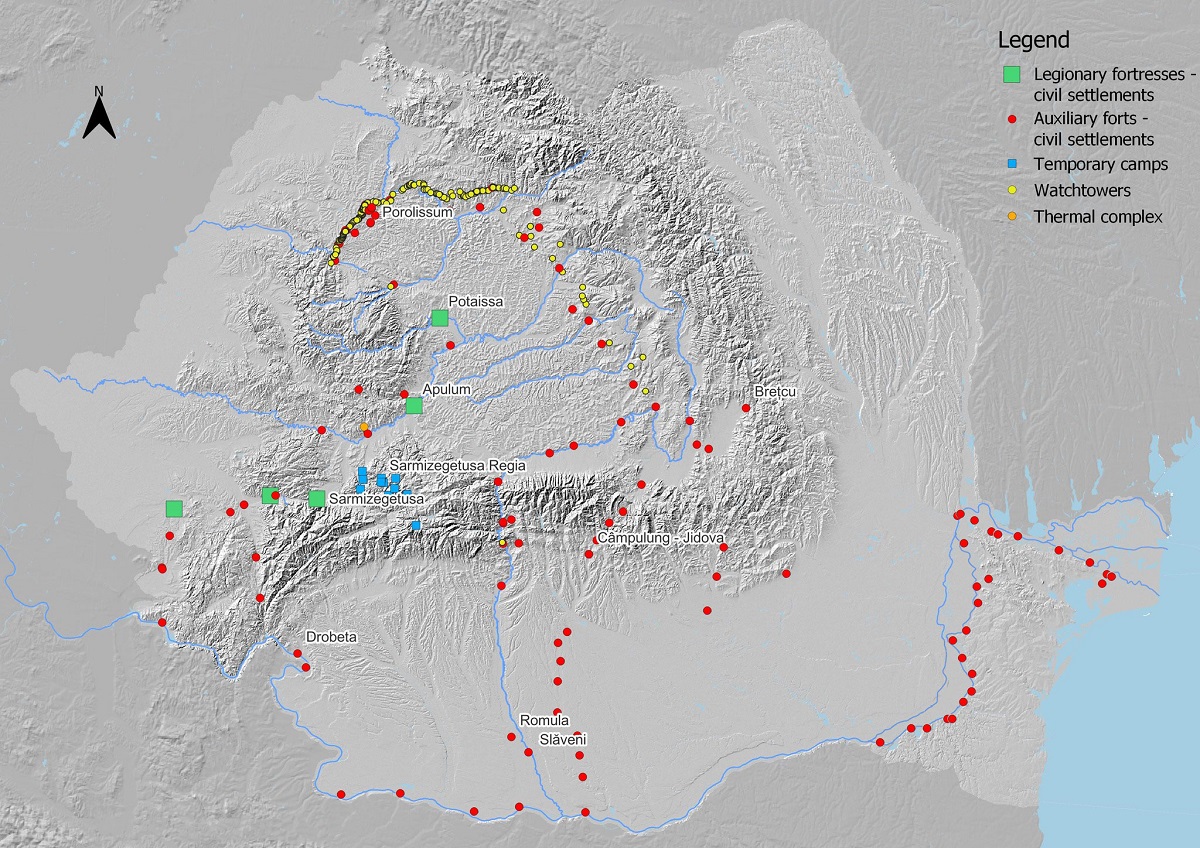
Huellas del Imperio Romano - Las fronteras del Imperio Romano de Dacia
Las fronteras del Imperio Romano – Dacia, conocida como las Limas Dacias ("muro fronterizo")
comprende 285 sitios romanos, en toda Rumania, marcando los límites norte del Imperio Romano.
Con una extensión de más de 650 millas, es el sector fronterizo romano terrestre más largo de Europa.
The Dacian Limes include an extensive network of ancient Roman forts, earthen ramparts, legionary fortlets,
brigeheads, military camps, watchtowers, legionary barracks, auxiliary barracks with civilian settlements,
march barracks, towers and other fortification elements.
showcasing the historical reach and organizational prowess of the Roman Empire.
Emperor Trajan crossed the Danube around AD 101/102, conquered Dacia in modern Romania and established a new province, which lasted until AD 271. As part of the general defensive system of the Roman Empire, the Danube limes on the Romanian territory strengthened the northern frontier of the Roman Empire power, constituting a physical manifestation of the Roman imperial policy. It illustrates the ambition of the Roman Empire to dominate the whole world by imposing its laws and lifestyle in a long-term perspective. It is the testimony of the Roman colonization in the affairs of the territories, the distribution of the Roman culture and the various traditions - military, engineering, architectural, religious, economic and political - and the numerous human settlements associated with state defence, which contribute to the understanding of the lives of Roman soldiers and their families, in this part of the Empire.
The Limes of the Roman Empire was not initially created as a bulwark or military facility against enemies,
an impermeable barrier beyond these borders but as a place of exchange, communication and trade with the world beyond the Roman Empire.
The Roman frontiers controlled and allowed population movements: not only military troops but also civilians and merchants.
Thus, they have begun the exchange of cultural values through the deployment of soldiers and civilians of different ethnicities.
This has caused profound changes and developments in the affected regions, in terms of habits of human settlements, architecture and landscaping,
in a word, the organization of the surrounding area.
The forts, burgers, towers, earth ramparts, walls, along with the connected infrastructure and civil settlements
indicate an important exchange of human and cultural values at the peak of the Roman civilization by developing the Roman military architecture
and expanding its technical knowledge in the construction and management to the edges of the Empire.
These structures reflect the imposition of a complex border system on existing societies starting from the northern part of the Roman Empire,
introducing for the first time military installations and dependent civilian settlements connected through an extensive infrastructure network.
The Lower Danube Limes in its final sector (Romania) is a remarkable example of the Roman military architecture,
construction techniques and their evolution, perfected by engineers of the time, over many generations.
It demonstrates the variety and sophistication of the Romans' response to the specific and climatological topography,
or to the political, military and social circumstances in the northern part of the Empire that can be found throughout the European Empire,
and thus influenced most of the later developments in this part of the world.