
Datos curiosos sobre Sighisoara
Nombre: Sighișoara (pronunciado: Ver ghee swahr' ah)
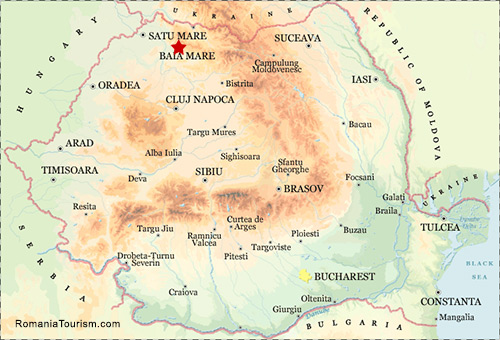
Ubicación: Transilvania, Rumania central
Aeropuertos más cercanos: Targu Mures y Sibiu
Área: 3 millas cuadradas (7,12 kilómetros cuadrados)
Elevación: 1,140 pies (250 metros)
Población: 28,000
Primer documento: 1280 d.C.
Oldest building: Casa Vlad Dracul - mid 1300s
Historia de Sighisoara
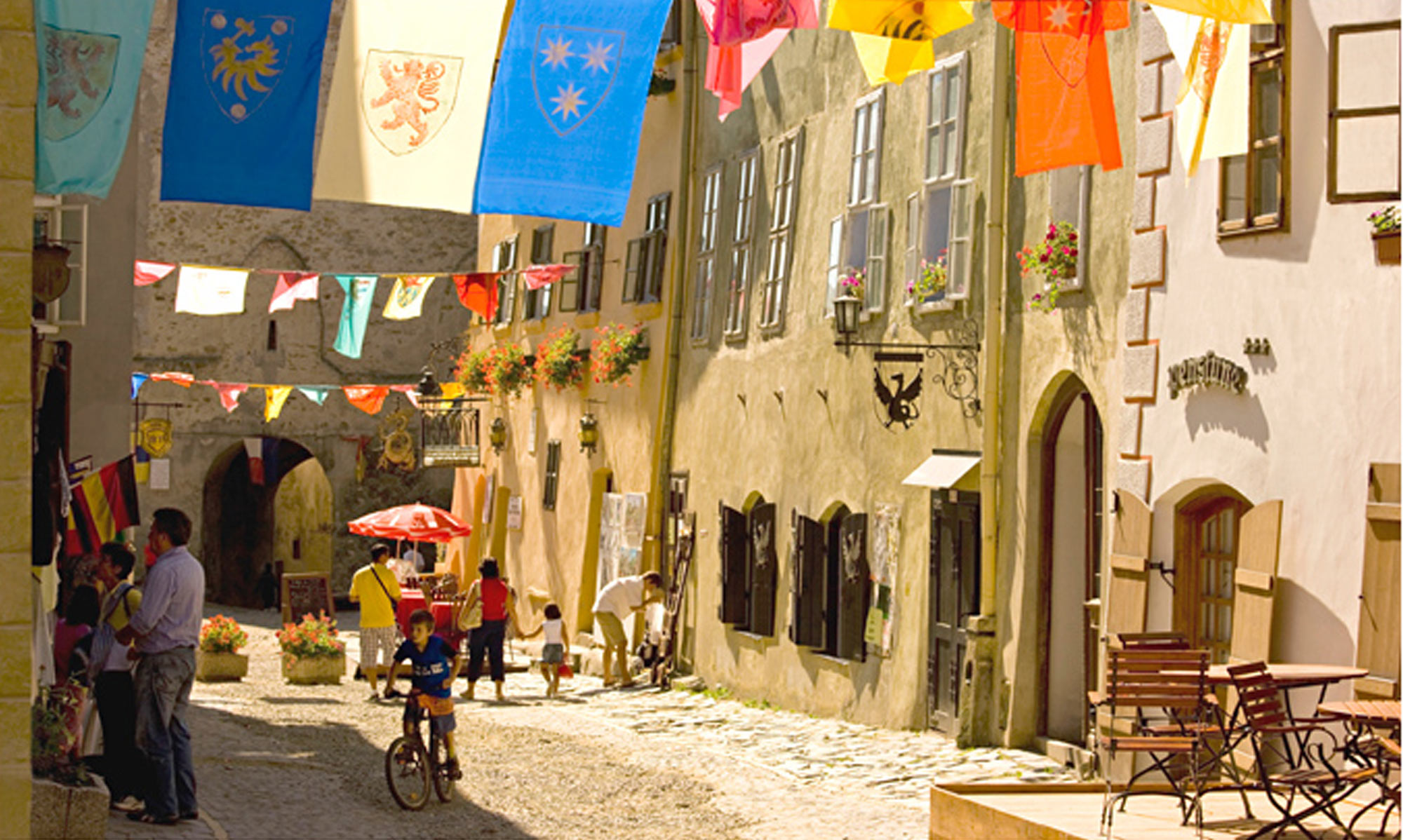
The origins of Sighisoara go back to the Roman times. During the First Century AD, the Dacians (ancient inhabitants of the territory of modern Romania which eventually will develop into the Romanian people), built a fortification called Sandava. Under the Roman administration it was known as Castrum Stenarum. During the 12th century, the Transylvanian Saxons built a new citadel which was named Schäßburg. Sighisoara (Schäßburg - Schassburg o Schäsbrich in German) still stands as one of the most beautiful and best-preserved medieval towns in Europe. Designated as a World Heritage Site by UNESCO, this perfectly intact 16th century gem with nine towers, cobbled streets, burgher houses and ornate churches rivals the historic streets of Old Prague or Vienna for atmospheric magic. It is also the birthplace of Vlad Draculea, also known as Vlad Tepes (Vlad the Impaler), ruler of the province of Walachia from 1456 to 1462. It was he who inspired Bram Stoker's fictional creation, Count Dracula. Vlad Draculea house is just one of the many attractions here. Others include the Church on the Hill with its 500-year-old frescoes, the 13th century Venetian House and the Church of the Dominican Monastery, known for its Transylvanian renaissance carved altarpiece, baroque pulpit, Oriental carpets and 17th century organ.
Sighisoara's citadel was built in the 12th century, when it was known as Castrum Sex (Fort Six), and was further strengthened and extended in the 15th century.
In 1298, the town was mentioned as Schespurch, while in 1367 it was called Civitas de Seguswar.
The name of Sighisoara was first mentioned in a written document issued by Vlad Dracul,
Vlad the Impaler's father, in 1431.
In the 14th and 15th centuries, the economic growth recorded by Sighisoara's industrious craftsmen and tradesmen ensured financial means for the construction of a strong defense system provided with 14 towers and several bastions provided with gunnery directed to all four cardinal points. Each tower was built, maintained and defended by a craft guild.
Among the most striking is the 14th century Clock Tower.
This tower controlled the main gate of the half-mile-long defensive wall and stored the town's treasures.
Sighisoara was not the biggest or richest of the seven Saxon walled citadels* in Transylvania, but it has become the best-known. A walk through the town's hilly streets with their original medieval architecture, unique mix of winding cobbled alleys, steep stairways, secluded squares, towers, turrets and enchantingly preserved citadel, make many visitors feel like stepping back in time.
Las siete ciudadelas amuralladas fundadas por los sajones de Transilvania: Bistrita (Bistritz), Braşov (Kronstadt), , Cluja (Klausenburg), , Medios (Mediasch), , Sebes (Mühlbach), Sibiu (Hermannstadt) y Sighisoara (Schassburg) fueron llamados, durante la época medieval, "Siebenburg".
...
Lugares de interés y lugares emblemáticos de Sighisoara
Ciudadela de Sighisoara
Cetatea Sighisoarei
Durante varios siglos, Sighisoara fue un bastión militar y político. Durante los siglos XIV al XVI,
los gremios de artesanos sajones erigieron torres alrededor de las murallas de la ciudadela para proteger la ciudad de las incursiones turcas.
Dispuestas en dos a cuatro niveles, las torres almacenaban municiones y suministros de alimentos y estaban provistas de ventanas de disparo.
para cañones, proyectiles y flechas. De las catorce torres originales y cinco bastiones de artillería,
nueve torres y dos baluartes han sobrevivido al paso del tiempo.
Las estructuras medievales que han perdurado a lo largo de los siglos incluyen las fuertes murallas defensivas y nueve torres:
Torre de los zapateros (Turnul Cizmarilor),
Torre de los herreros (Turnul Fierarilor),
Torre de los Carniceros (Turnul Macelarilor),
Torre de los peleteros (Turnul Cojocarilor),
Torre de los cordeleros (Turnul Franghhierilor),
Torre de los sastres (Turnul Croitorilor),
Torre de los curtidores (Turnul Tabacarilor) y
Torre de los hojalateros (Turnul Cositorilor) - todavía son visibles las huellas del asedio de 1704.
La Torre del Reloj (Turnul Ceasului) en sí.
Sur de Transilvania, viaje de dos días, comenzando en Bucarest
Duración: dos días / una noche
Itinerario:Bucarest -- Sinaia -- Brasov -- Sighisoara (pernoctación) -- Bran -- Bucarest
Lo más destacado: Castillo de Peles - Sinaia, Brasov, ciudadela medieval de Sighisoara, Castillo de Bran (Drácula)
Book this Tour
Plaza de la ciudadela de Sighisoara
Piata Cetatii
Esta pequeña y pintoresca plaza se encuentra en el corazón de la ciudadela.
Antiguamente aquí se celebraban mercadillos, ferias de artesanía, ejecuciones públicas y juicios de brujas.
Desde esta plaza se puede acceder fácilmente a las principales atracciones de Sighisoara.
La Torre del Reloj
Turnul cu Ceas
Dirección: Calle Turnului
Horario:
| ... | Mar. - Vie. | Sáb. - Sol. |
| 15 de mayo - 15 de septiembre | 9 a. m. - 6:30 p. m. | 10 a. m. - 5:30 p. m. |
| 16 de septiembre - 14 de mayo | 9 a. m. - 3:30 p. m. | 10 a. m. - 3:30 p. m. |
One of Sighisoara's main points of attraction is the Clock Tower, also known as the Council Tower, built in the second half of the 14th century and expanded in the 16th century. The four small corner turrets on top of the tower symbolized the judicial autonomy of the Town Council, which could apply, if necessary, the death penalty.
Después de un incendio en 1676 cuando explotaron los depósitos de pólvora de la ciudad situados en la Torre de los Sastres,
Artistas austriacos reconstruyeron el techo de la torre en su estilo barroco actual y en 1894 se añadieron tejas de colores.
En el siglo XVII, en lo alto de la torre se colocó un reloj de dos placas, con figuras talladas en madera de tilo, con una esfera mirando hacia la Ciudad Baja (Orasul de Jos) y la otra hacia la ciudadela (cetato en rumano, burgo in German). The figurines, moved by the clock's mechanism, each represent a different character. On the citadel side we see Peace holding an olive branch, accompanied by a drummer who is beating the hours on his bronze drum; above them are Justice, with a set of scales, and Law, wielding a sword, accompanied by two angels representing Day and Night. At 6 am, the angel symbolizing the day appears, marking the beginning of the working day and at 6 pm, the angel symbolizing the night comes out carrying two burning candles, marking the end of the working day.
The dial overlooking the Lower Town features a set of seven figurines, each representing the pagan gods who personified the days of the week: Diane (Monday), Mars (Tuesday), Mercury (Wednesday), Jupiter (Thursday), Venus (Friday), Saturn (Saturday) and the Sun (Sunday).
The spire of the tower ends in a small golden sphere.
At the top, there is a meteorological cock, which, turned around by air currents, forecasts the weather.
La Torre del Reloj sirvió como lugar de reunión del Ayuntamiento hasta 1556.
Desde 1899 alberga el Museo de Historia.
Desde lo alto de la Torre del Reloj, los visitantes pueden ver todo el casco antiguo con su techo de tejas rojas intacto,
Casas sajonas del siglo XVI bordean las estrechas calles adoquinadas.
Hoy en día, los comerciantes y artesanos siguen trabajando como lo hacían hace siglos.
Iglesia del Monasterio de los Dominicos
Biserica Manastirii Dominicana
Dirección: Piata Cetatii
Not far from the Clock Tower stands the Church of the Dominican Monastery.
First attested in a document in 1298 as part of a Dominican monastic settlement,
the church became the Saxons' main Lutheran church in 1556.
The monastic complex demolished in 1888 and its place was taken by the present town hall.
Only the church has remained from the original structure.
Built in late-gothic style typical of the hall-churches, with two naves and two rows of pillars,
the church was restored in the 15th century and then again in the 16th century after the big fire of 1676.
The last repairs were done in 1894 and 1929, when the church acquired its present-day look.
Inside the church, you can admire some valuable artistic objects, such as the bronze font dating back to 1440,
the stone doorframe carved in 1570 in Transylvanian renaissance style and built into the northern wall of the church,
the collection of 16th and 17th century Oriental carpets, a baroque organ and a fine altarpiece from 1680.
Classical and baroque concerts are often held here.
Iglesia en la Colina
Biserica din trato (Bergkirche en alemán)
Dirección: Strada Cojocarilor 3
Abierto: todos los días, de 10 a. m. a 6 p. m.
Cargo de admisión
To the north of the Clock Tower stands one of the most representative gothic-style structures in Transylvania, the Church on the Hill - so called because of its location on the top of citadel's highest hill. First mentioned in a document in 1345 and superposed on a former Roman basilica, its construction lasted almost 200 years.
Inicialmente una iglesia católica, se convirtió en la iglesia principal de los habitantes sajones de Sighisoara, que habían pasado del catolicismo romano al luteranismo después de la reforma de 1547.
Una restauración reciente recuperó fragmentos de algunos de los frescos originales de finales del siglo XV.
Beautifully restored fragments of murals from the late 1400s and renaissance-style furniture can be admired in the church. The gothic altarpiece dedicated to St Martin dates from 1520 and was painted by Johann Stoss, the son of the renowned sculptor, Veit Stoss from Nürnberg. The three wood-carved coats of arms, found in the anterooms of the side naves, belonged to Mathias Corvin and his wife, Beatrix, the Transylvanian prince Stephen Bathory of Nyir (1479-1493) and the king of Poland and Hungary, Wladislav the 3rd. The church is reached via a covered wooden staircase known as Scara Scolarilor (Escalera de los Estudiantes - escaleras cubiertas que conducen a la escuela y la iglesia). Frente a la iglesia se encuentra la entrada principal del tranquilo cementerio sajón (abierto todos los días de 8 a. m. a 8 p. m.).
Escalera de estudiantes
Scara Scolarilor
Dirección: Strada Scolii
Ubicado al final de Strada Scolii (the School Street), Students' Stair connects citadel's Main Square with the Church and School on the Hill. Built in 1642, the Students' Stair (or Schoolboys' Stair) - a covered stair-passage - facilitates access the school and church and protect school children and church-goers, from the elements. It was initially ment to connect the lower section and the upper section of the citadel. 176 steps of the initial 300 are still in use today.
Casa Vlad Dracul
Casa Vlad Dracul o Vlad Draculea
Dirección: Strada Cositorarilor 5
Vlad Dracul House is located in the Citadel Square, close to the Clock Tower.
This ochre-colored house is the place where Vlad Tepes, the inspiration for Bram Stoker's famous Dracula, was born in 1431 and lived with his father, Vlad Dracul, until 1435 when they moved to Targoviste. A wrought-iron dragon hangs above the entrance. The ground floor of the house serves as a restaurant, while the first floor is home to the Museo de Armas.
Por sus hazañas, se le otorgó la Orden del Dragón, de ahí el título Drácul
(la palabra latina para dragón es draco).
Mientras que en el señuelo medieval los dragones servían como símbolos de independencia, liderazgo, fuerza y sabiduría,
la asociación bíblica del diablo con la serpiente que tentó a Adán y Eva,
Le dio al dragón con forma de serpiente connotaciones de maldad.
Así, la palabra rumana Drácul significa en inglés dragón y diablo.
Drácula, el apellido de Vlad Tepes (el Empalador), significa Hijo del Dragón.
Casa del ciervo
Casa cu Cerb
Dirección: Strada Scolii 1
Built in the 17th century in Transylvanian renaissance style,
the Stag House draws its name from the stag skull set on one of the corners of its façade.
Recent restorations revealed an external mural depicting the stag's body.
Nowadays, the building houses a hotel, with a ground floor that doubles as a cellar bar.
Casa veneciana
Casa Veneciana
Dirección: Strada Cositorarilor 5
Construida en el siglo XVI, la casa fue posteriormente restaurada en estilo gótico veneciano.
formando la parte superior de las ventanas un arco trilobulado.
Torres de la ciudadela de Sighisoara
Turnurile Cetatii Sighisoara
El muro de defensa de media milla estaba inicialmente provisto de 14 torres,
de los cuales nueve se han conservado hasta el día de hoy. Entre los más impresionantes se encuentran:
Torre de los cordeleros
Turnul Frangherilor
Dating from the 13th century and standing above the pre-Saxon citadel walls,
Ropemakers' Tower is one of the oldest buildings in Sighisoara.
Its role was to defend - together with the Goldsmiths' Tower - the northwest corner of the hill.
Nowadays, the tower is the home of the caretaker of the Saxon cemetery, located next to the Church on the Hill.
Torre de los Sastres
Turnul Croitorilor
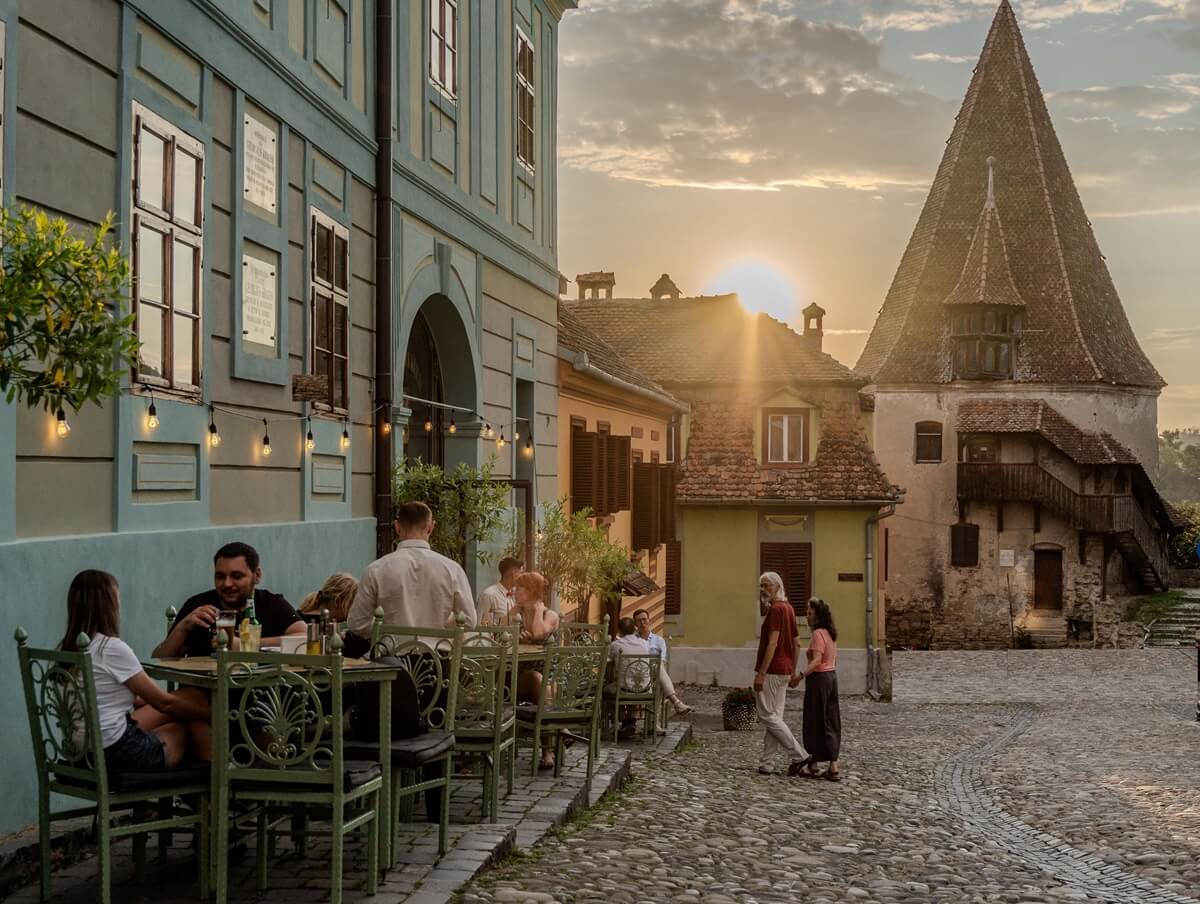
This imposing tower was raised in the 14th century by the richest guild in town.
Initially as tall as the Clock Tower, its upper part was destroyed in the 1676 fire,
when the town's gunpowder deposits, located here, exploded.
Tailors' Tower, with its two vaulted galleries which used to have huge oaken gates with an iron lattice,
also serves as the second access road into the citadel.
Torre de los zapateros
Turnul Cizmarilor
data de mediados del siglo XVI pero fue reconstruido desde cero en 1650.
La torre tiene influencia de la arquitectura barroca, presentando una base hexagonal con lados de diferentes longitudes.
Su techo, parecido a un casco puntiagudo, alberga una pequeña torre de observación.
Ciudad Baja de Sighisoara
Orasul de José
Lack of water and supplies made life in the Citadel quite difficult at times.
By comparison, living conditions in the Lower Town, which had started to develop at end of the 15th century, were much better.
Today, the Lower Town, less picturesque than the Citadel area, centers around Hermann Oberth Square (Piata Herman Oberth)
and Strada 1 Decembrie. Here, you can admire 17th century houses.
Iglesias históricas de Sighisoara
Iglesia de los Leprosos
Biserica Leprosilor
Dirección: Strada Stefan cel Mare 34
Situada en la Ciudad Baja, a orillas del río Tarva, esta pequeña iglesia gótica del siglo XV sirvió como capilla del asilo de leprosos entre 1647 y 1684. Como a los leprosos no se les permitía entrar a la iglesia, se instaló un púlpito exterior desde donde se predicaba el Evangelio a los enfermos.
La Catedral Ortodoxa
Catedral Ortodoxa Sighisoara
La Catedral Ortodoxa de Sighisoara está situada en la orilla norte del río Tarnava Mare.
Construido entre 1934 y 1937, en estilo bizantino,
Este lugar de culto tiene hermosos frescos en blanco y negro.
Iglesia Católica Romana de San José
Biserica Romano-Católica Sf. José
Dirección: Strada Zidul Cetatii
Construida en un estilo ecléctico en 1894, la iglesia sufrió importantes restauraciones después de un incendio en 1983.
El órgano actual, diseñado por Karl Einschenk en 1908, fue traído de una iglesia sajona cerca de Sighisoara.
...
Museos de Sighisoara
Museo de Historia de Sighisoara
Muzeul de Istorie Sighisoara
Dirección: Piata Muzeului 1
Tel: (+4) 0265 771.108
Correo electrónico
Housed in the Clock Tower (also called "Tower of the Hours"), Sighisoara History Museum displays rich archeological collections,
farmacy and medical instruments, art, medieval furniture, musical instruments, guild symbols and tools, ethnographic artifacts,
textiles, ceramics, old clocks and coins.
Datos sobre la Torre del Reloj de Sighisoara:
| Año de construcción: | mediados del 1300 |
| Alto: | 210 pies. |
| Espesor de paredes (primer piso): | 8 pies. |
| # de niveles: | 6 |
| # de pasos hasta la cima | 110 |
| Horario: | ... |
| 15 de mayo - 15 de septiembre | Mar. - Viernes: 9 a. m. - 6:30 p. m. Sáb. - Dom.: 10 a. m. - 5:30 p. m. |
| 16 de septiembre - 14 de mayo | Mar. - Viernes: 9 a. m. - 3:30 p. m. Sáb. - Dom.: 10 a.m. - 3:30 p.m. |
La sala de tortura
Cámara de Tortura
Dirección: Piata Muzeului 1
Tel: (+4) 0265 771.108
Este pequeño pero interesante museo se encuentra al pie de la Torre del Reloj.
en la misma sala donde se torturaba a los prisioneros y se arrancaban confesiones durante la Edad Media.
Se exhiben algunos de los sorprendentes instrumentos y métodos de tortura.
Colección de armas medievales
Colectia de Arme Medievale
Dirección: Piata Muzeului 1
Tel: (+4) 0265 771.108
Ubicado en el primer piso de la casa en la que nació Vlad el Empalador (Vlad Draculea),
El museo presenta una variedad de armas medievales, que muestran el desarrollo de las armas.
utilizado en y alrededor de la ciudad a lo largo de los siglos.
También se exhibe un retrato de Michael Freiherr von Melas (1731-1806).
Nacido en Sighisoara, Michael Freiherr von Melas se convirtió en general de las tropas montadas austríacas.
y luchó contra el ejército de Napoleón Bonaparte en Marenga (14 de junio de 1880).
...
Atracciones cerca de Sighisoara
Iglesia Fortificada de Saschiz
Dónde: 10 millas al este de Sighisoara
Acceso: coche, autobús, tren
Iglesia Fortificada de Saschiz información
Iglesia fortificada de Biertan
Dónde: 18 millas al oeste de Sighisoara
Acceso: coche, bicicleta
Iglesia fortificada de Biertan información
Bethlen - Castillo de Cris
Dónde: 12 millas al suroeste de Sighisoara
Acceso: coche, autobús
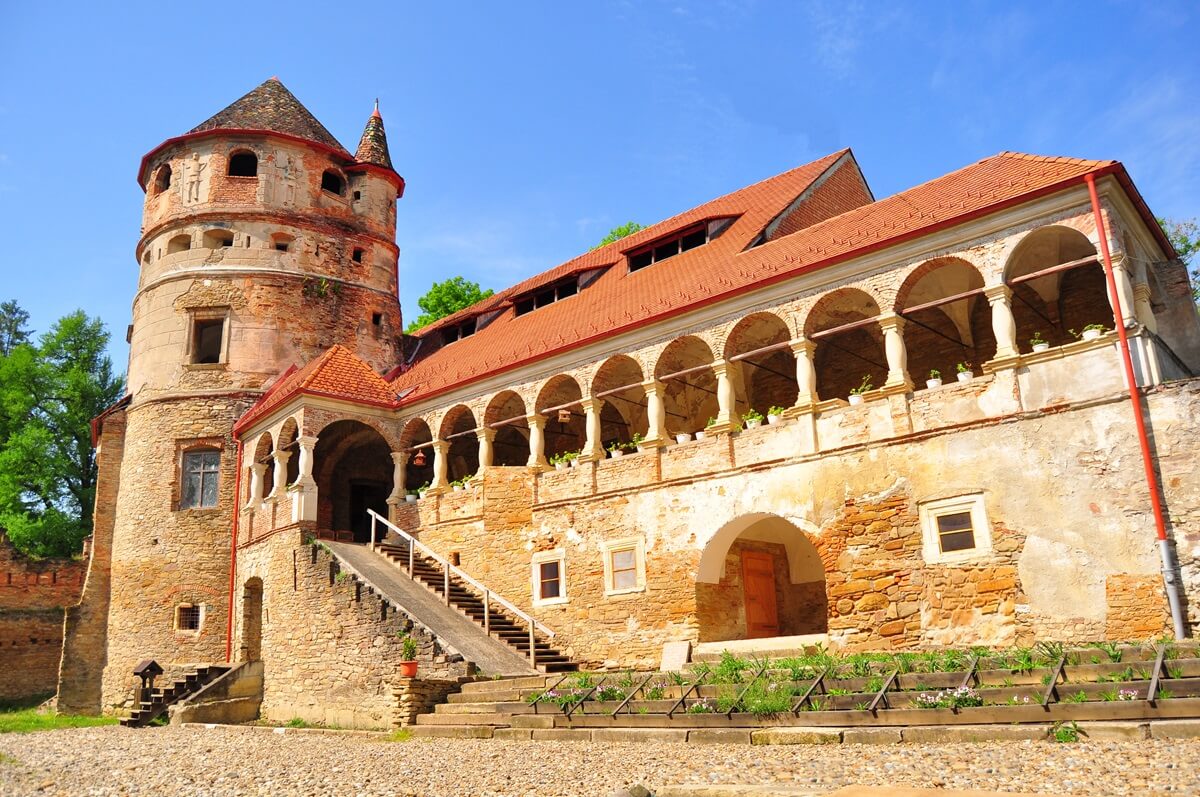
Considered by many as the most beautiful Renaissance-style residence in Transylvania,
Bethlen - Cris Castle was erected in the 14th Century.
Several additions and remodeling occured in the 15th to 17th centuries.
Much of the original elegance and features:
loggias, bastions, the massive Gate and Archers’ Towers are still present.
Horario: 10 a. m. a 4 p. m., todos los días.
Bethlen - Cris Castle más información
Ciudad de Targu Mures
Dónde: 34 millas al norte de Sighisoara
Acceso: coche, autobús, tren
Targu Mures información
...
Excursiones de un día desde Sighisoara
Pueblo Malancrav
Donde:
15 millas al suroeste de Sighisoara
Acceso: coche, autobús, bicicleta
Pueblos Biertan y Richis
Dónde: al suroeste de Sighisoara, 45 millas (ida y vuelta)
Acceso: coche, autobús
Iglesia fortificada de Biertan información
Pueblos Saschiz y Rupea
Dónde: al sur de Sighisoara, 68 millas (ida y vuelta)
Acceso: coche, autobús, tren
Iglesia Fortificada de Saschiz información
Pueblo de Medios
Dónde: 20 millas al suroeste de Sighisoara
Acceso: coche, autobús, tren
Medios información
Pueblo de Sibiu
Dónde: 54 millas al suroeste de Sighisoara
Acceso: coche, autobús, tren
Sibiu información
Pueblo Viscri
Dónde: 40 kilómetros al sureste de Sighisoara
Acceso: coche
Iglesia Fortificada de Viscri información
Sighisoara -- Bodega Vila Vinea (Mica) -- Targu Mures -- Bodega Liliac (Batos) -- Sighisoara
Grandes vinos y excepcional arquitectura de la Secesión
Dónde: al norte de Sighisoara, 130 millas (ida y vuelta)
Acceso: coche, autobús
Bodega Vila Viña información,
Bodega Liliac información
Iglesias fortificadas de Harman y Prejmer
Dónde: 65 millas al sureste de Sighisoara
Acceso: coche, tren a Brasov y autobús de Brasov a Harman
Harman información
Ciudad de Braşov
Dónde: 72 millas al sureste de Sighisoara
Acceso: coche, autobús, tren
Braşov información
Castillo de Bran (Drácula)
Dónde: 98 millas al sureste de Sighisoara
Acceso: coche, tren hasta Brasov y autobús desde Brasov hasta Bran
Castillo de Bran información
...
Festivales y eventos de Sighisoara
Los festivales que tienen lugar, cada año, en Sighisoara incluyen:
~ Marzo: Festival de Blues de Sighisoara
~ último fin de semana de julio: Festival de Artes y Oficios Medievales
Sighisoara medieval atmosphere, complete with troubadour music and costume parades, street entertainers and handicraft displays,
open-air concerts and medieval ceremonies is recreated every July in the Citadel.
The event offers attendees a chance to immerse themselves in the lore and legends of medieval Transylvania.
~ Agosto: ProEtnica Festival de Minorías Étnicas)
...
SIGHISOARA TRIP PLANING INFO
Transporte
Transporte aéreo a SighisoaraLos aeropuertos más cercanos a Sighisoara son:
Targu Mures (TGM) - 30 millas al norte
Sibiu (SBZ) - 54 millas al oeste
Braşov (GHV) - 72 millas al sureste
Cluj-Napoca (CLJ) - 90 millas al noroeste
Estación de tren de Sighisoara
Gara Sighisoara
Dirección: Str. Libertatii 51
Tel: (+4) 0265 771.130
Hay trenes diarios desde/hacia Bucarest, Arad, Brasov, Cluj-Napoca, Oradea, Satu Mare.
y varias otras ciudades de Rumania así como de Budapest (Hungría).
Para consultar los horarios de trenes hacia/desde Sighisoara, visite
Turismo en Rumania Sección de transporte.
Para salidas desde Bucarest por favor seleccione Bucuresti Nord
...
Transporte interurbano en autobús en Sighisoara
Estaciones de autobuses interurbanos de Sighisoara (rutas nacionales e internacionales):
Estación de Autobuses #1
Autogara 1 Sighisoara (Cambus bus stop)
Dirección: Calle. Libertatii 53
(cerca de la estación de tren)
Estación de Autobuses #2
Autogara 2 Sighisoara
Dirección: Str. Morii 21
Empresas de autobuses - Rutas internacionales - que sirven a Sighisoara:
Atlassib
Dirección: Str. Morii 21
Tel: (+4) 0265 777.249
Servicio de autobús diario a varios países de Europa.
Agente Pletl
Dirección: Str. O. Goga 6
Tel: (+4) 0265 778.887
Servicio diario de autobús a Austria y Alemania.
...
Llegar a Sighisoara en coche La ruta más rápida de Bucarest a Sighisoara es por la carretera E60:
Bucarest -- Ploiesti -- Sinaia -- Brasov -- Rupea -- Sighisoara
Una ruta panorámica alternativa (en verano) desde Bucarest a Sighisoara es la ruta 7C.
- el Transfagarasan camino panorámico:
Bucarest -- Pitesti –- Curtea de Arges –- Carta –- Noul Roman -- Agnita -- Sighisoara
(la carretera está abierta del 1 de julio al 31 de octubre, si el clima lo permite)
| Distancia por carretera hacia/desde Sighisoara: | |
|---|---|
| Ciudad/Pueblo | Distancia (Millas) |
| Bucarest | 170 |
| Arad | 210 |
| Braşov | 75 |
| Budapest | 370 |
| Cluj-Napoca | 90 |
| Constanza | 300 |
| Iasi | 185 |
| Oradea | 180 |
| Sibiu | 55 |
| Sighetu Marmatiei | 160 |
| Suceava | 160 |
| Targu Mures | 35 |
| Timisoara | 205 |
| Viena | 520 |
...
Alquiler de coches en SighisoaraExcelentes precios de alquiler de vehículos en Sighisoara.
Inchirieri Sighisoara
Teléfono: (+4) 0744 759 433
Alquiler de coches Sighisoara
Teléfono: (+4) 0744 759 433
...
Las compañías de taxis locales en Sighisoara incluyen:
| Compañía de taxis | Número de teléfono |
|---|---|
| Taxi elegante | 0740 779.000 |
| Taxi Sighisoara | 0740 688.312 |
| Taxi Nova | 0265 779.000 |
| OK Taxi | 0265 770.020 |
| Taxi Regal | 0265 778.899 |
| Taxi Real | 0265 777.776 |
| Taxi TransAldea | 0265 777.785 |
...
Sighisoara Alojamientos

El alojamiento en Sighisoara incluye:
| Nombre del hotel | Clase | Ubicación |
|---|---|---|
| Fronio | boutique | Ciudadela de Sighisoara |
| Sighisoara | tres estrellas/escala media | Ciudadela de Sighisoara |
| Casa cu Cerb | boutique | Ciudadela de Sighisoara |
| Mercure Sighisoara Binderbubi | cuatro estrellas/escala media | 0,4 millas al sur de la ciudadela de Sighisoara |
| Parque Central | cuatro estrellas/escala media | 0,2 millas al sur de la ciudadela de Sighisoara |
| Árbol Doble | cuatro estrellas/escala media | 0,4 millas al noreste de la ciudadela de Sighisoara |
| Casa Georgius Krauss | boutique | Ciudadela de Sighisoara |
| Bulevar | cuatro estrellas/escala media | 0,2 millas al este de la ciudadela de Sighisoara |
| Casa Savri | tres estrellas/escala media | 0,2 millas al este de la ciudadela de Sighisoara |
| Castillo Ugrón | boutique | 12 miles east of Sighisoara Citadel |
...
Información turística de Sighisoara
Centro de información turística de Sighisoara - Torre del Reloj
Dirección:
Torre del Reloj de Sighisoara - Piaţa Muzeului 1
Oficina de Promoción Turística de Sighisoara
Centro Nacional de Información y Promoción Turística - Sighisoara
Dirección: Calle. Octavio Goga 8
Teléfono: (+4) 0365 882.937
Correo electrónico
...
Sighisoara Local Authorities
Ayuntamiento de Sighisoara
Primaria Sighisoara
Dirección: Piata Muzeului 7
Teléfono: (+4) 0265 771.280
Departamento de Turismo del Ayuntamiento de Sighisoara
Primaria Sighisoara - Turismo Departamental
...
Oficina Postal Principal de Sighisoara
Oficina Postal Sighisoara
Dirección: Str. Oberth Hans 16 - 18
Tel: (+4) 0265 772.055
Abierto: lunes - viernes 7 a. m. - 8 p. m.
Los carteles de la oficina de correos muestran la palabra POSTA.
Telefonear a Sighisoara desde el extranjero
Código de acceso internacional +4 (código de país) + 0265 o 0365 (código de área) + número de teléfono de seis dígitos
...
Sighisoara - Emergencia general #: 112
(Ambulancia, Policía, Departamento de Bomberos)
Hospital Municipal de Sighisoara
Spitalul Municipal Sighisoara
Address: Str. Zaharia Boiu 40
Teléfono: (+4) 0265 771.451
...
Mapas
Mapa de Sighisoara -- Harta Cetatii Sighisoara
Mapa interactivo de Sighisoara -- Harta Interactiva a orasului Sighisoara
Mapas de Rumania -- Harti ale Romaniei