

» Drácula – Más allá de la leyenda
» Lugares para explorar
» Bram Stoker's inspiration
» ¿Quién fue Vlad Drácula?
Some say that Transylvania sits on one of Earth's strongest magnetic fields and its people have extra-sensory perception. Vampires are believed to hang around crossroads on St. George's Day, April 23, and the eve of St. Andrew, November 29. The area is also home to Bram Stoker's Dracula, a fictional character: undead, centuries-old vampire, Transylvanian nobleman. Driving along Transylvania's winding roads through dense, dark, ancient forests and over mountain passes makes it easy to get caught up in the tale.
Tales of the supernatural had been circulating in Romanian folklore for centuries when Irish writer Bram Stoker picked up the thread and spun it into a golden tale of ghoulishness that has never been out of print since its first publication in 1897. To research his immortal tale, Stoker immersed himself in the history, lore and legends of Transylvania, which he called a "whirlpool for the imagination."
El Conde Drácula se inspiró en una de las figuras más conocidas de la historia rumana, Vlad Draculea, apodado Vlad Tepes. (Vlad el Empalador), quien fue el gobernante de Valaquia a mediados del siglo XV. Nacido en 1431 en Sighisoara - Transilvania, Vlad residió la mayor parte de su vida adulta en Valaquia (sur de Rumanía).
Seguimiento de Drácula
Aunque Bram Stoker, el autor de la novela Drácula, nunca viajó a Rumania, llenó su libro con descripciones de muchos lugares reales que todavía se pueden visitar en la actual Rumanía. ellos incluyen Sighisoara ciudadela medieval - lugar de nacimiento de Vlad el Empalador, castillo de Bran (Drácula), paso de Borgo, ciudad de Bistrita.
Otros sitios de Drácula incluyen: el Antigua corte principesca (Palatul Curtea Veche) en Bucarest, Monasterio Snagov, where, according to legend, Vlad's remains were buried; the ruins of Fortaleza Poenari (considerado el auténtico Castillo de Drácula); el pueblo de Arefu donde todavía se cuentan las leyendas de Drácula, la ciudad de Braşov donde Vlad dirigió incursiones contra los comerciantes sajones y, por supuesto, Salvado Castillo.
Algunas giras también cubren los aspectos folclóricos del Drácula ficticio. Por ejemplo, los visitantes pueden comer la misma comida que Jonathan Harker comió en The Golden Crown en Bistrita and sleep at Castle Dracula Hotel, built no so long ago on the Paso Borgo en el sitio aproximado del castillo ficticio del Conde.
Lugares para explorar
- Antigua corte principesca de los gobernantes de Valaquia - Bucarest
- Monasterio Snagov
- Fortaleza de Targoviste
- Fortaleza Poenari
- Pueblo Arefu
- Ciudad de Brasov
- Salvado (Drácula) Castillo
- Ciudadela de Sighisoara
- Pueblo de Bistrita
- Paso Borgo (Pasul Tihuta)
Bucarest
On September 20, 1459 Prince Vlad Tepes (Dracula) signed a document attesting the existence of Bucuresti (Bucharest).
It is the oldest known document that confirms the city's origin under the name of Bucharest.
Bucharest is laden with historical charm – from the streets of the Old Town,
to the grand architecture of the late 1800s and the lush green of Cismigiu Park.
The city also claims a large number of museums, art galleries, exquisite Orthodox churches and unique architectural sites.
Antigua corte principesca
Palatul Curtea Veche
Dirección: Carretera Francesa 25 - 31
Teléfono: (+4) 021 315.68.58
Horario: Actualmente Cerrado por obras de restauración.
At the southern edge of Bucharest Old Town sit the remains of the Old Princely Court, commissioned in the 15th century by Prince Vlad Tepes, ruler of Walachia.
According to local lore, Vlad kept his prisoners in dungeons beneath his palace.
The palace reached it glory at the end of the 17th Century, during the reign of Prince Constantin Bracoveanu.
Little remains today from the 6-acres former residence of Walachia's rulers.
The Old Princely Court Museum was established in 1972 when an archaeological dig revealed the remains of the fortress,
along with Dacian pottery and Roman coins, evidence of Bucharest's earliest inhabitants.
The oldest document attesting to the city's origin under the name of Bucuresti was discovered here.
It was issued on September 20, 1459 and signed by Prince Vlad Tepes.
Junto al palacio se encuentra la antigua iglesia de la corte (Biserica Curtea Veche),
Data del año 1559 y se considera el más antiguo de Bucarest, aún en pie.
Durante dos siglos, la iglesia sirvió como lugar de coronación de los príncipes rumanos. Se han conservado algunos de los frescos originales del siglo XVI.
Monasterio Snagov
Manasterea Snagov
Dónde: 45 kilómetros al norte de Bucarest
Dirección: Strada Mânăstirea Vlad Ţepeş Siliștea Snagovului
Estación de tren más cercana: Bucuresti Nord
Parada de autobús más cercana: Snagov / Silistea Snagovului
In 1458 - more than one hundred years after the original church was built - Prince Vlad Tepes (Vlad the Impaler) ordered thick defending walls,
a dungeon and an escape tunnel to be built.
A plaque inside the church marks the grave with the presumed remains of one of Walachia bravest rulers - Vlad Draculea - the Impaler.
A finales del siglo XVII, la isla Snagov también albergaba una imprenta.
Bajo la supervisión del abad Antim Ivireanul
numerosos libros en rumano, griego, eslavo y árabe vieron la luz en Snagov.
El monasterio está situado en una isla en el lago Snagov, acceso: puente peatonal o barco.
Monasterio Snagov más información
Targoviste – Princely Court
Curtea Domneasca Targoviste
Dónde: 55 millas al noroeste de Bucarest
Estación de tren más cercana: Targoviste
Dirección: Calea Domneasca 181
Telephone: (+4) 0245 613.946
Horario: mar. – Sol. 9 a.m. – 7 p.m.
La ciudad de Targoviste fue la capital de Valaquia desde 1396 hasta 1714.
Esta fortaleza del siglo XIV dominaba una enorme torre de vigilancia. Turnul Chindiei
es el lugar donde el Príncipe Vlad Draculea empaló a muchos nobles (boyardos) desleales después de invitarlos a una fiesta de celebración.
Chindiei Watchtower ahora alberga una exposición que ilustra la vida de Vlad.
Fortaleza Poenari
Cetatea Poenari
Ubicación: pueblo Căpățânenii Pământeni, Región de Valaquia – Sur de Rumanía
Dónde: 120 millas al noroeste de Bucarest
Pueblo grande cercano: Curtea de Arges (30 kilómetros al sur)
Estación de tren más cercana: Curtea de Arges
Parada de autobús más cercana: Arefu
Horario: 10 a. m. - 5 p. m., todos los días
Para llegar a la fortaleza de Poenari,
Los visitantes deben seguir el sendero forestal del monte Cetatuia y subir 1.480 escalones.
The remnants of Poienari Fortress stand high on a cliff overlooking the Arges River, at the foothills of the Carpathian Mountains.
Built at the beginning of the 13th century by the first Walachian rulers, the castle changed names and residents a few times over the centuries;
eventually, it was abandoned. Vlad recognized the potential of the location and upon taking over the throne of Walachia,
he ordered that the structure be consolidated, turning it into one of his main fortresses.
When the Turks attacked and captured the castle in 1462, Vlad escaped via a secret passageway leading north through the mountains.
Although the castle continued to be used after Vlad's death, in 1476, it was eventually abandoned again in the first half of the 16th century
and left to the ravages of time and weather.
In 1888, a major landslide brought down a portion of the castle which crashed into the river far below.
The castle underwent repairs in the late 1960s. Sections of its walls and towers stand to this day.
Prince Vlad Dracula Castle (Cetatea Poenari) más información.
Pueblo Arefu
Dónde: 115 millas al noroeste de Bucarest /
16 millas al norte de Curtea de Arges
Acceso: coche, autobús o tren hasta Curtea de Arges y luego autobús o taxi
Many inhabitants of Arefu trace their ancestry back to the loyal minions of Vlad Tepes himself. Legend has it that when the Turks attacked and took over the Poenari Castle in 1462,the villagers of Arefu helped Vlad escape. Spend a night with the locals and listening to centuries-old folk tales. Homestays and B&Bs are available in Arefu and nearby villages.
Ciudad de Braşov
Dónde: 110 millas al norte de Bucarest
Estación de tren más cercana: Brasov
Fringed by the peaks of the Southern Carpathian Mountains and resplendent with gothic, baroque and renaissance architecture,
as well as a wealth of historical attractions, Brasov is one of the most visited places in Romania.
Founded by Teutonic Knights in 1211 on an ancient Dacian site
and settled by the Saxons as one of their seven walled citadels (Siebenburgo),
Brasov todavía rezuma un distintivo ambiente medieval.
Vlad the Impaler had strong connections with Brasov and a love-hate relationship with its citizens.
In 1456 (September 6) Vlad made an understanding with Brasov Merchants Guild
to whom he promised that in exchange for refuge in Brasov, if needed, he will offer support against the Ottomans.
On April 29, 1459 Vlad impaled 41 Brasov merchants for not complaying to the Reciprocal Privileges Agreement
concluded between Transylvanian and Walachian merchants.
But Walachia's best-known medieval ruler was very much in love with a Saxon lady from Brasov, named Katarina Siegel.
He intended to marry Katarina and requested Pope Pius II to annul his marriage with his wife Anastasia Holszanska, niece of Queen of Poland.
Many historical sources suggest that Vlad's Brasov residence was located somewhere on
Calle Constantin Lacea, justo al sur de Ecaterina Gate.
Castillo de Bran
Castillo de Bran
Where: 110 miles north of Bucharest / 19 miles southwest of Brasov
Acceso: coche o,
tren o autobús a Brasov y luego autobús de Brasov a Bran
tren o autobús hasta Predeal y luego taxi desde Predeal hasta Bran
Castillo de Bran más información
Ciudadela de Sighisoara
Dónde: 300 kilómetros al noroeste de Bucarest
Estación de tren más cercana: Sighisoara
Founded by Transylvanian Saxons during the 12th century, Sighisoara is, arguably, Europe's most authentic and best-preserved medieval citadel.
Designated as a World Heritage Site by UNESCO, this perfectly intact 16th century gem
with nine towers, cobbled streets, burgher houses and ornate churches rivals the historic streets of Old Prague or Vienna for atmospheric magic.
Vlad Tepes (Vlad the Impaler), ruler of the province of Walachia (1456 - 1462) was born in Sighisoara in 1431.
The house in which Vlad was born, almost 600 years ago, is located in Sighisoara's Citadel Square, steps to the impressive Clock Tower.
This ocher-colored structure is where Vlad lived with his father, Vlad Dracul (más sobre la historia del nombre Dracul)
hasta 1435 cuando se trasladaron a Targoviste. Un dragón de hierro forjado cuelga sobre la entrada.
La planta baja/primera es hoy un restaurante popular,
mientras que las salas del segundo piso se utilizan para una pequeña exhibición de armas medievales.
Casa de Vlad Dracul (Casa Vlad Dracul)
Dirección:
Strada Cositorarilor 5
Pueblo de Bistrita
Dónde: 440 kilómetros al noroeste de Bucarest
Estación de tren más cercana: Bistrita
Situado al pie de las montañas de Bargau, no lejos del paso de Borgo (Pasul Tihuta in Romanian) which connects the provinces of Transylvania and Moldavia, the town of Bistrita is one of the oldest in the region. Archeological findings indicate that the area has been inhabited since the Neolithic age, long before Bram Stocker chose it as the setting of his fictional Dracula's castle.
Los colonos sajones, que se establecieron aquí en 1206, ayudaron a convertir la ciudad en un floreciente puesto comercial medieval. Mencionada por primera vez en 1264 como Villa Bistiche, el nombre se cambió más tarde a Civitas Bysterce. Muy pronto, Bistritz como lo conocían sus habitantes alemanes, se convirtió en una de las ciudadelas sajonas más importantes de Transilvania (Siebenbürgens*).
Hoy en día, las pintorescas casas de comerciantes de los siglos XV y XVI del casco antiguo, los restos de las murallas de la fortaleza del siglo XIII y un ritmo generalmente pausado han preservado parte de la atmósfera medieval de Bistrita.
Paso Borgo
Pasul Tihuta
Dónde: 450 kilómetros al noroeste de Bucarest / 22 kilómetros al noreste de Bistrita
Acceso: sólo coche.
Paso Borgo (Bargauen rumano), que se hizo famoso en el capítulo inicial de Drácula de Bram Stoker,
es un paso muy transitado a través de las montañas de los Cárpatos en el norte de Transilvania.
Ubicado cerca del pequeño municipio de Tihuta, el paso alcanza una altura máxima de 3840 pies.
El valle de Bargau abarca algunos de los paisajes montañosos vírgenes más bellos de los Cárpatos.
con pintorescos pueblos tradicionales ubicados en valles y laderas,
Bases ideales para practicar senderismo, montar a caballo o descubrir su vívido tapiz de antiguas costumbres, artesanías y folclore.
Aquí, entrarás en un reino que la ficticia Mina Harker describió en su diario como "un condado encantador;
"Está lleno de bellezas de todo tipo imaginable, y la gente es valiente, fuerte y sencilla, y parece llena de buenas cualidades".
Drácula – Más allá de la leyenda
Bram Stoker's inspiration
Vlad Tepes was born in 1431 in the fortress city of Sighisoara.
His father, Vlad Dacul, was the military governor of Transylvania and had become a member of the Order of the Dragon a year before.
The Order, similar to the Order of the Teutonic Knights, was a semi-military and religious organization
established in 1387 in Rome in order to promote Catholic interests and crusades.
La Orden es relevante para la leyenda, principalmente porque explica el nombre de Drácula.
Por sus hazañas, se le otorgó la Orden del Dragón, de ahí el título Drácul (la palabra latina para dragón es draco). Mientras que en el señuelo medieval los dragones servían como símbolos de independencia, liderazgo, fuerza y sabiduría, la asociación bíblica del diablo con la serpiente que tentó a Adán y Eva le dio al dragón con forma de serpiente connotaciones de maldad. Así, la palabra rumana Drácul significa en inglés dragón y diablo.
Drácula, the title of Vlad Tepes,translates as Hijo de Dracul.
Además, el uniforme ceremonial de la Orden (capa negra sobre vestimenta roja) fue la fuente de inspiración de Bram Stocker para el look del Conde Drácula.
But how did Bram Stoker's story turn into a myth? A partial explanation is provided by the circumstances under which the book was written and received. A genuine epidemic of "vampirism" had hit Eastern Europe at the end of the 17th century and continued throughout the 18th century. The number of reported cases soared dramatically, especially in the Balkans. Then, the epidemic traveled west to Germany, Italy, France, England and Spain. Travelers returning from the East would tell stories about the undead, which helped keep the interest in vampires alive. Western philosophers and artists tackled the issue ever more often. Bram Stoker's novel came as the pinnacle of a long series of works based on tales coming from the East. Back then, most readers were certain that the novel had been inspired by real facts and that its story was perhaps just a bit romanticized.
¿Quién fue Vlad Drácula?
Una figura intrigante en el siglo XV
de Benjamin Hugo Leblanc - EPHE-Sorbonne (París) & Universidad Laval (Québec) Count
Dracula is more than 100 years old and still alive! Of course, almost everybody has heard about this Nosferatu: through movies featuring Max Schreck, Bela Lugosi, Christopher Lee or Gary Oldman; in several books, including the recent Vampire Chronicles of Anne Rice, or even in bedtime stories told to us in our childhood. We all have an idea of who or what the Count is. However, on the other hand, Vlad Tepes (Dracula), the historical figure who inspired Bram Stoker's novel, is definitely less well-known.
Vlad Tepes was born in December 1431 in the fortress of Sighisoara, Romania.
Vlad's father, governor of Transylvania, had been inducted into the Order of the Dragon about one year before.
The order — which could be compared to the Knights of the Hospital of St. John or even to the Teutonic Order of Knights —
was a semi-military and religious society, originally created in 1387 by the Holy Roman Emperor and his second wife, Barbara Cilli.
The main goal of such a secret fraternal order of knights was to protect the interests of Christianity and to crusade against the Turks.
Los boyardos de Rumania asociaron al dragón con el Diablo y decidieron llamar al padre de Vlad "Dracul", que en idioma rumano significa "Diablo".
"Drácula" es un diminutivo que significa "el hijo del diablo".
In the winter of 1436-1437, Dracul became prince of Walachia (one of the three Romanian provinces)
and took up residence at the palace of Targoviste, the princely capital.
Vlad followed his father and lived six years at the princely court.
In 1442, in order to keep the Turks at bay, Dracul sent his son,
Vlad, and his younger brother, Radu, to Constantinople (today Istanbul) as hostages of the Sultan Murad II.
Vlad was held there until 1448.
This Turkish captivity surely played an important role in Dracula's upbringing;
it must be at this period that he adopted a very pessimistic view of life and learned the Turkish method of impalement on stakes.
The Turks set Vlad free after informing him of his father's assassination in 1447.
He also learned about his older brother's death and how he had been tortured and buried alive by the boyars of Targoviste.
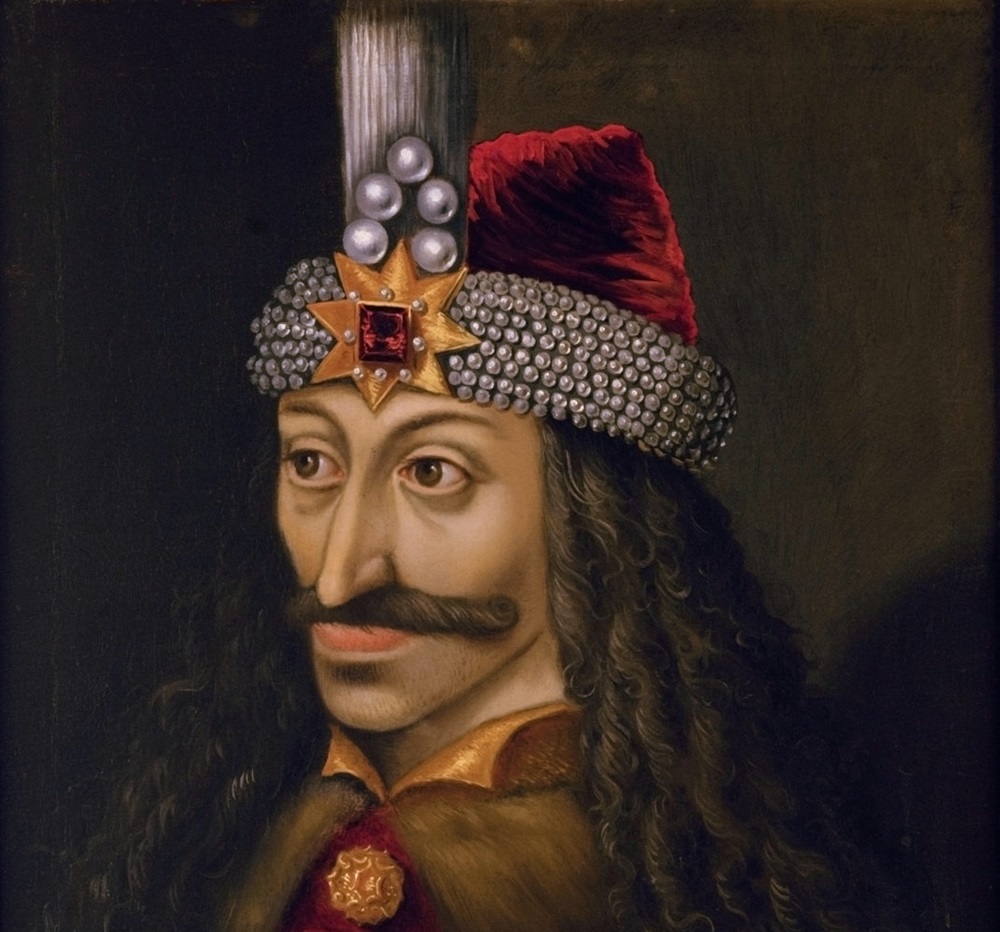
When he was 17 years old, Vlad Tepes (Dracula), supported by a force of Turkish cavalry and a contingent of troops lent to him by Pasha Mustafa Hassan, made his first major move toward seizing the Walachian throne. Vlad became the ruler of Walachia in July of 1456. During his six-year reign, he committed many cruelties, hence establishing his controversial reputation.
His first major act of revenge was aimed at the boyars of Targoviste for not being loyal to his father. On Easter Sunday of what we believe to be 1459, he arrested all the boyar families who had participated at the princely feast. He impaled the older ones on stakes while forcing the others to march from the capital to the town of Poenari. This fifty-mile trek was quite grueling and no one was permitted to rest until they reached their destination. Dracula then ordered the boyars to build him a fortress on the ruins of an older outpost overlooking the Arges River. Many died in the process. Dracula, therefore, succeeded in creating a new nobility and obtaining a fortress for future emergencies. What is left of the building today is identified as Poenari Fortress (Cetatea Poenari).
Vlad Tepes adopted the method of impaling criminals and enemies and raising them aloft in the town square for all to see. Almost any crime, from lying and stealing to killing, could be punished by impalement. Being so confident in the effectiveness of his law, Dracula placed a golden cup on display in the central square of Targoviste. The cup could be used by thirsty travelers, but had to remain on the square. According to the available historical sources, it was never stolen and remained entirely unmolested throughout Vlad's reign. Crime and corruption ceased; commerce and culture thrived, and many Romanians to this day view Vlad Tepes as a hero for his fierce insistence on honesty and order. It's worth mentioning that most written sources regarding his reign are based on the numerous propagandistic pamphlets spread by the Germans with the help of their new invention, the printing press.
In the beginning of 1462, Vlad launched a campaign against the Turks along the Danube River. It was quite risky, the military force of Sultan Mehmed II being by far more powerful than the Walachian army. However, during the winter of 1462, Vlad was very successful and managed to gain several victories. To punish Dracula, the Sultan decided to launch a full-scale invasion of Walachia. His other goal was to transform this land into a Turkish province. He entered Walachia with an army three times larger than Dracula's. Finding himself without allies and forced to retreat towards Targoviste, Vlad burned his own villages and poisoned the wells along the way, so that the Turkish army would find nothing to eat or drink. Moreover, when the Sultan, exhausted, finally reached the capital city, he was confronted by a most gruesome sight: hundreds of stakes held the remaining carcasses of Turkish captives, a horror scene which was ultimately nicknamed the "Forest of the Impaled." This terror tactic, deliberately stage-managed by Dracula, was definitely successful. The scene had a strong effect on Mehmed's most stout-hearted officers, and the Sultan, tired and hungry, decided to withdraw (it is worth mentioning that even Victor Hugo, in his Legende des Siecles, recalls this particular incident). Nevertheless, following his retreat from Walachian territory, Mehmed encouraged and supported Vlad's younger brother, Radu, to take the Walachian throne. At the head of a Turkish army and joined by Vlad's detractors, Radu pursued his brother to Poenari Castle on the Arges River. According to legend, this is when Dracula's wife, in order to escape capture, committed suicide by hurling herself from the upper battlements, her body falling down the precipice into the river below, a scene exploited by Francis Ford Coppola's production. Vlad, who was definitely not the kind of man to kill himself, managed to escape the siege of his fortress by using a secret passage into the mountain. He was, however, assassinated toward the end of December 1476.
The only real link between the historical Dracula (1431-1476) and the modern literary myth of the vampire is the 1897 novel.
Bram Stoker built his fictional character solely based on the research that he conducted in libraries in London.
Political detractors and Saxon merchants, unhappy with the new trade regulations imposed by Vlad, did everything they could to blacken his reputation.
They produced and disseminated throughout Western Europe exaggerated stories and illustrations about Vlad's cruelty.
Vlad Tepes' reign was, however, presented in a different way in chronicles written in other parts of Europe.
(Extractos de un artículo publicado en el número 5 del Journal of the Dark, por Benjamin Leblanc).