
LA ESCRITURA DE “TRAS LAS HUELLAS DE DRÁCULA”:
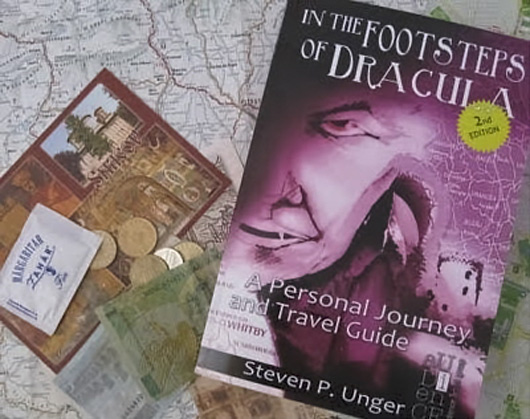
UN VIAJE PERSONAL Y GUÍA DE VIAJE - Por Steven P. Unger
Mi obsesión por viajar a todos los sitios relacionados con el ficticio Conde Drácula o su homólogo histórico real, el Príncipe Vlad Drácula el Empalador, surgió de una visita a Whitby, Inglaterra, donde parte de la novela Drácula tiene lugar.
Me paré en la colina del cementerio donde, en la historia de Bram Stoker Drácula, Lucy Westenra y Mina Murray pasaron hora tras hora sentadas en su "asiento favorito" (un banco colocado sobre la tumba de un suicida cerca del borde del acantilado), contemplando el "promotorio llamado Kettleness" y el Mar del Norte abierto más allá, mientras el Conde Drácula dormía justo debajo de ellas.
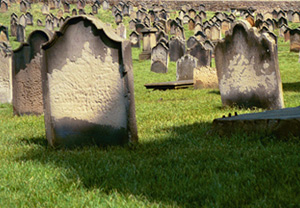
Cementerio de la antigua iglesia parroquial - Whitby, Inglaterra
In my mind's eye, I could see the un-dead Count Dracula rising at night from the flattened slab of the suicide's gravestone to greedily drink the blood of the living. The graveyard where Count Dracula spent his days sleeping in the sepulcher of a suicide looks the part that it plays, with its weathered limestone tombstones blackened by centuries of the everpresent North Sea winds. That graveyard made the novel more visible, more visceral, to me, and I wondered if the sites in Transylvania and in the remote mountains of southern Romania would evoke the same feelings.
Como iba a descubrir, lo hicieron.
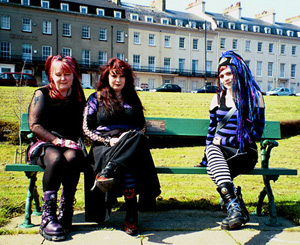
Chicas góticas adornando el asiento conmemorativo de Bram Stoker en Whitby
At that moment I decided to visit and photograph every site in England and Romania that is closely related to either Bram Stoker's fictional Count Dracula or his historical counterpart, Prince Vlad Dracula the Impaler—to literally walk in their footsteps and to write a book about my experiences.
Eventually I traveled along the Dracula Trail alone, using only public transportation, to some places that I'd seen before and to others I had only dreamed of, trying my best to systematically strip away the layers of myth about Count Dracula and Prince Vlad the Impaler to find the reality within. I discovered in broken stones and parchments signed in blood why Prince Vlad's monstrous deeds in life would brand him forever with the name of Vlad Tepes (pronounced Tzeh·pish), Romanian for Vlad the Impaler, soon after his death.
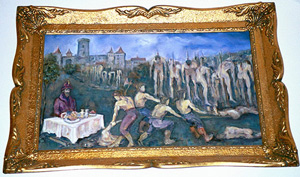
Vlad el Empalador rodeado de sus víctimas
En mis investigaciones y viajes descubrí dos coincidencias fascinantes que vinculan el Drácula histórico y el literario. Lo primero y más importante es que Bram Stoker eligió llamar a su villano "Drácula", basándose en la traducción de la palabra rumana "dracul" a "diablo", sin saber nunca que el personaje histórico Voivoda (Príncipe) Drácula sobre quien había leído también era Vlad Tepes, con una biografía propia horrible y convincente.
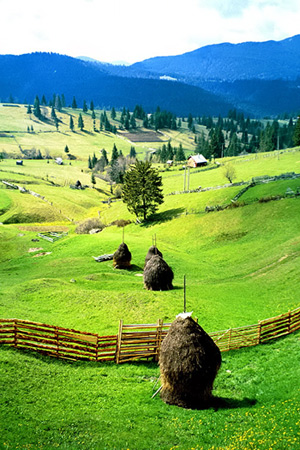
Pajares a lo largo del paso Borgo de Transilvania
Bram Stoker's Transylvania was the pipe dream of an armchair traveler with a genius for writing: real enough for the 19th Century reader, but bearing little resemblance to any Romania that ever existed. For example, Stoker wrote of "hay-ricks [haystacks] in the trees" based on illustrations of Transylvanian haystacks built around stakes, with the ends of the stakes poking out like branches. Thus, generations of Drácula los lectores asumieron que los transilvanos colocaban sus pajares en los árboles.
La segunda coincidencia es el asombroso parecido del real Castle of Dracula—Vlad Tepes' fortress at Poenari, which Stoker had no knowledge of—to Count Dracula's fictional castle in Transylvania. Perched on a remote peak near a glacial moraine in the Fagaras Mountains of southern Romania and mirroring Count Dracula's fictional castle at the top of the Borgo Pass almost stone for stone, Poenari remains pristine and almost inaccessible.
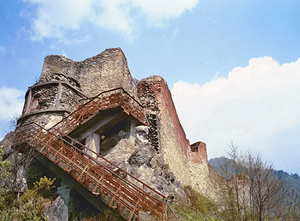
Las ruinas de la fortaleza de Poenari
Uno de mis lugares favoritos en el Camino de Drácula es Sighisoara, en Transilvania, el lugar de nacimiento de Vlad Tepes. Quedé encantado en el momento en que entré en la Ciudad Alta de Sighisoara.
All at once I was in the middle of a perfect storybook medieval village enclosed by thick fortress walls, with cobblestone streets and Easter-egg-colored houses leaning every which way. Guarding the town square was a spire-roofed and turreted 14th Century clock tower replete with carved wooden figures that circle a track to mark the passage of time. In one window, a drummer plays to signal the hours; below the drummer, the angel of the night replaces the angel of the day at the final stroke of midnight. In another window, gods and goddesses appear, changing for each day of the week.
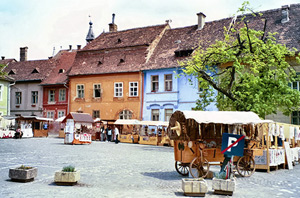
Piata Cetatii—Sighisoara
Pero volvamos a Poenari, el real Castle of Dracula. I had traveled to other remote, forbidding places before entering the almost lightless forest of Poenari. Near Albania's southern border, I hiked the Vikos Gorge, a dozen miles from the nearest stone-housed village. I baked beneath the unrelenting sun of the Timna Valley close to the Red Sea, where 120° in the shade is considered picnic weather. But never before or since have I felt the apprehension and isolation I did while climbing to Vlad Tepes' mountaintop fortress at Poenari. The forest was as quiet as a tomb; I can't recall hearing the song of even a single bird.
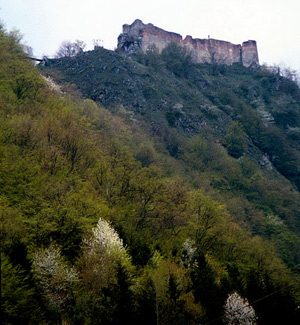
Puente peatonal hacia la fortaleza Poenari
The ascent was exhausting. At last I arrived at the lone approach to the fortress, a wooden footbridge (see top left of photo). Of all the places I explored that are associated with Vlad Tepes, only at Poenari did I feel that he was somehow still keeping watch. Thousands of boyars and their families had been force-marched there from Targoviste to die rebuilding the castle for Prince Vlad; it was here that his treacherous brother Radu stormed the fortress with cannons, reducing the once courtly residence into broken turrets and formless rubble. And it was here that Prince Dracula's wife cast herself from the highest window of the eastern tower, choosing a swift death over the torture of the stake.
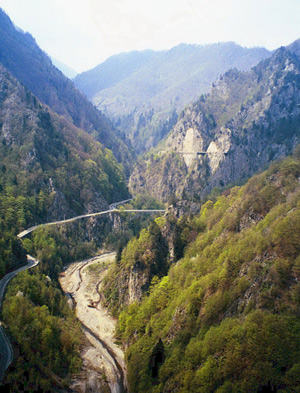
La TransfCarretera agarasan, vista desde Poenari
Walk along the top of the thick fortress walls of Poenari, look northward, and you can see part of the Transfagarasan Road, leading to a glacial moraine and one of the deepest lakes in the world. (According to local legend, a dragon sleeps at the bottom of the lake, and the villagers nearby will caution you not to throw stones in the water lest the dragon awake.)
La vista hacia el sur desde la fortaleza es recta hacia abajo, hasta el río Arges a lo lejos, y aún más lejos, el camino a Curtea de Arges.
Partes de este artículo han aparecido anteriormente en Viajero Romar y otras publicaciones en línea.
In the Footsteps of Dracula: A Personal Journey and Travel Guide,
es publicado y distribuido por World Audience Publishers.
http://worldaudience.powweb.com/pubs_bks/Dracula.html
In the Footsteps of Dracula también está disponible en
www.amazon.com,
www.amazon.co.uk,
www.barnesandnoble.com,
www.amazon.fr,
www.amazon.de,
www.amazon.com/Kindle,
and with free delivery worldwide from
www.bookdepository.co.uk.