Name: Corvin Castle (Castelul Corvinilor or Castelul Huniazilor, in Romanian)
Location: town of Hunedoara, Transylvania
Address: Curtea Corvineștilor 1 - 3, Hunedoara
Nearest large towns: Deva (12 miles N), Alba Iulia (50 miles E), Sibiu (80 miles E), Timisoara (105 miles W)
Nearest train stations: Hunedoara (1.5 miles NE) and Deva (12 miles north)
Telephone: (+4) 0786 048.718
Corvin Castle Hours and Admission
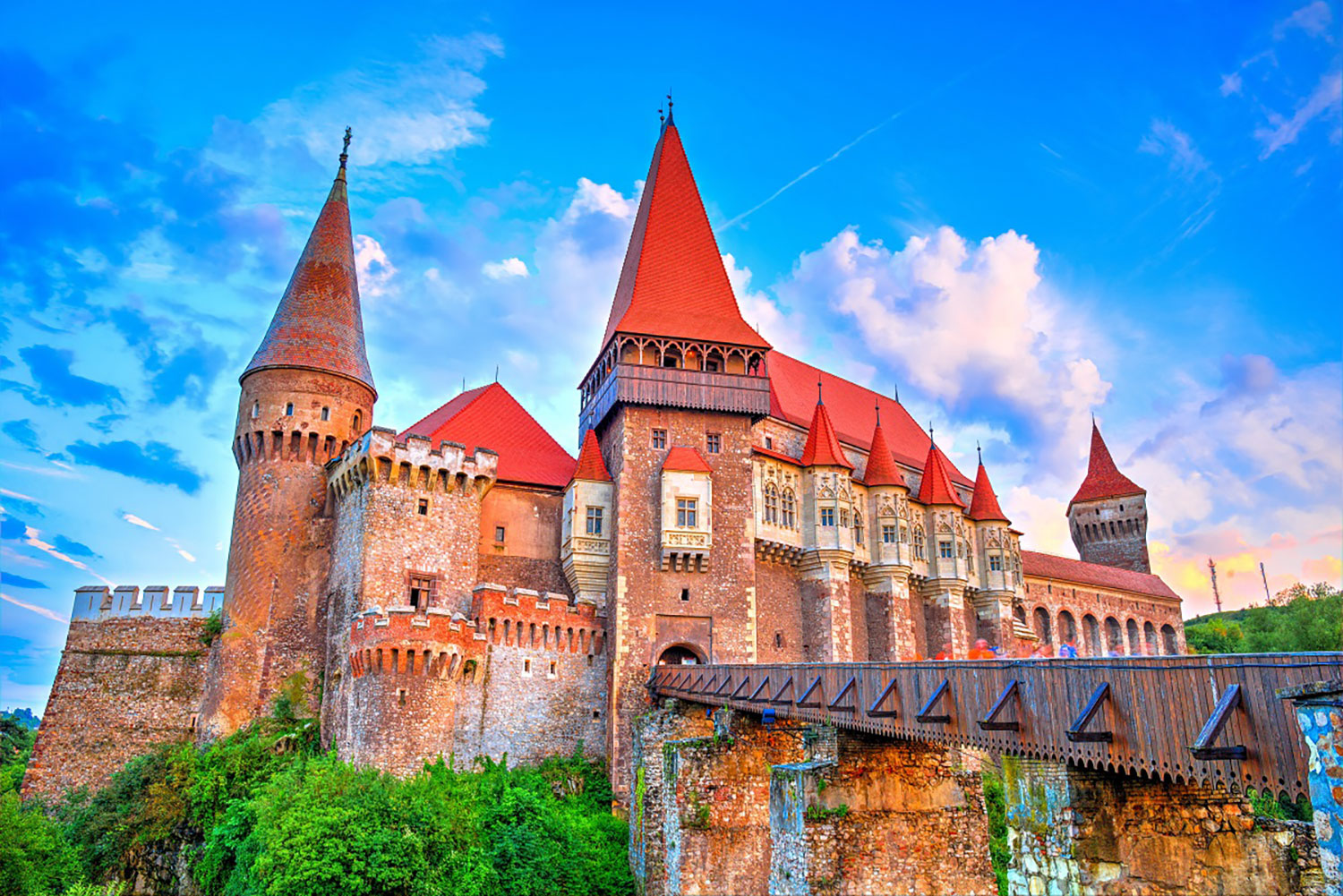
The most spectacular Gothic landmark in Romania, the Corvin Castle,
stands on the site of a former Roman camp, where a stone fortress was later built at the request of the House of Anjou.
In 1409, the fortress becomes the property of Voicu de Hunedoara (Voyk Hunyadi),
Wallachian nobleman - the father of respected military leader and Voivode of Transylvania
Iancu de Hunedoara (Ioannes Corvinus)
and grand father of Matthias Corvinus, the King of Hungary (1458 to 1490).
Iancu de Hunedoara (Ioannes Corvinus) transformed the 14th century stone fortification into a castle,
by significantly expanding and upgrading the original structure.
Major restoration and remodeling works also occured during the 17th and 19th centuries.
In 1421, Iancu de Hunedoara the fortress was reinforced: the outer walls were extended, and circular towers were built at each corner. A unique military-purpose structure was built at a later date: a five-levels tower, with several openings for firearms, called "Nje Boisa" (Fear Not in church Slavonic). The tower - named by the Serbian mercenaries, members of the castle garrison - is connected to the castle through a 100-ft. long 'suspended' corridor, which is supported by massive limestone pillars.
A unique feature of the castle is the 'Nje Boisia' tower,
a five-levels structure built for military purposes.
Further expansion and renovation, that took place between 1442 and 1456,
added Renaissance architecture elements and transformed the residence of Transylvania's voivode Iancu de Hunedoara
(Ioannes Corvinus in Latin, Hunyadi in Hungarian),
into a magnificent Transylvanian castle.
In 1458, construction began on the castle's Matia Wing (Matthias Corvinus).
On completion, in 1480, Corvin was one of the largest castles in Eastern Europe.
New additions, were made, in the 17th century
for aesthetic (the Large Quarters) and military purposes(the White Tower and the Artillery Tower).
The beautifully preserved castle features double walls with rectangular and circular bastions, a sumptuous Knights' Hall (formerly used for feasts), a Council Chamber (or the Diet Hall used for ceremonies and formal receptions), a chapel, a grand circular staircase, an impressive drawbridge, towering buttresses, an inner courtyard with a well, myriads of windows and balconies decorated with sculptured stone-work and, more than 50 rooms adorned with medieval art and furniture.

The castle's courtyard features a 94-foot deep well dug
into solid dolomite rock, nearly 600 years ago.
Legend says that the wheel was dug by three Turkish prisoners
who were promised freedom when job was done.
It took them 15 years and 28 days to reach water.
One of the chapel's buttresses bears an inscription in Arabic that appears to confirm the legend:
"He who wrote this is Hasan, who lives as a slave of the giaours in the fortress near the church."
(Ghiaour (or giaour) is a derogatory term used during the Ottoman Empire
by Muslims, to refer to non-Muslims, particularly Christians.

Although a museum, Corvin Castle occasionally hosts private functions and special celebrations.

Attractions near Corvin Castle
Town of
Deva, 11 miles north
Town of Deva is home to the spectacular, 700 years-old, fortress,
Magna Curia (Renasissance architecture) Palace - home the the Dacian - Roman Civilizations Museum.
I Giardini di Zoe Park ( Gradinile Banpotoc), 16 miles north
Nine acres of gardens that change with the seasons without ever losing their charm.
In spring, the paths are draped in pastel colours and filled with delicate scents;
in summer, the gardens pulse with life and lush greenery;
in autumn, they take on shades of copper and gold;
and in winter, they exude tranquillity, revealing pure, almost magical contours.
Castle Nopcsa - Săcel, 22 miles south
A 17-room / 14,000 sf, set on a 4.5 acres estate built in the early 1800s is a fine example of
historicist architecture with Neo-Romanesque and Neo-Gothic features.
It once belonged to Baron Franz Nopcsa, the scholar credited with the first discoveries of dinosaur fossils in the Hațeg region of Transylvania.
Retezat Mountains National Park, 33 miles south