

Catedral Curtea de Arges Fatos e História
Em 1515, o Príncipe Neagoe Basarab, voivoda do Principado de Valáquia, commissioned a church, like no other. To to make his wish a reality, he invited to Curtea de Argeș, then the capital of Walachia, the most skilled architect in the Ottoman Empire: Manoli of Niaesia. Manoli (Manole) was a brilliant Armenian who had built several mosques in Constantinople / Istanbul. Prince Basarab never anticipated that, for a short time, Curtea de Argeș will become the center of European architectural innovation.
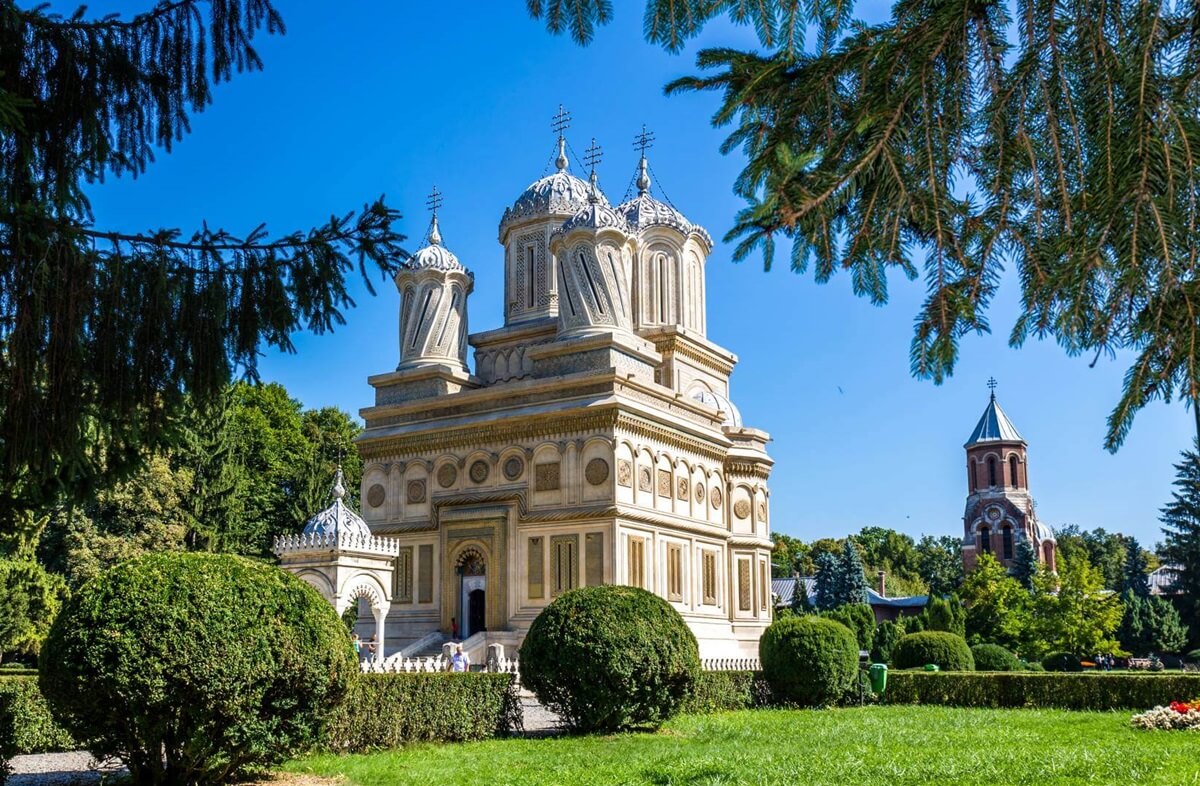
Os registros escritos atribuem o conceito do edifício ao próprio príncipe Nigo Bassarab. Acredita-se que, em sua juventude, o príncipe passou algum tempo em Constantinopla e se familiarizou com a arquitetura do Oriente Médio. O príncipe Neagoe Basarab e Manoli e sua equipe criaram o primeiro estilo de arquitetura religiosa mista na Europa: Layout bizantino com decorações armênias, georgianas e otomanas. É algo completamente novo, invisível no mundo conhecido, uma verdadeira revolução arquitetônica. A arquitetura original da Catedral de Curtea de Arges tem sido inspirada por muitos outros edifícios ao longo dos séculos. Um lugar ou um culto, mas nenhum sequer se aproxima dele.
A construção da catedral foi concluída em tempo recorde – apenas três anos.
O Patriarca de Constantinopla, Teolipt, esteve presente na cerimônia de consagração em 15 de agosto de 1517.
Outras figuras importantes presentes na cerimônia incluem o Monte Athos Comunidade Santa (conselho)
e todo o clero de Valáquia.
O fato de que pela primeira vez, na história, um Patriarca de Constantinopla pôs os pés em solo romeno
foi uma confirmação da unidade da Ortodoxia de uma forma que nunca tinha sido visto antes.
A igreja tornou-se Catedral Bispada em 1793, parte de um grande conjunto monástico.
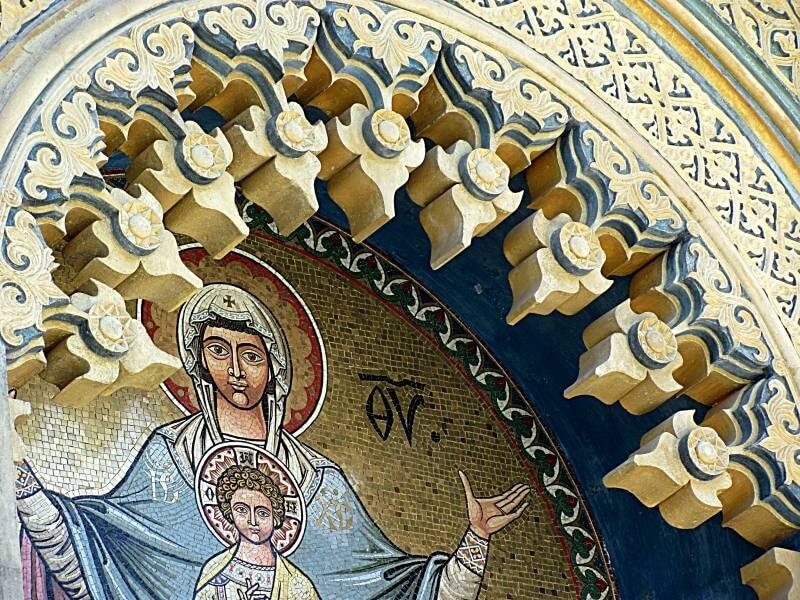
A arquitetura única da catedral Curtea de Argeș ilustra o espaço artístico inter-relacionado que se estendeu da Europa Oriental e do Império Otomano à Rússia, o Cáucaso e além, até a Ásia Central.
Curtea de Arges cathedral architecture and decorations have drawn admiration since the earliest chronicles and traveler accounts.
In 1654, Paul, the Archdeacon of Aleppo (Paul of Aleppo) - an Ottoman Syrian Orthodox clergyman and chronicler -
wrote that the cathedral was "one of the wonders of the world."
Words of high praise were also written, in 1794, by Sir Robert Ainslie, the British ambassador to the Porte (1776-1794),
and later, by French painter and illustrator Louis Bouquet (of the most brilliant French decorators in the inter-war period) and,
French lithographer, engraver and illustrator Dieudonné Auguste Lancelot (1860).
Their travel notes and prints spread the fame of the cathedral beyond the borders of Romania.
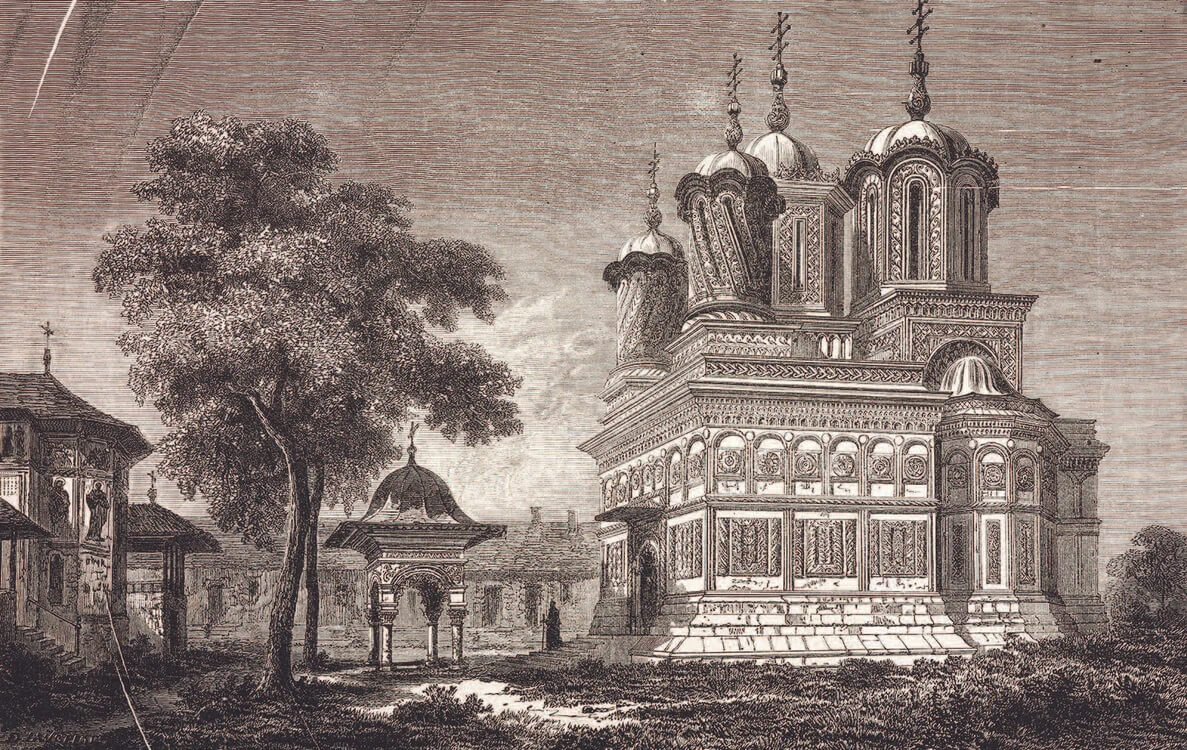 Mosteiro de Curtea de Arges, litografia de 1860 de Dieudonné Auguste Lancelot, foto © Wikimedia Commons
In 1867, at Paris Universal Exhibition, the cathedral Curtea de Arges stood as one of the most representative landmarks of Romania and a symbol of the new Romanian state. The church represented one of the main references of Romanian religious architecture: in 1878, it was called “the main title of glory of the Romanian arts of the past”.
A lavish restoration of the cathedral Curtea de Argeș was commissioned by King Carol I in 1875 when the king asked French architect André Lecomte du Noüy to recondition the cathedral. Works supervised by du Noüy included changes to the interior structure and the replacement of the original fresco with vividly-colored neo-Byzantine ones. A grand Episcopal Palace was constructed 200 feet away from the cathedral.
Logo após a conclusão das obras de restauro, em 1886, O rei Carol I designou a Catedral de Curtea de Argeș como necrópole real.
O Exterior
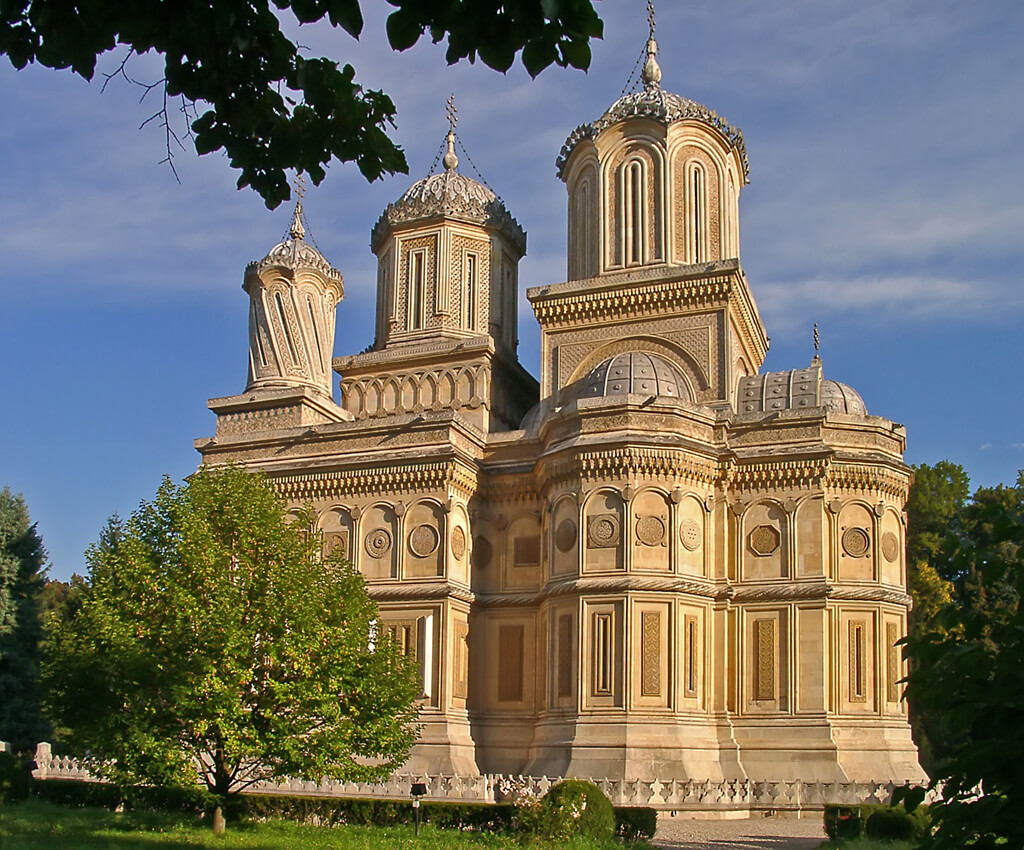
The 59-feet long, 33-feet wide and 82-feet high, cathedral in Curtea de Arges was one of the most impressive constructions of its time.
The beige limestone facades are decorated with flat reliefs featuring Caucasian and Islamic motifs.
A richly-carved middle cordon (brau em romeno) circunda a fachada e a divide em seções inferior e superior.
A parte inferior exibe janelas estreitas com molduras de pedra ricamente decoradas,
interrompido por lajes de mármore branco ou decoradas.
A parte superior é marcada por uma fileira de arcadas cegas (arcos contíguos), cada uma contendo um grande disco de pedra decorativa.
Outra fila de discos decorativos menores é exibida onde os arcos se encontram.
Cada disco apresenta um motivo decorativo único.
A parte superior de cada pequeno disco apresenta um pássaro de bronze que mantém um pequeno sino em seu bico.
Os pássaros na fachada não eram apenas decorativos.
De acordo com um cronista medieval, o vento fez os pássaros assobiarem e os pequenos sinos debaixo deles chiam,
criar uma atmosfera única em torno do edifício.
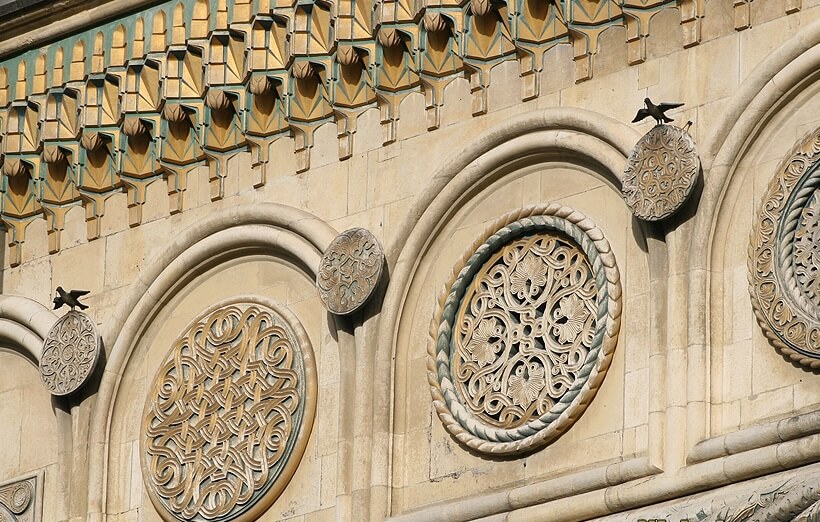
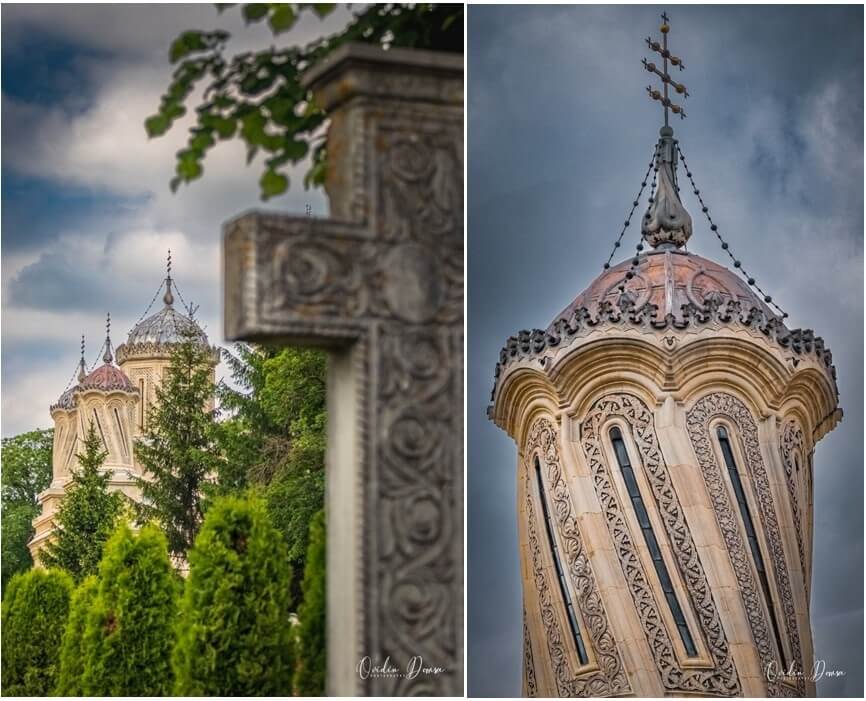
The cornice of the roof is marked by muqarnas-type ornaments, which are the beginning of extremely rich stone carvings, that cover the entire upper part of the church, including the roof and the four towers. The church's structure rises in a series of volumes and surfaces, on which the four towers stand. The towers display the richest decorations, especially along the very thin windows, and culminating with the curved windows and window frames of the smaller towers that give them the unique, twisting impression. The rare ornamental richness, like lace in relief, include a number of elements of Arabic and Georgian art skilfully harmonized. (Attribution: Princeton.edu)
O Interior
O interior da catedral é adornado com afrescos a óleo de pintores
Émile-Frédéric Nicolle (francês),
Charles Paul Renouard (francês),
e Nicolae Constantinescu (romeno, nascido em Curtea de Argeș).
Other decorative elements that draw attention and are considered exceptional sculptural achievements
include the votive panels, the altar made of marble, gilded bronze, and onyx,
the mosaic icons and the group of 12 columns representing the 12 Holy Apostles.
Each column, originally decorated with floral motifs, is carved from a single block of marble.
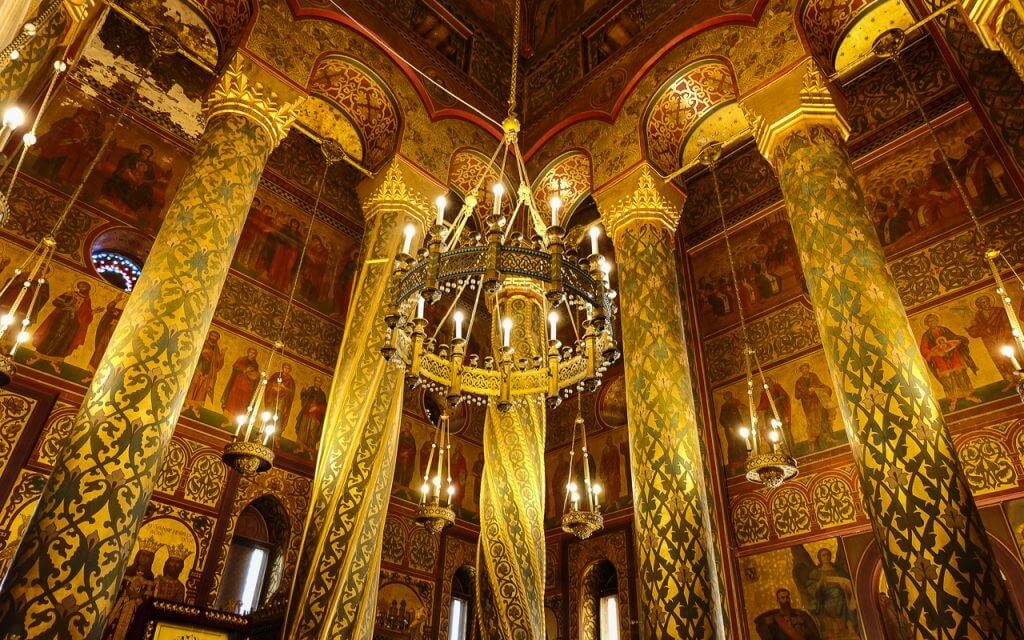
The nave is surrounded by three apses, the central one serving as the altar, and bearing the eastern tower, the highest, in the middle. Unusual for an Orthodox church, the narthex is larger than the nave. It is square-shaped and another smaller square is formed in the middle by twelve columns that support a second central tower and two smaller and twisting western towers.

The enlarged narthex was designed to host princely graves, namely that of Neagoe Basarab, his immediate family members and successors. But it was most probably also the setting for an original religious scenography, with chairs and double-sided icons (four of them still existing) placed between the twelve columns.
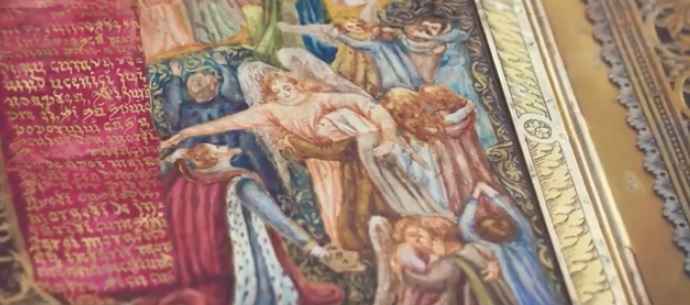
It contains the twelve Gospels read on Maundy Thursday, as well as the Gospel of the Resurrection from Holy Saturday. The large and richly decorated Codex was painted on parchment and written in gold and silver letters by Queen Elisabeth of Romania, herself.
...
Catedral Curtea de Arges Lendas
Cathedral Curtea de Arges is the setting of two captivating legends:
~ A criação da notável estrutura bizantina (Legenda Mănăstirii Argeșului),
desenvolvendo o tema do sacrifício pela arte
e
~ O destino malfadado do Grão Mestre Manoli (Legenda Meșterului Manole),
uma variação do mito de Ícaro.
Lenda da criação da Catedral de Curtea de Arges
Tudo que Manole e sua equipe construíram durante o dia desmoronou durante a noite.
Por muito que tentassem, não podiam continuar com a construção.
Uma noite Manole sonhou que a única maneira de completar a catedral era com um sacrifício humano.
Especificamente, a primeira mulher a aparecer na manhã seguinte deve estar immurada dentro das muralhas da catedral para apaziguar forças desconhecidas.
Manole contou a seus pedreiros sobre seu sonho, e todos concordaram em agir de acordo com o sonho do Grandmaster.
Since the site for the cathedral was remote, the only people coming by were the workers’ family.
Shortly after Manole and his team agreed to sacrifice the first woman who came to the construction site,
Manole looked over the hills and caught glimpse of his pregnant wife, Ana, coming to bring him lunch.
He prayed to God to start a strong storm that would make her to return home.
But Ana’s determination to bring food to her beloved husband kept her going.
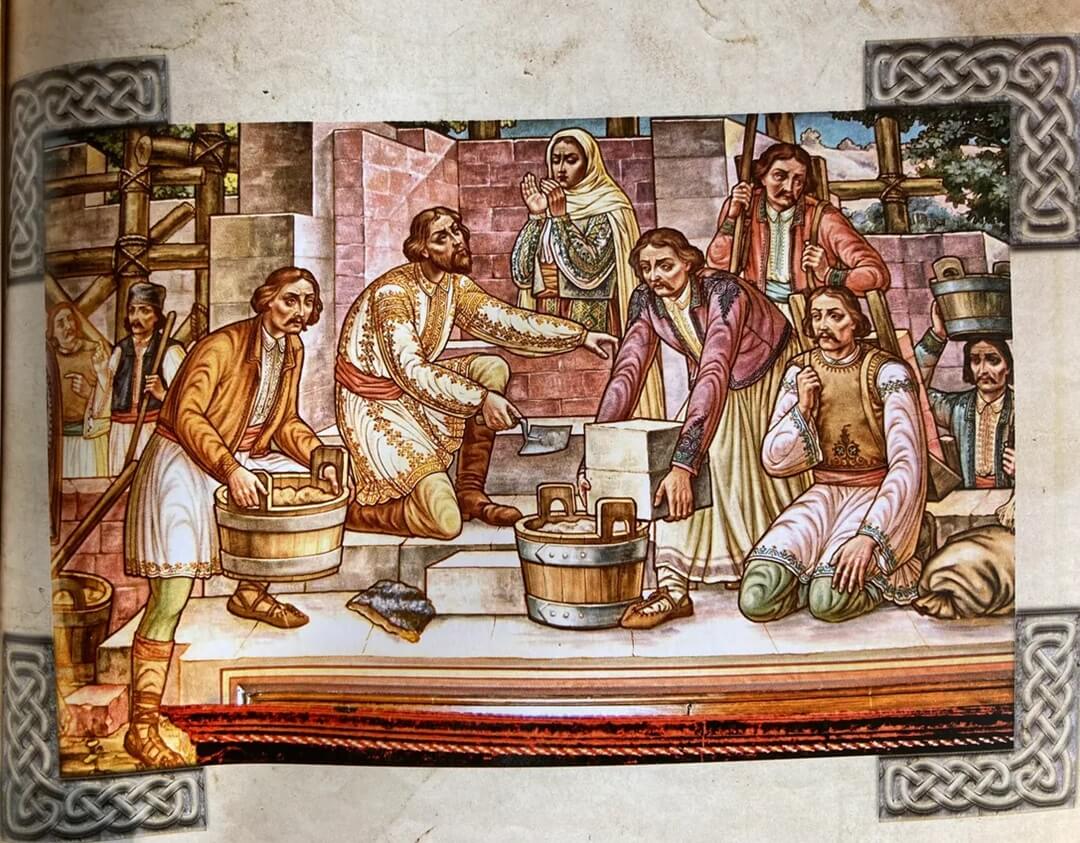
Manole kept praying but neither the strong wind nor the torrential rain could stop Ana to reach the construction site.
When she arrived, Manole and the other builders told her that they wanted to play a little game,
which involved building walls around her body.
She accepted but soon she became uncomfortable and implored Manole to stop.
Although Ana begged for her life and her unborn child but Manole kept walling his wife brick by brick.
With his heart broken and tears in his eyes, and,
without saying one word, Manole immured his wife into the southern wall of the cathedral.
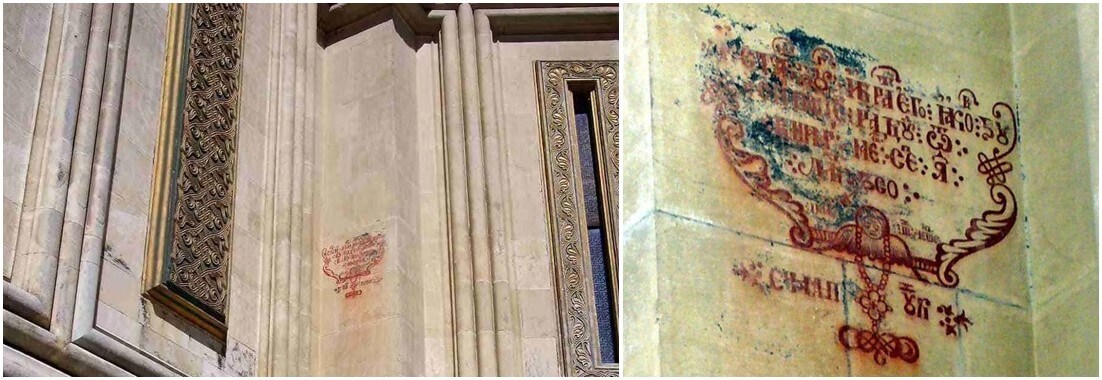
A red mark on the cathedral's souther wall marks the place where Manole's wife's was immured, in the edifice.
...
O fim infeliz do Grão-Mestre Manoli
Outra lenda fala do fim de Manole, causado por ciúme.
When the cathedral was almost completed, and Manole and his craftsmen were doing roof's finishing touch,
prince Neagoe Basarab asked Grandmaster Manoli if he could build an even more beautiful church.
Manole answered he could.
Because the prince wanted to make sure that nothing to match his stunning cathedral would ever be replicated,
he ordered his men to remove the scaffolds and Manoli and his team were left stranded on the roof.
Sem meios de sair do telhado, Manoli e seus homens decidiram usar telhas de madeira
para fazer asas de pássaros e chegar ao chão.
No entanto, a tentativa falhou e todos os artesãos morreram ao chegar ao solo.
The legend also says that, miraculously,
a water spring appeared on the very spot where Manoli supposedly landed and died.
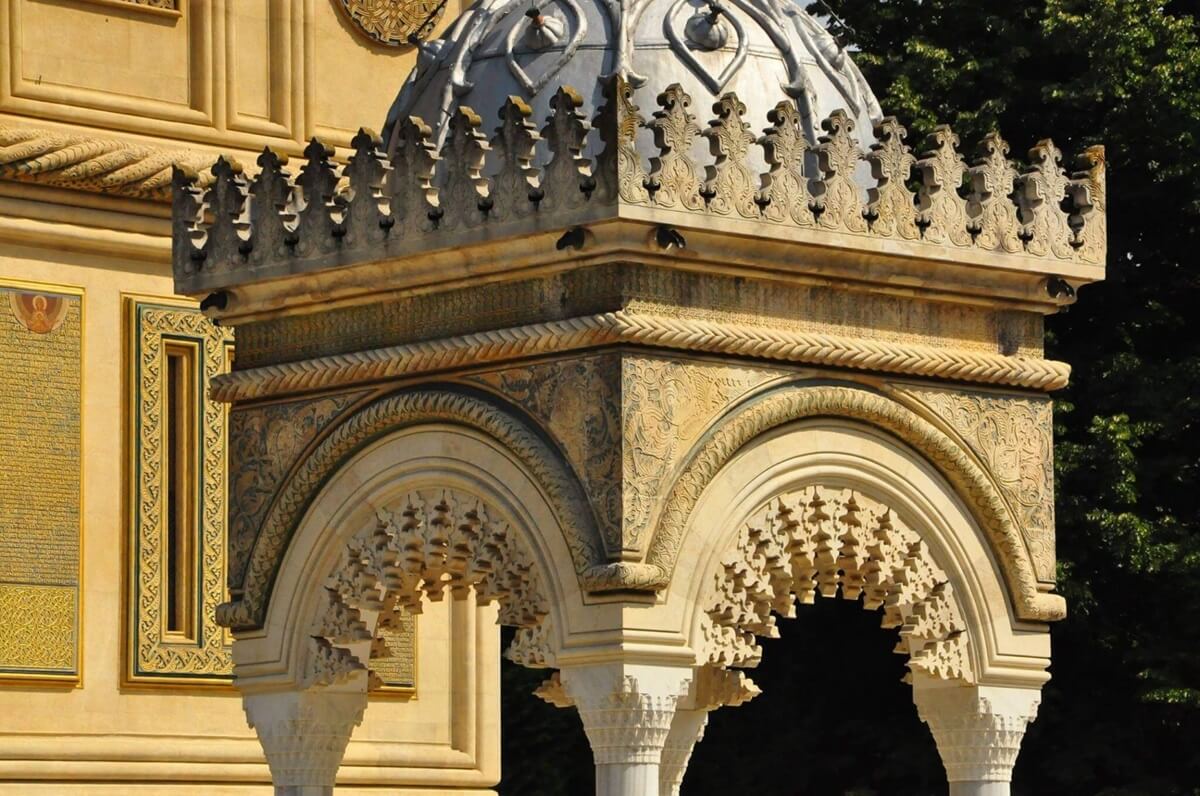
The spring (Fantana lui Manole) está localizado a 690 pés a oeste da entrada da catedral,
em um pequeno parque chamado Manole's Spring.
Moradores e visitantes sedentos podem beber água direto da nascente.
...
Planeje sua visita a Curtea de Arges
Como chegar a Curtea de Arges, de Bucareste
Carro:
Rodovia 1 (Autoestrada A1),
Bucareste - Pitesti - Curtea de Arges,
Curtea de Arges está localizada 96 milhas a noroeste de Bucareste, 84 milhas a sudoeste de Brasov e 86 milhas ao sul de Sibiu.
A partir de Curtea de Arges, os visitantes podem continuar a:
Brasov, via Campulung Muscel → Rucar - Passo da montanha de Bran → Castelo de Bran (Drácula) → Fortaleza de Rasnov
ou para
Sibiu, através do
TransFagarasan estrada panorâmica, (Fortaleza Poenari → Barragem de Vidraru → Lago Balea)
(o TransFagarasan está fechado de novembro a junho)
ou pela estrada panorâmica do Rio Olt (Valea Oltului).
Trem:
terminal ferroviário mais próximo Curtea de Arges,
(tempo de viagem de trem de/para Bucareste: 3 horas e 30 minutos)
Ônibus:
Os ônibus de Bucareste para Curtea de Arges partem de Autogara Militari (endereço: Str. Valea Cascadelor 1 - Bucareste),
(tempo de viagem de ônibus e micro-ônibus de/para Bucareste: 2 horas e 30 minutos)
Alojamento perto da Catedral Curtea de Arges
| Nome do hotel | Turma | Localização |
|---|---|---|
| Posada | 4 estrelas / escala média | 0,3 milhas ao sul |
| Casa Domneasca | Pousada | 1,9 milhas ao sul |
| Curtea Veche | Pousada | uma milha ao norte |
| Hotel THR | 3 estrelas/escala média | 1,7 milhas ao sul |
| Pensiunea Prestige | Pousada | 0,6 milhas ao norte |
Atrações em Curtea de Arges ou não muito longe
• Museu Municipal de Curtea de Arges,
• Pintor Dumitru I. Coleção de Arte Norocea,
• a Igreja Principesca (Biserica Domneasca) -
a Byzantine church in the Paleologian Renaissance style -
the oldest voivodal residence in
Valáquia (sul da Romênia).
As pinturas interiores da Igreja Principesca datam da década de 1360.
Um dos afrescos retrata a Virgem Maria grávida.
O único afresco semelhante pode ser visto no Mosteiro de Chora, em Istambul - Turquia.
•
Fortaleza Poenari
- refúgio do príncipe Vlad, o Empalador (Draculea) nas montanhas dos Cárpatos
• Barragem Vidraru e estrada panorâmica TransFagarasan