

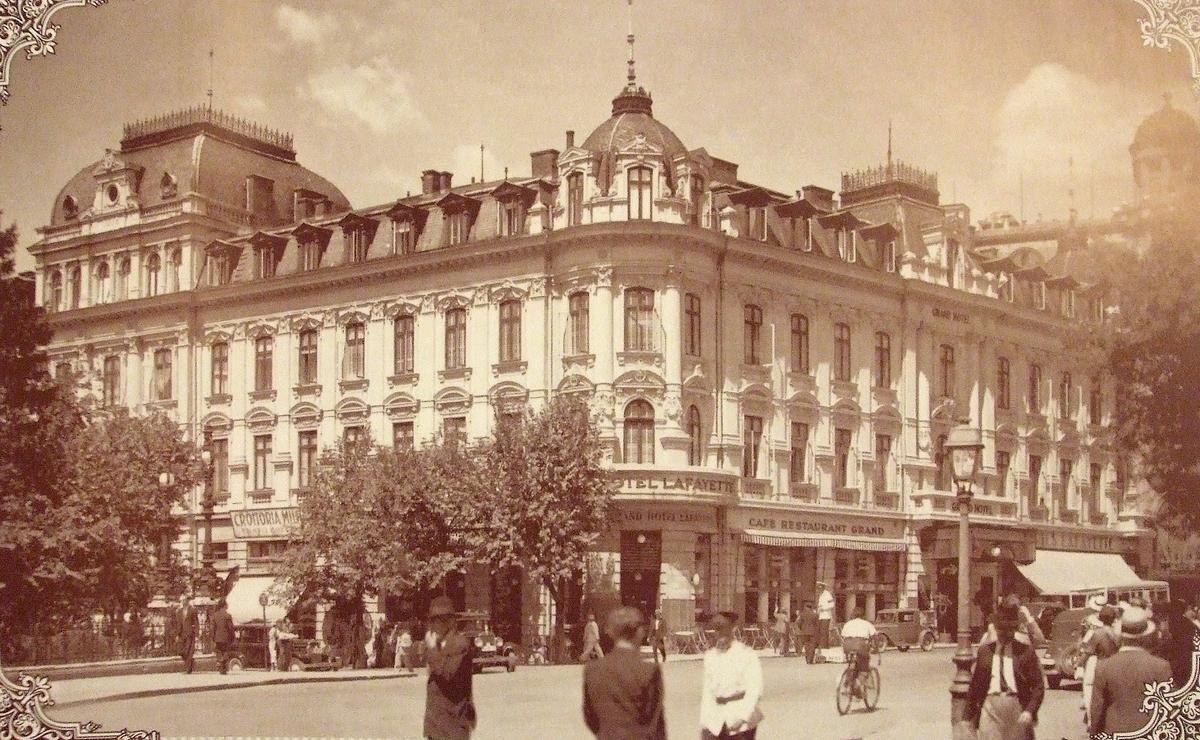
What foreign visitors said about Bucharest at the end of the 19º / principios del 20º siglo:
As early as 1879, Emile-André Lecomte du Noüy - French architect and restorer noticed Bucharest's "power and vitality". It was during his time that Bucharest became known to the “flâneurs” of high-society France as “Little Paris”, for its adoration of all things Gallic in its architecture, academia, and cuisine. (flaneur = una persona que deambula observando la sociedad).
“Bucarest se ha transformado rápidamente con la creciente riqueza de sus habitantes. y ahora merece plenamente su sobrenombre de “ciudad alegre”. (Geógrafo francés Jacques Élisée Reclus - 1883).
In 1905, his compatriot, André Bellessort, French poet and essayist but also an avid traveler
spoke of the "cheerful" character of Bucharest, a city drowned in greenery, of its "interminable" streets,
in which "the hut leans against the mansion wall, the spectre of the hovel against the illusion of the Palace".
The different ethnic groups are not too mixed: there's an Armenian neighbourhood,
a Jewish, a Bulgarian, and areas with Greek street-vendors.
He is impressed by the new public buildings: the National Bank, "the most beautiful temple to blind luck",
The House of Deposits and Consignments, "so gracious, everyone gets enticed
to see art objects deposited there and all of painter Nicolae Grigorescu works",
the Palace of Justice, "capable of holding the pleaders and lawyers of the entire world",
The Post Office Palace, so big it crushes the neighbourhood.
Bellessort also mentions the elegant Bucharest people strolling along
‘Calea Victoriei’ and ‘the Șosea’, then the pompous funerals, where even the poor luxuriate,
and finally, the "gentle morals" of the population.
Otro francés, Alphonse Muzet, ingeniero, Encargado de misión en Oriente
, que conoció la ciudad durante la Primera Guerra Mundial, quedó impresionado por la gran cantidad de iglesias y hospitales.
Pero lo que le llama especialmente la atención es el "exhibición de lujo femenino";
Las mujeres elegantes de Calea Victoriei van vestidas "con un cuidado que sólo se encuentra en las grandes capitales".
(Le Monde Balcanique: : Roumains de Roumanie, de Transylvanie et de Bukovine...)
Count Charles Louis Stanislas de Moüy, French - writer and diplomat - who,
bemused by Bucharest, observed it was difficult to find one’s place in a city whose neighbourhoods
veered so radically from first-world elan to seemingly intractable poverty,
with crooked streets neighbouring a Champs-Élysées-like avenue, luxurious and ox-drawn carriages on the same streets,
elegant people and very poorly dressed bystanders, decrepit shops and fine boutiques, mansions next to huts and shacks.
(Atribución:
JSTOR, biblioteca sin fines de lucro para intelectualmente curiosos)
...
Sabores de la antigua Bucarest
Mititei - 'Littles' o 'Wee-Ones' - salchicha de ternera sin piel.
Un plato inmensamente popular en Rumania, el Mititei (Mici para abreviar) se ofrecieron por primera vez a los clientes, a mediados del siglo XIX, en Casa "La Trei Frunze de Viță" un restaurante de Bucarest conocido por sus deliciosos platos tradicionales y por el ambiente amenizado por los mejores músicos de la época. El escritor Constantin Bacalbașa (1856-1935) afirma en su libro "Bucarest de otro tiempo" que "Mititei" eran una variación no planificada de una salchicha de ternera, popular en aquella época. Cuando el dueño del restaurante se quedó sin tripas de cordero, que solía utilizar para la tripa de las salchichas, decidió poner la carne directamente a la parrilla.
Los auténticos Mititei están hechos de cuello de res.
If the meat is too lean, some cow's or muton's tallow is added (100 to 150 grams per kg. of meat).
Other ingredients include (thick) beef bone broth (broth obtained from 500 g of bones for each kg of ground beef),
Sodium bicarbonate (8g), lemon juice (one teaspoon), vegetable oil (one spoon), extra fine ground black pepper (8 g.),
dried thyme (12 g.), allspice (2 g.), coriander (2 g.), Turkish cumin (2 g.), star anise (1 g.),
strained garlic juice (one clove, little salt and water / 1 kg of meat).
Meat is twice-grinded then mixed with half of the beef-bone broth. The following ingredients are then added, little by little, in the following order: Sodium bicarbonate, lemon juice, half of the beef-broth and the spices. The original recipe requires mixing/kneading the ground meat for at least one hour.
La mezcla de carne se refrigera por 24 horas y luego se retira del refrigerador.
Se deja reposar unas horas a temperatura ambiente y luego se vuelve a mezclar, durante media hora, con el caldo de res restante.
Al final se añade el jugo de ajo colado a la mezcla y se amasa, una vez más, durante otros 15 minutos.
La carne se refrigera por otras 24 horas.
Obteniendo el Mititei listo para ser servido:
Meat is removed from the fridge and left at room temperature, for about three hours.
Small skinless sausages (3 inches long and 1.25 inches thick) are hand-shaped and placed on a hot grill (wood embers).
The Mititei need to be medium-cooked, taking care not to dry out the juices that contain spice's flavor.
Some sources indicate that, during grilling, the Mititei are occasionally drizzled with garlic sauce and are flipped three times.
(Attribution: Libertatea.ro)
Orasanu también llamó "La Idee" (la idea) al popular restaurante "La Trei Frunze de Vita".
Mititei fueron presentados formalmente a los gourmets internacionales en la Exposición Universal (París - 1889), Exposición Universal (París - 1900) y Exposición Universal de Nueva York (1939).
El
Mititei
se sirven como merienda o como plato principal, generalmente con mostaza como condimento.
La mayoría de los restaurantes en Rumania ofrecen "Mititei", pero,
muy, muy pocos de ellos, si es que hay alguno, los preparan siguiendo la receta original.

Negro – una bebida ligeramente amarga con aroma y sabor distintivos.
Durante los años de entreguerras, algunos cafés y restaurantes de Bucarest se hicieron famosos por su ambiente vibrante y su excelente "șvarț’.
Șvarț - del alemán ‘schwarz(-kaffee)’ o negro(-café) -
se elaboraba a partir de sucedáneos del café, como achicoria o cebada tostada, o a partir de café y achicoria, mediante el método de vertido/goteo.
A principios de la década de 1940, surgió esta alternativa asequible al café real, que a veces podía ser caro o difícil de encontrar.
tuvo una seria competencia por parte del llamado café turco (elaborado con semillas de garbanzos, mijo o higos).
Hoy en día, el Svart es muy difícil de encontrar en Rumania ya que la mayoría de la gente prefiere el café expreso o el café filtrado.
Irónicamente, un empresario rumano puede haber contribuido a la decadencia de la bebida svart:
Francesco Illy, inventor de illeta - considerado el modelo de la moderna máquina de café expreso (nacida en Timisoara en 1892).
Sin embargo, el Svart sigue siendo un símbolo del período de entreguerras y evoca nostalgia por los tiempos en que Bucarest era apodada "la pequeña París".
Marghilomana:
una bebida que lleva el nombre del personaje político Alexandru Marghiloman (1854 – 1925),
un líder conservador y ex primer ministro.
Un día, mientras cazaba, Marghiloman pidió un café. A falta de agua, su mayordomo pidió permiso para utilizar brandy para preparar el café.
Marghiloman estuvo de acuerdo y así "Marghilomana" nació.
Así es como se prepara la 'Marghilomana' original:
100 ml (3.5 fl.oz.) of Jamaica Rum or brandy are placed in a small, cooper, kettle and mixed with two teaspoons of sugar.
The kettle is dunked into a bed of hot sand (or ember) and brought to a boil, at low heat.
Three teaspoons of coffee are added, the kettle is covered, and left to rest until the ground coffee sinks to the bottom (about three minutes).
As alcohol does partially evaporate during cooking the resulting drink is not very strong and it has a unique flavor.
Marghilomana was traditionally served in a small, spoutless cup called 'filigeană'.
Marghiloman was one of the largest landowners in Romania.
Besides politics, his greatest passion was horses.
He founded the first equestrian center in Romania, complete with modern stables, qualified staff and a race-course
and is often referred to as "the father of Romanian equestrianism".
Alexandru Marghiloman Mansion (Conacul Marghiloman) en Buzau, su ciudad natal, está hoy abierto a los visitantes.

Joffre - el “cilindro” de chocolate,
un postre creado por el pastelero rumano Grigore Capșa y adoptado, con los brazos abiertos, por los confiseurs franceses.
Preparado por primera vez en 1920 para honrar la visita a Rumania del mariscal de campo francés Joseph Jacques Césaire Joffre,
La forma de este postre de chocolate recuerda a un casco militar francés.
Los ingredientes utilizados hasta el día de hoy son: petit-four/langue de chat (pastelería),
mantequilla, azúcar, huevos, harina, aromas y, sobre todo, cacao de la más alta calidad,
todo cubierto con un delicioso glaseado de chocolate.
(historia.ro)
Joffre todavía está disponible en muchas pastelerías, incluidas Cofetaria Capsa y Zexe Braserie - Zelateria .
Carolinas
Galleta bañada en ron rellena de mucha crema de manteca de cacao
y cubierto con crema batida y chocolate rallado.
(creado por el pastelero Emil Frederic).
Actualmente no se ofrece en pastelerías en Rumania..

...
(Dale Peterson Información privilegiada empresarial).