
Whether you travel in Romania along the coast of the Black Sea or in the Dobrogea Plateau near the Danube Delta region or in the Province of Moldova or along valley slopes of the scenic Carpathian Mountains or in Transylvania Province or in Wallachia or in nearly any agricultural area throughout Romania, you're in wine country. Romania is one of the world's top-ranking producers of numerous delicious wines, some of which never leave its borders.
Archeological evidence of country-wide wine production in Romania's grape-friendly soil and climate
dates back to the classical Greek and Roman eras of settlement in Romania.
Today, on a list of the world's "Top 12 Wine Producers", in which France ranks number one and Italy is listed as number two,
Romania ranks tenth among the world's top wine producers by volume.
(Notícias dos EUA e Relatório Mundial,
citando fonte: Wine Institute – Office Internationale de la Vigne et du Vin.)
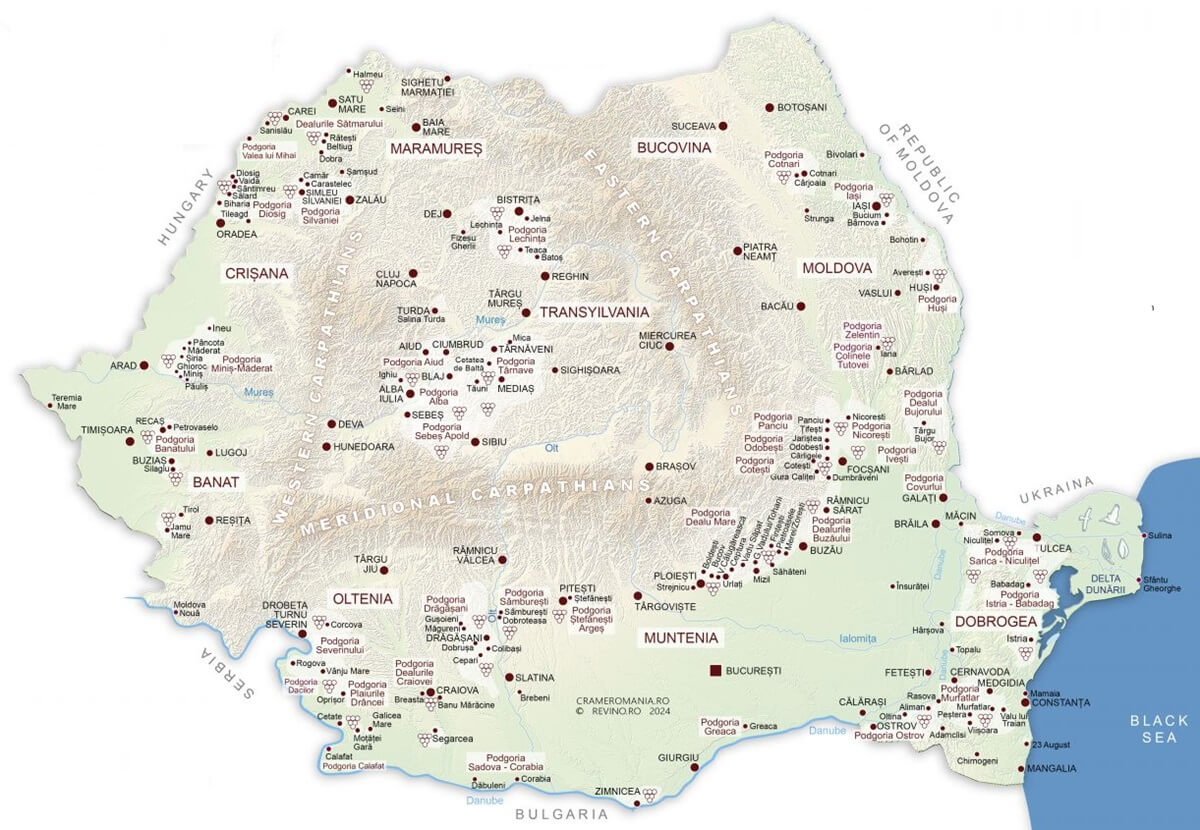
Romania has eight major wine regions, each with its own terroir and unique climatic influences and, 41 major vineyards, which are grouping together dozens of wine-growing centres. Each vineyard is distinguished by its own oenological profile. The grape varieties cultivated in these wine-growing areas reflect the geographical and climatic profile, of the region.
Roménia, principais regiões vinícolas e vinhas | |
|---|---|
| Região vinícola | Principais Vinhas (Podgória) |
| Dealurile Moldávia Região da Moldávia Colinas |
Colinele Tutovei, Cotnari, Cotesti, Covurlui, Dealul Bujorului, Huși, Iași, Ivești, Nicorești, Odobesti, Panciu, Zeletin. |
| Colinele Dobrogei Colinas da região de Dobrogea | Ístria-Babadag, Murfatlar, Sarică-Niculițel. |
| Terasele Dunarii Terraços do rio Danúbio | Aliman, Băneasa, Greaca, Oltina, Ostrov. |
| Nisipurile Sudului Areias do sul da Romênia | Calafat, Dacilor, Sadova-Corabia |
| Dealurile Olteniei si Munteniei Região de Munténia e Oltenia Colinas |
Dealu Mare, Dealurile Buzăului, Dealurile Craiovei, Drăgășani, Plaiurile Drancei, Sâmburești, Severin, Ștefanești. |
| Dealurile Banatului Região de Banat Colinas | Dealurile Banatului - Recaş e Teremia |
| Dealurile Crisanei si Maramuresului Colinas Crișana e Maramureș | Diosig, Miniș-Maderat, Silvaniei, Valea lui Mihai. |
| Podisul Transilvaniei o planalto da Transilvânia Trem | Aiud, Alba, Lechința, Sebeș-Apold, Târnave. |
Vinhos pouco conhecidos da Romênia
O clima e o solo da Roménia são propícios à produção de muitos tipos diferentes de vinhos,
desde brancos secos e brilhantes até vermelhos ricos, aromáticos e arroxeados.
As variedades de uvas nacionais populares usadas para a produção de vinho incluem:
Băbească, Cadarca, Fetească Albă, Fetească Neagră, Frâncuşă, Tămâioasă.
Francês – A very versatile soft, dry wine, crisp and lively,
with just the slightest touch of sweetness.
Fetească Albă – Vinho branco meio seco, bem equilibrado,
com um aroma distinto que lembra a primeira floração da vinha.
Tămâioasă Romanească - Um vinho branco naturalmente doce ou meio doce
com aromas sutis de mel e manjericão, uma cor âmbar requintada e um sabor rico e persistente.
Seu sabor doce também pode sugerir uma mistura de pétalas de rosa e frutos silvestres.
Grama de Cotnari – Um vinho branco naturalmente doce com uma fragrância delicada
e uma interação suave de frutado e acidez.
Galbenă de Odobeşti – A light white wine with a delicate bouquet
that preserves the fragrance of the mellow grape.
Fetească Neagră – Vinho tinto meio doce, de corpo médio, leve, com aromas originais.
Băbească Neagră – Vinho tinto tradicional, encorpado, com bouquet delicado e leve sabor de cravo.
Cadarça - this red, native variety , displaying a ruby-red color with a stinging taste of fresh clove,
was the wine of the imperial court of Vienna during the reign of Emperor Franz Josef, in the 18th century.
>
Other natives grapes used for vinification include
Babeasca Gri, Codana, Galbena Neagră, Galbena de Odobesti, Remus, Zghihara de Huși.
A Roménia também produz a sua quota de colheitas mundiais,
incluindo Riesling, Merlot, Sauvignon Blanc, Cabernet Sauvignon, Chardonnay e Muscat Ottonel.
For the traveler interested in adding viniculture to his or her cultural itinerary, a trip to Romania offers many opportunities to visit wine-producing regions and to discover and sample the many different wines of Romania, from little-known local and regional wines to Romania's great wine labels, such as Murfatlar, Cotnari, Jidvei, Dealu Mare e Odobeşti.
...
As maiores vinícolas da Romênia
Jidvei
Cramele Jidvei
A região do vale de Târnava, na Transilvânia, é conhecida pelos seus excelentes vinhos brancos secos.
Vinícola Jidvei oferece degustações do século XVI
Castelo de Bethlen
na aldeia Cetatea de Baltă.
Herdade Segarcea
Domeniul Coroanei - Segarcea
Located 150 miles southwest of Bucharest, Segarcea winery is known for its high quality
Cabernet Sauvignon, Merlot, Sauvignon Blanc, Fetească Albă and Italian Riesling wines.
Segarcea Estate may be the only wineyard in the world which produces
the "Tămâioasă Roză" (Mascate Rosa)
- um vinho rosé fino e seco com um aroma delicado a cascas cristalizadas de laranja e toranja.
Outras variedades de uvas nacionais cultivadas nos vinhedos de Segarcea incluem:
Novac, Negru de Drăgăşani, Fetească Neagră, Tămâioasă Albă Românească, Fetească Albă, Crâmpoşie.
Murfatlar
Podgoria Murfatlar - Crama Statiunea Murfatlar
Murfatlar is the largest and one of the best known Romanian vineyards, located 12 miles west of the Black Sea coast.
Over 300 days of sunshine, along with cool breezes from the sea, make this area ideal for the production of sweet dessert wines,
such as late harvest Chardonnay, Pinot Gris and Muscat Ottonel.
Soft, rich red wines are also produced here - Cabernet Sauvignon and Pinot Noir being the most popular.
Cotnari
Cramele Cotnari
A Vinícola Cotnari é mundialmente conhecida pelos deliciosos vinhos brancos doces feitos de uvas
rico em açúcar e colhido no final do outono, após as primeiras geadas, como Grama de Cotnari, a noble aromatic wine with a nutlike savor.
The quality of these wines relies on a combination of rich soil, the late harvest and the presence of a special mold (Botritis cinerea).
The vineyards have a long history, spanning over seven centuries, dating from the mid-1400s.
The winery's most popular wines include Francês (seco), Fetească Albă (semidoce) -
muito apreciado por preservar o sabor e a frescura da uva; e o doce e dourado Grama de Cotnari,
um vinho nobre e aromático com sabor a nozes e Tămâioasă.
Cramele Odobesti
Odobesti é um dos maiores e mais antigos vinhedos da Romênia. Seu produto mais famoso é Galbenă de Odobeşti, a light white wine with a delicate bouquet that preserves the fragrance of the mellow grape. The wide variety of wines produced by the Odobesti includes five traditional sorts of Romanian wine, namely: Galbenă de Odobeşti, Plavaie, Fetească Albă e Fetească Regală (vinhos brancos) e Băbească Neagră (vinho tinto).
O Miniş - Maderat
Cramele Minis
Estendendo-se pelas colinas do oeste da Romênia (Crişana), entre Lipova e Pancota, produz a variedade vermelha, nativa Cadarça,
displaying a ruby-red color with a stinging taste of fresh clove.
During the reign of Emperor Franz Josef, in the 18th century, Cadarcă served as the wine of the imperial court of Vienna.
In 1862, at a wine contest in London, Rosu de Miniş (Red Miniş) recebeu o primeiro prêmio.
Pinot Noir, Merlot, Cabernet Sauvignon, Cabernet Franc e Cadarça are produced employing classical winemaking technologies,
while the white wines like Italian Riesling, Traminer, Pinot Gris and Sauvignon Blanc, are obtained by using cooling zymurgy,
resulting in fruity white wines of great finesse.
Recapitulação
Cramele Recas
18 milhas a leste da cidade de Timisoara fica a vinha de Recapitulação,
com uma história que remonta ao século XV. Alguns dos vinhos premiados produzidos aqui incluem Riesling italiano,
Fetească Regală, Mascate Ottonel/Fetească Regală, Sauvignon Blanc (white wines); Cabernet Sauvignon, Merlot, Pinot Noir/Merlot (red wines).
...
Vinhos desconhecidos da Romênia
Notas de viagem de Thibaut ASSO
“Neste país tudo é possível, mas ao mesmo tempo tudo é impossível”. Recentemente eu estava lendo um artigo de Gisela Williams sobre a Roménia e este ditado romeno chamou-me a atenção.
Estive uma vez, em 1996, neste país localizado na intersecção da Europa Central e do Sul, na fronteira com o Mar Negro. It still remains one of my most amazing trips even though the infrastructure was not nearly as good as it is now. At the time I was only able to taste the Tuica, uma bebida espirituosa local (50% de álcool) feita de ameixa. Só em 2012 é que tive a oportunidade de descobrir o vinho deste país.
Romania and wine started their common history 4000 years ago (2000 BC) when the Greeks arrived from the Black Sea, making it one of the world's oldest viticulture regions (in comparison the Greeks introduced wine in France around the 6th century BC and it was further developed during the Roman time).
O vinho romeno tem visto muita história, desde a lenda do Dionísio (o deus do vinho para os trácios, também conhecido como Baco) para filoxera em 1880 (uma doença da videira que destruiu a maioria dos vinhedos da Europa) e a era comunista (nacionalização das vinícolas)… mas o vinho romeno ganhou uma segunda juventude no final da década de 1990, quando as vinícolas foram privatizadas.
Hoje a Roménia está entre os 10 principais países do mundo no que diz respeito à área cultivada com vinha e produção de vinho. Existem 7 regiões vinícolas demarcadas: Transilvânia (centro do país), Moldávia (leste), Crisana (noroeste), Munténia e Olténia (sul), Banato(oeste), Areias do Sul e Terraços do Danúbio (sul) e Dobrogea (south east); each of them containing a number of sub regions.
Mistura de uma longa história vinícola, os indígenas (Feteasca Negra, Babeasca Neagra) and the newly imported grapes (Chardonnay, Merlot …) along with modern winemaking technology and passionate winemakers make Romanian wine very attractive. However, it is still not yet well known by the wine drinker and, unfortunately, Romanian wine is not yet easy to find at your local wine store.
Nossa primeira parada de vinhos será no sul da Romênia, no Olténia com o vinho de região Domeniul Coroanei Segarcea. Esta adega produz vinho numa antiga propriedade real localizada perto da cidade de Segarcea. It presents the advantage of having a long wine history, the kings were actually producing wine in the same exact area, King Carol I first set up the vineyard in 1884. Furthermore it is located in the same latitude as the Bordeaux, Burgundy and Piedmont wine areas.
Em 2002 Cornélia Mihai Anghel e família, assumiram o patrimônio
empregando muito trabalho, paixão e, claro, investimento financeiro para restaurar a vinícola e atualizar para a tecnologia mais recente.
Fruto da combinação de tradição, terroir excepcional e tecnologia
eles saíram com o Mínima Morália linha de vinho.
Deixe-me dizer, eu absolutamente adoro os vinhos do Mínima Morália vinho.
When I look at a bottle I am always interested in the label, as this is the first thing you see in a wine store. Each type of wine has a face of a person in black and white, and each wine is named after a value that humanity was built upon: Esperança, Gratidão, Respeito, Devoção, Honestidade e Honra.
Se eu tiver que destacar apenas um de seus vinhos, seria o Mínima Moralia Honestidade. Esta é uma mistura de Viognier e Tamâioasă Românească, de cor amarelo dourado e aroma de mel da uva indígena e sabor de damasco da Viognier, definitely an elegant, refreshing wine. This is a perfect ambassador for Romanian wine and shows what Romanian white wine can be.
Estamos hospedados na mesma vinícola Domeniul Coroanei Segarcea mas com uma linha diferente de vinhos. Como referi anteriormente, a propriedade foi estabelecida pelo rei da Roménia e produz sempre um vinho de boa qualidade. Naturalmente, desde 1947 e a abdicação do Rei Miguel I, este país já não é uma monarquia. No entanto, após o início dos anos 90 e o fim da era comunista, Sua Alteza Real a Princesa Margarida da Romênia voltou para sua terra e tornou-se embaixador do renascimento cultural do país. Como homenagem a ela, a adega decidiu produzir uma linha especial de vinho Príncipe Margareta. O vinho branco é uma mistura de Chardonnay, Pinot Gris e Viognier, com ligeiras alterações na proporção dependendo da safra, mas Viognier continua sendo a uva principal. Este vinho branco complexo apresenta sabores de baunilha e ameixa com bouquet floral.
From the South "west" of the country, we are now going East to the center of the Dobrogea plateau. People have been growing vines and producing wine in this area for centuries. The Greeks and the Romans developed wine production in this part of Romania. Over the years various types of grapes have been planted in this area. This is where the Podgoria Mulfatlar (vinha) está localizada, cobrindo 3.000 ha em 4 aldeias. A vinícola tem uma longa tradição de vinificação, e produz diversas linhas de vinhos, cada uma delas para um segmento específico do mercado. O Trei Hectare A coleção me chamou a atenção. Esta linha reserva é dedicada ao apreciador e devo dizer que gostei do Chardonnay. O rótulo é atraente e o buquê floral e o rico aroma de frutas são deliciosos.
Para o próximo vinho iremos para o norte, para a região da Moldávia. Senador é uma vinícola que produz mais de 20 tipos de vinhos diferentes, todos divididos em diferentes gamas de vinhos. Um deles Monser é dedicado ao vinho feito exclusivamente com uvas indígenas (variedade de videira romena pura: Feteasca Neagra, Babeasca Neagra, Cadarca, Babeasca Gri, Zghihara, Feteasca Regala, Feteasca Alba, Sarba, Tamaioasa Romaneasca e Busuioaca de Bohotin), o pré filoxera grapes. This line provides a very good understanding of what the Romanian wine were before the 1900s. Of course since the 1990s and the privatization of the vineyard, the latest technology has been used for production, but this is still a fair ambassador of the taste of the past, of the Belle époque romena (reforçado pela observação no rótulo): "Soiuri pure romanesti pentru boieri si obrazuri subtiri" que significa: "Variedades romenas puras para bochechas burguesas e finas". O Sarbă é o nome de um dos vinhos, mas também o nome da uva utilizada. Esta é uma espécie de mistura entre Riesling e Mascate uvas. Não é um vinho doce, mas se você é fã de Riesling, você vai gostar: bouquet floral, frutas exóticas e um toque de manjericão (uma particularidade deste tipo de uva).
When I think about Romanian wine, I go directly for white, as in my opinion they can easily compete with white wines from other parts of the world. They are elegant, have flavor and are well done in general. The reds are different and I have mixed reviews for them. They are nice but need to open up a while before you start to drink them. Here are some wineries I have discovered with great potential.
Estamos agora a explorar o lado oeste do país na secção romena do Banato . As pessoas produzem vinho aqui desde a época romana e a lenda diz que Baco passou a infância aqui. Perto da cidade de Timisoara você encontrará o Recapitulações vinha.
Esta zona já era conhecida pela produção de vinho em 1447 e é onde Cramele Recas winery is located. Since the beginning of 21st century, this winery has been modernized and the vineyard replanted in order to increase production and control the quality of the wine. Similar to other Romanian wineries they produce a large range of wines, each brand according to their specific target in order to cover the entire market. Of course I was mainly interested in the Selo Exclusivo e fiquei agradavelmente surpreso com o Paparuda Rezerva Cabernet Sauvignon. Como mencionado anteriormente, você precisa dar algum tempo para o vinho se abrir, então começará a ter toda a expressão do vinho com algum sabor de framboesa entre outros.
Os vinhos da Roménia estão a aumentar a sua reputação na Europa, principalmente em Alemanha, provavelmente uma das razões pelas quais Reh-Kendermann GMBH vinícola em Bingen (oeste de Frankfurt na Alemanha) decidiu estabelecer uma propriedade neste país em 1994. Provavelmente também é por isso Alemanha é hoje o maior mercado de exportação do vinho romeno.
Nossa próxima parada está localizada no sudoeste do país, no Olténia , mais precisamente na aldeia de Opressor no condado de Mehedinti. A vinha aqui foi replantada em 2001 para substituir as vinhas velhas. O Carl Reh – Crama Oprisor winery here has 8 separates labels. Of course I would have loved to enjoy the entire range of their wines, but they were not all available at the tasting. My main discovery from this winery was the La Cetate Cabernet Sauvignon. Aged for 12 months in French oak barrel (the ambassador of the winery mentioned that they had tried the American oak but it didn't match the style of the wine they were looking to produce), you will find some light coffee and strong black currant flavor.
Senador produz vinho em 4 principais áreas vitivinícolas da Romênia: Husi, Insuratei, Vrancea (all three areas being located on the East side of the country) and Tirol (west side of the country). As I was explaining previously they produce over 20 types of wine, under different brand names. The Coleção Particular do Senador was created to display their best wine. For the winemaker, the best way to evoke their best expression was to blend the different type of grapes. The Red wine from the private collection is a blend between Merlot (60%), Cabernet Sauvignon and some local grapes such as the Feteasca Neagra. Violet flavor and red fruit flavors are the particularity of this wine.
Para o último vinho ao qual vamos voltar Podgoria Murfatlar. This large winery represents 33% of the Romanian wine market, mainly because they offer a wide range of product. Over the years they have invested over 50 million euro in renovation, innovation and have created several labels to cover the need of each market segment, even the niche markets, such as hotels and restaurants. For the red wine I paid particular attention to their latest wine: Murfatlar M1 Syrah Semi-Seco. Do rótulo ao sabor esta é definitivamente uma garrafa que irá causar uma reação, boa ou má, a escolha é sua, mas honestamente é uma surpresa feliz. Esta não é a expressão típica do Syrah, you will find the flavor to be light with a hint of red berries.
Para finalizar vamos voltar ao
Domeniul Coroanei vinícola,
na cidade de Segarcea.
One of the particularities of the estate is that it is split in the middle by the railroad of the royal train.
This gave the owner the idea to create a brand named
Trem Azul.
O Trem Azul era o nome do trem dos reis, transportando-os para suas funções ao longo do século XX.
Fiz duas degustações no mesmo dia do
Trem Azul Feteasca Neagra
and I have to say my first impression was not very good.
Somehow my opinion improved with the second glass (both were from different bottles).
But the last one was very good and I really enjoyed the black currant flavor of this delicious wine.
Se você encontrar algum desses vinhos em uma loja ou carta de vinhos, com certeza deveria escolher um. Você ficará agradavelmente surpreso. No momento, eles ainda são difíceis de encontrar, mas espero que isso mude em breve.
...