

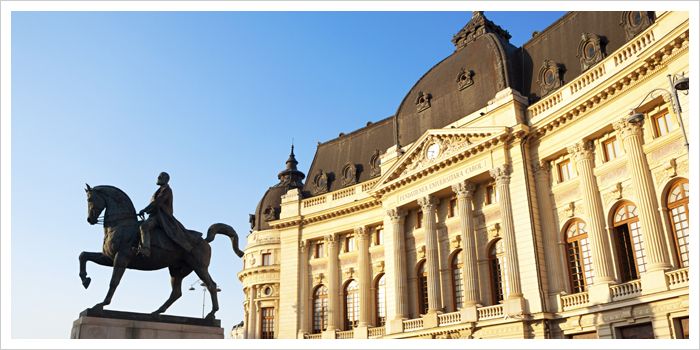
DURANTE una semana entera, las tormentas saturaron Bucarest. En el primer día de relevo, guardé mi equipo para el mal tiempo, me uní a los jóvenes rumanos vestidos elegantemente que acababan de llegar a Calea Victoriei, la arteria principal de la ciudad, y me dispuse a disfrutar del cofre del tesoro arquitectónico que es la capital rumana.
As the sun burned through the clouds that fall afternoon, the city's cultural influences - outlined in the worn neo-Classical, Art Nouveau and blocky Communist-era structures - were revealed. Within these old buildings, many of them recently renovated, stores like Max Mara and Escada are continually sprouting, helping to transform Bucharest's image as Communist hangover to that of a steadily modernizing city hoping to be the capital of a European Union nation as early as January 2007.
It was hard to believe that I was standing at the former nexus of an ironfisted regime that in the 1980's was arguably closer to North Korea's brand of Communism than to the Eastern Bloc's. Less difficult to imagine was Bucharest's earlier history, dating back to the turn of the 20th century when the city was known as the Paris of the East because of its affection for everything French - from food to fashion to architecture.
Now Bucharest is redefining itself again, and in the process, it is fast becoming an intriguing alternative destination in Europe. In the last year alone, there has been a 24 percent increase in tourism from the United States, according to the national tourist office in New York. And though the city has a ways to go before its rough edges are smoothed out, the anticipation of what the future might bring is palpable.
This impression could be said to exist to a lesser extent all over Eastern Europe. But this isn't Pragueor Budapest. Bucharest is deep in the Balkans and the end of Communism wasn't facilitated by a velvet revolution. When Nicolae Ceausescu, Romania's megalomaniacal dictator, was ousted in 1989, the cost was around 1,000 lives. The dictator himself was hunted down and shot.
Perhaps no place in Bucharest, population 2.1 million, represents the hope of what change may bring than the city's historic center: a mostly neglected collection of streets in an area of town long overdue for a revitalization plan that will be carried out by the end of 2006, according to Bucharest's mayor, Adriean Videanu. It is known locally as Lipscani because Lipscani Street, its east-west axis, acts as its anchor. Some Romanians call the area the Lipscani ruins.
Yet, the center - which was established in the 15th century by Vlad (the Impaler) Tepes, who is thought to have been the inspiration for Bram Stoker's Dracula - is the site of many marquee attractions. These include the stone-columned remains of the 15th-century Prince's Palace and Stavropoleos Church, which was built in 1724 by a Greek monk in the Byzantine style.
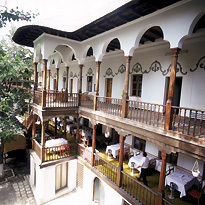
In the southeast corner of this historic area, Manuc's Inn was built around 1808 to serve merchants on the trade route between the Ottoman Empire and Europe. Today, inside its courtyard - complete with encircling wooden balconies - a functioning hotel, restaurant and wine cellar still seem primed to play host to rowdies and prostitutes.
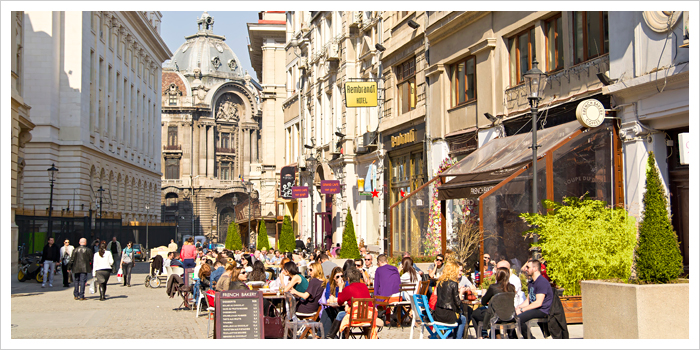
As I turned into Lipscani from Calea Victoriei, women in high heels hurried across the avenue just ahead of notoriously wild Romanian drivers. It was now dusk. Streetlights flickered to life and the keepers of a corner shop selling the last of its fresh Romanian pretzels called covrigi pulled the metal-wire guard over the window. Even with the crumbling facades of the former town houses, bistros and banks, it wasn't difficult to imagine how the pedestrian-only district, pre-Ceausescu, could, given the resources, become the city's tourist engine.
At a cafe, Françoise Pamfil, an architect and lecturer at the Ion Mincu University of Architecture and Urbanism, told me: "During Ceausescu's time, people started not to care about public spaces. If it wasn't yours, and it was shared, it looked awful. If you extend that thinking, you can see how people forgot to celebrate public places. It's a deep wound."
But with a smattering of new restaurants and boutiques, it would seem that the wound is healing. On the wall of the Amsterdam Grand Cafe, a restaurant and bar with a cosmopolitan feel, a poster read "YES to Revitalization of the historic center. NO to Isolation." As I ate tortellini formaggio, served with ham and Parmesan, a chorus of languages filled the dining room. Upstairs, a tango lesson was in full swing.
"No sólo creo que Bucarest esté en ascenso, lo veo todos los días", dijo Jerry van Schaik, el director general del café. "Hay un gran revuelo en la ciudad: la gente inicia negocios, la construcción está en auge, se toman iniciativas clandestinas".
Otro comensal, Mark Nava, un guionista estadounidense, se mostró igualmente entusiasmado.
"Ha sido realmente genial ver cómo ha cambiado este lugar", dijo Nava, que ha vivido en Rumania - un lugar cada vez más popular para los cineastas ("Cold Mountain", sobre todo) - desde 1998. "Hay una atmósfera bohemia del Moulin Rouge: puedes sentir los fantasmas y el romance".
Later, at an outdoor beer garden called Terasa La Ruine, the Rolling Stones' "Emotional Rescue" spilled across Lipscani Street and young residents in Levis and D & G apparel mingled with tourists. As I drank a local Bergenbier for about 2 new lei (around 65 cents, at 3.12 new lei to the dollar), I was reminded of what Michael Guest, the United States ambassador to Romania from 2001 to 2004, had recently told me in an e-mail message about the historic center: "A number of us in the expatriate community felt that with the right combination of historic preservation, infrastructure development and marketing, Lipscani could become a tourism draw for Bucharest."
It may be that the real strength of Bucharest is in how much it pushes its visitors to understand it on its own terms. For all the places that claim the moniker of "the gateway to the East," it takes little more effort than opening an Atlas to see that geography - between the Occident and Orient - tugs at the fiber of Bucharest.
"Bucarest es la ciudad de referencia para la integración de las civilizaciones europea y oriental", me dijo el alcalde Videanu en otro mensaje de correo electrónico. "La capital actual es el centro de la reafirmación espiritual, cultural y política de un pueblo con viejos valores europeos".
Cuando le pregunté al Sr. Guest por qué un turista debería ir a Bucarest, su respuesta fue menos dramática. "De alguna manera, logra transmitir cierto exotismo", escribió, "pero sin parecer demasiado alejado de las normas de cualquier otra ciudad occidental".
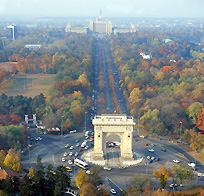
The next day I walked north of the city center along tranquil, tree-lined Soseaua Kiseleff Street, reminiscent of Paris and home to the city's mansion district. I passed through a 75-foot version of the Arc de Triomphe, erected in 1935, and made my way to two main, contrasting points of interest: the Village Museum and the Palace of Parliament.
A five-minute walk north of the arc is the outdoor Village Museum, which was established in 1936 to preserve a record of Romania's village life. It is an off-kilter, forested collection of more than 50 structures from different regions of the country, including Wallachia, Transylvania and Moldavia. Starting in 1935, many of the stone and wooden houses, workshops and churches were transported piece by piece to the site.
The Palace of Parliament, on the other hand, is a place that defines the darkest days for Bucharest, and is, in every way, the biggest attraction in town. Construction began in 1984 on the project, which is generally called the People's Palace and overflows with marble, crystal and lavishly furnished rooms. It is, at more than 3.7 million square feet, the world's second largest office building (after the Pentagon) and dovetails with both the downfall of the Ceausescu regime and the destruction of some of the oldest areas of town - almost 1,000 acres, an area bigger than Central Park - with thousands of homes razed for the monolith.
During my 45-minute guided tour of the palace (in which I saw roughly 5 percent of the building and its 1,000 rooms), I was told that the people of Bucharest starved while Ceausescu spent billions on a structure he never got to enjoy. Meant to be a living monument to the dictator, it was never truly completed.
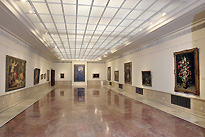
Back in the city center that afternoon, I decided to see how much I could do in one night for $40. My first stop was the National Art Museum, where a traveling exhibition called "Ombre et Lumières" from several French museums was in its last days in Romania. Housed in the 19th-century Royal Palace, the museum displays thousands of pieces by Romanians and masters like Rubens, Rembrandt and Monet.
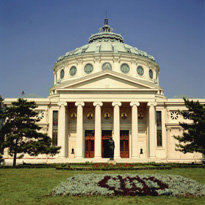
El Ateneo Rumano, sede de la Orquesta Filarmónica de George Enescu desde 1888, fue el siguiente. Dentro de esta magnífica sala de conciertos, con su interior de mármol arremolinado y un fresco gigante que representa la historia de Rumania, asistí a un concierto de Strauss, Bach, Mozart y Brahms.
With about $30 left, I dined at Restaurant Balthazar, which combines French and Asian cuisines. It is wedged into a beautiful old villa and is a favorite of diplomats and the jet set. After a dinner of duck with caramelized pineapple and wild berry sauce, and a glass of Cotes du Rhône, I had $10 left, and set off for Green Hours 22 Club Jazz Cafe, for some music and a trio of dark Silva beers.
Eso me dejó con suficientes lei para tomar una copa en Laptaria Enache, un bar en lo alto del Teatro Nacional. El bar y su vecino de la azotea, La Motor, se llenaron de estudiantes universitarios, artistas, músicos y jóvenes profesionales.
I wandered back onto Calea Victoriei just as the night seemed to be revving up: neon lights backlit hip young crowds and French-inspired Belle Époque buildings. A convoy with a Porsche Cayenne, a BMW X5 and a Mercedes S600 roared past Revolution Square, where Ceausescu was booed off the balcony of the Central Committee of the Communist Party building in 1989.
Apretujado entre andamios y multitudes de fiesta en aceras temporales de madera, me vino a la mente una frase que había escuchado una y otra vez al describir Bucarest: "Europa como solía ser". En ese momento, una ciudad europea en ciernes parecía más apropiada.
COMO LLEGAR
Muchas compañías aéreas van a Bucarest desde Estados Unidos pasando por otras ciudades europeas, pero no sin escalas. A mediados de diciembre, una búsqueda en Internet encontró tarifas para mediados de enero a partir de $566.
DONDE ALOJARSE
Los códigos de marcación son 40 para Rumania y 21 para Bucarest.
El Hotel Rembrandt, in the historic center at 11 Smardan Street, 313-9315, www.rembrandt.ro, has 15 homey rooms - leather armchairs and Tiffany-style desk lamps - that, with tax, range from 85 to 135 euros (about $102 to $162, at $1.20 to the euro). High-speed Internet, a bar and bistro, and 24-hour room service are among the amenities.
Con vista a la Plaza de la Revolución, Athénée Palace Hilton, 1-3 Calle Episcopiei, es la gran dama de los hoteles de Bucarest. Construido en 1914, el hotel está revestido de mármol, cuenta con 272 habitaciones que oscilan entre 340 y 830 euros, cinco restaurantes, Internet inalámbrico y un gimnasio. Información: 303-3777; www.hilton.com.
DONDE COMER
Gran Café de Ámsterdam, 6 Covaci Street, 313-7581, sirve de todo, desde quesadillas hasta pollo satay, y tiene una variada carta de vinos. Una comida para dos, con bebidas, cuesta alrededor de $25.
Baltasar, 2 Dumbrava Rosie, 212-1460, ofrece almuerzos y cenas de inspiración francesa-asiática y es un ejemplo perfecto de cuánta calidad se puede obtener en Bucarest por casi nada. La cena con vino me costó menos de 15 dólares.
QUÉ VER Y HACER
El Museo del Pueblo, en el norte de Bucarest en 28-30 Soseaua Kiseleff, muestra la bucólica historia de Rumania con 50 casas, tiendas e iglesias de todo el país. Abierto de martes a domingo. La entrada cuesta 5 nuevos lei. Información: 222-9110, www.muzeul-satului.ro.
El Palacio del Parlamento, 1 Calea 13 Septembrie, 311-3611, considerado un error catastrófico tanto desde la perspectiva de la arquitectura como del tejido social, de alguna manera se ha convertido en un motivo de fanfarronería en lugar de un monumento a un dictador con mano de hierro. Abierto todos los días; 20 leus nuevos.
Ubicado dentro del Palacio Real en 49-53 Calea Victoriei, el Museo Nacional de Arte está lleno de grandes obras de artistas como Rubens, Monet, Rembrandt y El Greco. Está abierto de miércoles a domingo y la entrada cuesta 12 nuevos lei. Información: 314-8119 y en línea en art.museum.ro/museum.html.
Cristian Florea corre CRIF Tours, 444-0164, www.discoverromania.ro, y guía a individuos y grupos a través de Bucarest o cualquier otro lugar de Rumania. Habla muy bien inglés y conoce bien la historia de Rumania.
Para obtener más información sobre Bucarest, visite:RumaniaTourism.com/Bucharest.html
Lea más artículos sobre Rumania en RumaniaTourism.com/Romania-in-the-Press.html