El camino a Miklosvar parece casi diseñado para mantener alejados a los visitantes. Cualquiera que desee llegar a este pueblo en lo profundo del centro de Rumania debe enfrentar baches y grava que golpean los huesos de los pasajeros incluso en los vehículos más lujosos.
Miklosvar sigue siendo un retroceso.
The reward for enduring the three- to four-hour trip from Bucharest is a part of Transylvania that appears to have changed little over the last century. Farmhouses, adorned with outsized, ornate wooden gateways, hug cobblestone and dirt roads. In nearby fields, men and women cut hay with scythes. Traffic, for the want of a better word, consists of horses and carts passing by once in a while.
Andrew Testa para el New York Times
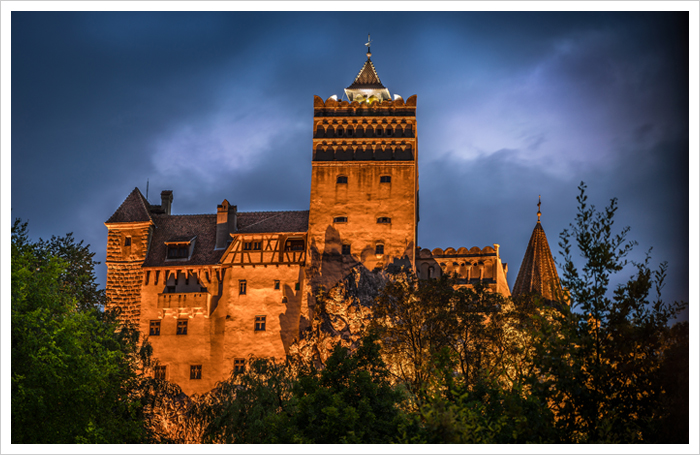
Para la mayoría de las personas, sin embargo, la idea de Transilvania evoca imágenes de "Drácula" de Bram Stoker y, según todas las apariencias, Miklosvar parece bien calificado como telón de fondo apropiado. mientras Castillo de Bran, la imponente fortaleza más estrechamente asociada con Vlad el Empalador, está a 41 millas de distancia, Miklosvar ofrece una mansión desierta con castillo, murciélagos que vuelan por las calles oscuras por la noche e incluso un conde encantador que habla en un inglés con un ligero acento.
Pero estas no son las razones por las que dicho conde, el hombre responsable de traer a la mayoría de los forasteros allí, le haría visitar.
For the last decade, Count Tibor Kalnoky, a former veterinarian and ornithologist, has been working to turn this village on the eastern edge of Transylvania — the Hungarian-speaking region in central Romania — as well as the surrounding woodland into an environmental retreat and a preserve of the region's architectural heritage.
Descendants of the feudal overlords of the area, whose roots there date back as far as 1252, Count Kalnoky and his family run a company that provides tours and accommodations for up to 20 guests in four farmhouses in Miklosvar. The money raised from Count Kalnoky's Estate, as his company is known, goes toward restoring the humble steep-roofed buildings in the village as well as two of the family's ancestral homes (one in Miklosvar and another nearby).
La empresa también está comprometida con la promoción y protección de la vida silvestre local. Está presionando para que el bosque detrás del pueblo, hogar de aves tan raras como el águila moteada, las cigüeñas negras y los pájaros carpinteros de lomo blanco, esté protegido por la legislación rumana y europea.
Los huéspedes se alojan en una de las cuatro casas de campo, todas las cuales han sido restauradas durante la última década.
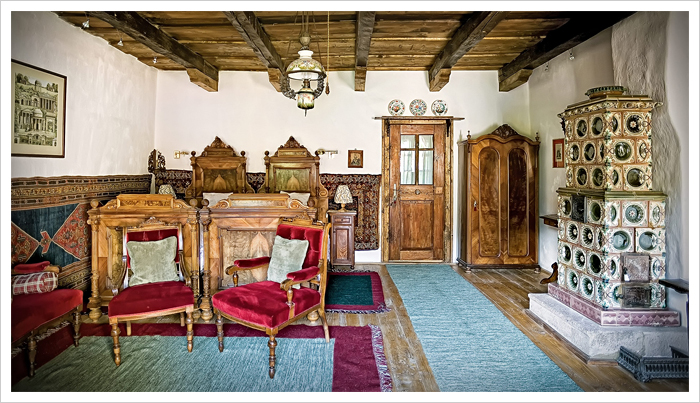
The 19th-century main guesthouse, or Upper House, has two stories and a cellar. Drinks are served in a drawing room with high-backed armchairs and a table covered in embroidered white cloth. At one end of the room stands a fireplace with a band of blue and white tiles that bear the Kalnoky crest. Meals are served in the cellar on a long wooden table in front of an open fire.
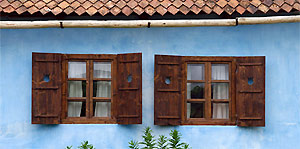
En un camino se encuentra otra casa de huéspedes, antigua vivienda de siervos. Es mucho más sencillo, pintado de azul claro (el color de las casas de siervos o trabajadores en condiciones de servidumbre) y con canalones de madera que cuelgan del tejado.
Las otras dos casas de huéspedes están a cinco minutos a pie y se enfrentan entre sí a través de un patio cerrado.
The family's former hunting manor, which combines Renaissance, Baroque and neo-Classical architecture, is the most ambitious restoration project, and lies empty at the northern end of the village in its own park. During Communist times, it was used as the village's main meeting hall and fell into neglect. Now it is open to visitors as the Kalnokys restore the stonework and frescoes on the outside walls.
While many villages in this region share this heritage, what makes Miklosvar different is that it has retained much of its original population. The villagers still make their livings almost exclusively from the land. Visitors can set out to track bears or wolves, visit bat-filled caves, walk through primeval forests and return each evening to the comfort of farmhouses with open fires and antique furniture, and eat rich local dishes like goulash with caraway seeds and sour cream.
Nearby there are numerous castles, former manors and fortified medieval churches to visit as well as crumbling Saxon villages, home to members of Romania's ethnic German minority for 800 years until most emigrated to Germany after the collapse of Communism. The beauty of this area and the Kalnokys' restoration work have attracted interest from both architecture and wildlife enthusiasts, including Prince Charles, who is involved in a similar environmental and restoration program in Viscri, a nearby Saxon village.
The creation of Miklosvar as a rural retreat began some 19 years ago. The collapse of the Berlin Wall a year later and a revolution in Romania paved the way for people to reclaim property seized by the state. By 1997, Count Kalnoky had regained Korospatak, the former family home. He then started building up neighboring Miklosvar.
"It's my answer to globalization, if you like," said Count Kalnoky, 39.
"Fue como si lo hubieran arrojado a un congelador", dijo sobre la zona de Miklosvar cuando la encontró, y así es como le gustaría conservarla.
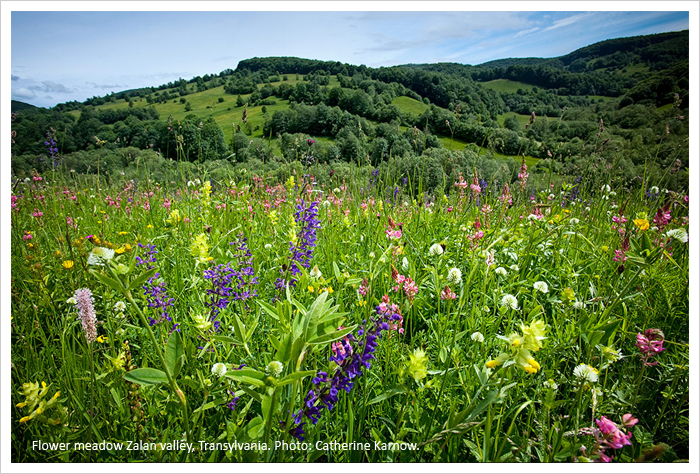
In late May, a short trip on top of a hay cart drawn by two horses brought the count and two guests to the woods overlooking the village. Over the next two hours, our guide, Gabor Tompos, led us on foot through thick grass to a burrow dug out by bears for hibernation. The paths were littered with wild orchids. Overhead, we spotted a large eagle's nest in a birch tree.
Back in one of the guesthouses, we sank into armchairs, surrounded by antique oak, walnut and pine furniture, the kinds of items the family says would until recently have either been thrown away or used as firewood. Heavy eiderdown-filled bedcovers, crisp white sheets and traditional wool-filled mattresses would ensure a deep sleep that night.
Just as Miklosvar has remained largely unscathed by modern progress, it has also remained poor. Even while urban areas in Romania experience sharp growth as it prepares to join the European Union in next January, the accompanying wealth eludes many rural areas. And so Kalnoky appears to have given at least some in the village a renewed sense of pride and purpose as foreigners flock there.
But there is an odd feeling, too, of a hint of a return to a feudal order. Villagers refer to the Western-educated veterinarian as "the count" (guests usually call him Tibor). The kitchen staff and housemaids wear traditional dress, and linguistic barriers mean there is little communication between the visitors and the employees or villagers.
Miklos Cserei, que dirige un pequeño bar cerca de la granja principal de los Kalnoky, donde las paredes estaban decoradas con un calendario descolorido de Cindy Crawford y un cartel de J. R. de "Dallas", recuerda la aprensión de muchos aldeanos cuando el conde recuperó su propiedad.
"I think the older people were afraid," Mr. Cserei said. "They could still remember stories when people here were peasants who worked for the count." He said that some of those fears subsided when the count gave gift packages to the elderly at Christmas, a tradition he has kept up ever since.
Sin embargo, de alguna manera, incluso el propio Conde Kalnoky ve a su familia cumpliendo el papel que desempeñaron sus antepasados antes que ellos.
"El valor real de la aristocracia es algo que me gustaría profundizar aquí", dijo. "Un sentido de responsabilidad hacia el lugar y la gente aquí".
INFORMACIÓN DEL VISITANTE
La forma más directa de Miklósvár is to fly to Bucharest and drive, or be picked up at the airport by Conde Kalnoky personal.
También hay trenes regulares entre Bucarest y Brasov, donde el personal de Kalnoky también recibe a los visitantes.
Si bien las habitaciones son cómodas, prepárate para vivir al aire libre. Un impermeable, un suéter y zapatos para exteriores son esenciales. El castillo está abierto todo el año, por lo que es posible pasar unas vacaciones de invierno, bajo una espesa nieve. (Los carros son reemplazados por trineos, pero todavía tirados por caballos).
No hay ningún otro lugar para comer cerca, a menos que quieras hacer el viaje de 30 minutos hacia el sur hasta Braşov, por lo que probablemente sea mejor optar por el paquete de una semana que ofrece Finca del Conde Kalnoky (40-742202-586, www.transylvaniancastle.com) que incluye tours, actividades y pensión completa con vino.
Hay mucho que hacer en el pueblo mismo. Dependiendo de la temporada, los visitantes pueden probar suerte en una variedad de actividades, como ordeñar una vaca, arar campos con un caballo, hornear pan e incluso ser herrero.
Sighisoara y Braşov, las dos ciudades principales de la región, son ricas en arquitectura medieval y renacentista. También existen numerosos sajón y pueblos Sekler (una subcultura húngara) para explorar. Viscri y Sáschiz son Unesco World Heritage Sites, cada uno con una iglesia fortificada y otras estructuras medievales.
Lea más artículos sobre Rumania en RumaniaTourism.com/Romania-in-the-Press.html