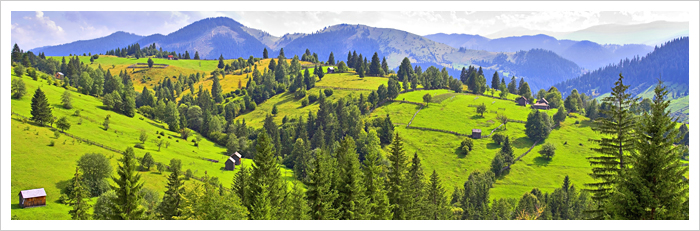
GURA HUMORULUI, RUMANIA — La región de Bucovina, en el extremo norte del país, escribió el erudito rumano Silviu Sanie, es "uno de esos reinos benditos donde los monumentos sagrados y seculares han enriquecido el encantador paisaje natural".
During a recent week's stay, I found this description remarkably apt.
Once the easternmost province of the Austro-Hungarian Empire, Bucovina ("land of beech trees") today straddles the border between Romania and Ukraine: northern Bucovina was annexed by the Soviet Union in 1940 and the region's historic capital, Chernivtsi (Czernowitz in German and Cernauti in Romanian) lies just 30 kilometers, or about 18 miles, north of the frontier.
The southern part, on the Romanian side, is a world of rolling farmland and steep forested hills, where antique villages and peasant culture coexist with new industry and modern construction. Horses and carts (and the occasional herd of cows) share the roads with SUVs, and intricately carved wood and other ornamentation still decorate many village homes and farmsteads.
Ejemplos excepcionales de un rico patrimonio religioso forman una parte importante de la mezcla.
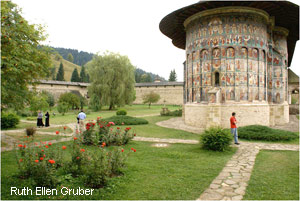
Aquí se encuentran los famosos monasterios pintados de Rumania, construidos en los siglos XV y XVI cuando la región, un bastión del cristianismo ortodoxo, estaba amenazada por los invasores otomanos.
Los frescos de colores vivos en sus paredes exteriores, obras maestras de la pintura bizantina, cuentan historias de santos y héroes y retratan en imágenes épicas la lucha cataclísmica entre el bien y el mal al final de los días.
Los monasterios se encuentran entre los tesoros culturales más famosos de Rumania. Incluidos en la lista de sitios del patrimonio mundial de la Unesco, atraen a un gran número de visitantes durante todo el año.
Here, too, however, are religious sites far less known and rarely visited that also form important components of the region's deeply rooted spiritual patrimony. These are the centuries-old Jewish cemeteries, whose weathered tombstones bear extraordinary carvings that meld folk motifs and religious iconography into evocative examples of faith expressed through art.
Estuve en Bucovina para realizar una investigación sobre el arte de las lápidas judías y pasé muchas horas fotografiando las lápidas ricamente esculpidas en los cementerios de Radauti, Siret y otras ciudades.
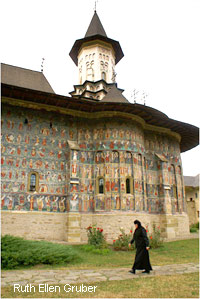
Pero, viajando en coche, también pude visitar casi media docena de monasterios pintados, todos ellos ubicados a poca distancia unos de otros.
Among them was Sucevita, a fortresslike complex in wooded hills that today is home to a monastic community of several dozen black-clad nuns. Protected by turreted defensive walls, it has a central church topped by an elegant steeple and covered with wonderfully bright paintings from 1602-04.
La sencilla iglesia de Arbore, construida en 1503, es de escala mucho menor. A la sombra de los árboles en un jardín apartado, presenta pinturas descoloridas pero poderosas del artista del siglo XVI Dragos Coman.
El fresco más famoso es un espléndido Juicio Final que se extiende a lo largo de la pared exterior trasera del Monasterio Voronet, a pocos kilómetros del pequeño pueblo maderero de Gura Humorului.
Here, in tones of russet, gold and a deep, rich blue, Satan sits astride a scaly two-headed monster, immersed in a river of fire. To one side, St. Peter opens the portal of Paradise to the souls of the righteous, while demons drive naked sinners to their fate. The dead leave their tombs to the sound of shepherds' horns, and land and sea animals of all sorts flock toward the throne of judgment.
The Jewish cemeteries are not as old as the monasteries, but the images carved on their tombstones are to me just as compelling as the vivid frescoes on the monastery walls. On them, hands of God reach down to break the Tree of Life; exquisitely carved animals - lions, deer, snakes, birds, and even imaginary griffins - prance and pose. Women's tombs are often marked by the depiction of candlesticks, as lighting the Sabbath candles is one of their traditional duties. In many cases, the candlesticks are so elaborate that they look like living trees with braided branches.
Bucovina alguna vez fue el hogar de una gran y próspera comunidad judía. Sin embargo, hoy en día, como en gran parte de Europa del Este, sólo viven allí unas pocas docenas de familias judías. La mayoría de los cementerios están descuidados, pero varios están bastante bien mantenidos y son fáciles de visitar.
These include cemeteries in Siret, on the border with Ukraine. The Old Jewish Cemetery there is one of the few listed as a national monument. Its richly carved tombstones date back nearly 300 years and are scattered picturesquely on steep terrain. A more recent cemetery nearby includes thousands of tombstones, many of them adorned with Baroque-style carvings so ornate that the sculpted forms seem to leap from the stone.
El cementerio judío de Gura Humorului también incluye una serie de ornamentaciones escultóricas muy originales. Se encuentra a las afueras de la ciudad y a pocos kilómetros de Voronet y de otro monasterio cercano, Humor.
Aunque hay muchos tours organizados a los monasterios pintados, se necesita un automóvil para ver la gama completa de sitios. Las carreteras y la infraestructura general de Bucovina se han mejorado significativamente desde que Rumania se unió a la Unión Europea en 2007.
Hay varios hoteles de lujo y numerosas pensiones y casas de huéspedes ofrecen habitaciones económicas. Muchos tienen restaurantes que sirven abundantes platos locales.
Para obtener más información sobre los Monasterios Pintados de Bucovina, en el norte de Rumania, visite:
RumaniaTourism.com/Painted-Monasteries.html
Para obtener más información sobre Bucovina, visite: RumaniaTourism.com/Bucovina-Moldova.html
Lea más artículos sobre Rumania en RumaniaTourism.com/Romania-in-the-Press.html