

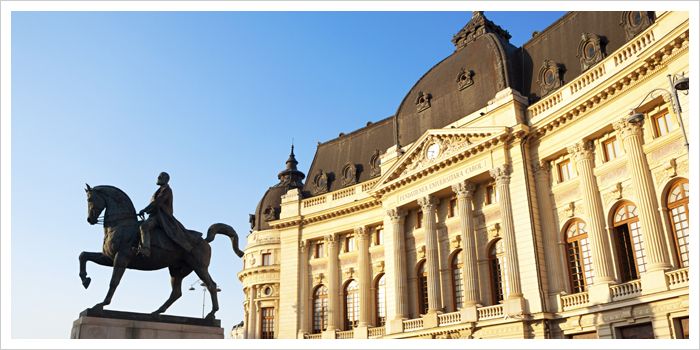
FOR a solid week storms saturated Bucharest. On the first day of relief, I put away my foul weather gear, joined the young, chicly dressed Romanians who had just emerged on Calea Victoriei, the city's main artery, and set out to enjoy the architectural treasure chest that is the Romanian capital.
À medida que o sol queimava através das nuvens que caíam à tarde, as influências culturais da cidade - delineadas nas desgastadas estruturas neoclássicas, art nouveau e blocky comunista-era - foram reveladas. Dentro destes edifícios antigos, muitos deles recentemente renovados, lojas como Max Mara e Escada estão crescendo continuamente, ajudando a transformar a imagem de Bucareste como ressaca comunista para a de uma cidade constantemente modernizando esperando ser a capital de uma nação da União Europeia já em janeiro de 2007.
It was hard to believe that I was standing at the former nexus of an ironfisted regime that in the 1980's was arguably closer to North Korea's brand of Communism than to the Eastern Bloc's. Less difficult to imagine was Bucharest's earlier history, dating back to the turn of the 20th century when the city was known as the Paris of the East because of its affection for everything French - from food to fashion to architecture.
Now Bucharest is redefining itself again, and in the process, it is fast becoming an intriguing alternative destination in Europe. In the last year alone, there has been a 24 percent increase in tourism from the United States, according to the national tourist office in New York. And though the city has a ways to go before its rough edges are smoothed out, the anticipation of what the future might bring is palpable.
This impression could be said to exist to a lesser extent all over Eastern Europe. But this isn't Pragueor Budapest. Bucharest is deep in the Balkans and the end of Communism wasn't facilitated by a velvet revolution. When Nicolae Ceausescu, Romania's megalomaniacal dictator, was ousted in 1989, the cost was around 1,000 lives. The dictator himself was hunted down and shot.
Talvez nenhum lugar em Bucareste, população de 2,1 milhões, representa a esperança de que a mudança pode trazer do que o centro histórico da cidade: uma coleção de ruas na maior parte negligenciada em uma área da cidade há muito esperada para um plano de revitalização que será realizado até o final de 2006, de acordo com o prefeito de Bucareste, Adrien Videanu. É conhecida localmente como Lipscani porque Lipscani Street, seu eixo leste-oeste, atua como sua âncora. Alguns romenos chamam a área de ruínas Lipscani.
Yet, the center - which was established in the 15th century by Vlad (the Impaler) Tepes, who is thought to have been the inspiration for Bram Stoker's Dracula - is the site of many marquee attractions. These include the stone-columned remains of the 15th-century Prince's Palace and Stavropoleos Church, which was built in 1724 by a Greek monk in the Byzantine style.
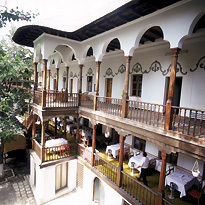
In the southeast corner of this historic area, Manuc's Inn was built around 1808 to serve merchants on the trade route between the Ottoman Empire and Europe. Today, inside its courtyard - complete with encircling wooden balconies - a functioning hotel, restaurant and wine cellar still seem primed to play host to rowdies and prostitutes.
Quando me transformei em Lipscani, de Calea Victoriei, as mulheres de salto alto correram pela avenida à frente de motoristas romenos notoriamente selvagens. Era agora o anoitecer. As luzes de rua brilharam para a vida e os guardiões de uma loja de canto vendendo o último de seus pretzels romenos frescos chamado covrigi puxou o guarda de fio de metal sobre a janela. Mesmo com as fachadas em ruínas das antigas casas da cidade, bistrôs e bancos, não foi difícil imaginar como o bairro pedestre, pré-Ceausescu, poderia, dado os recursos, tornar-se o motor turístico da cidade.
At a cafe, Françoise Pamfil, an architect and lecturer at the Ion Mincu University of Architecture and Urbanism, told me: "During Ceausescu's time, people started not to care about public spaces. If it wasn't yours, and it was shared, it looked awful. If you extend that thinking, you can see how people forgot to celebrate public places. It's a deep wound."
But with a smattering of new restaurants and boutiques, it would seem that the wound is healing. On the wall of the Amsterdam Grand Cafe, a restaurant and bar with a cosmopolitan feel, a poster read "YES to Revitalization of the historic center. NO to Isolation." As I ate tortellini formaggio, served with ham and Parmesan, a chorus of languages filled the dining room. Upstairs, a tango lesson was in full swing.
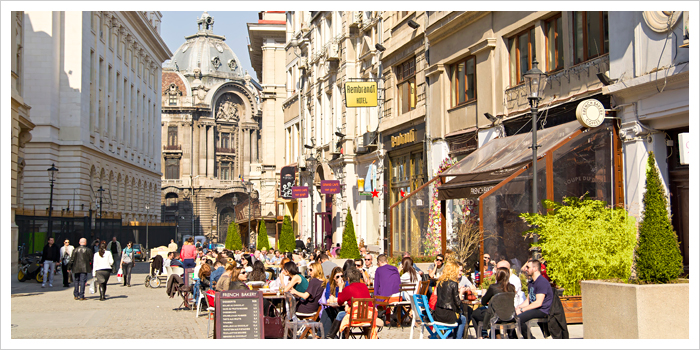
"I don't just think Bucharest is on its way up, I see it going up every day," said Jerry van Schaik, the general manager of the cafe. "There's a buzz in town - people starting businesses, construction is booming, underground initiatives are taken."
Outro cliente, Mark Nava, um roteirista americano, ficou igualmente entusiasmado.
"It's been really cool to see how this place has changed," said Mr. Nava, who has lived in Romania - an increasingly popular place for filmmakers ("Cold Mountain," most prominently) - since 1998. "There's a bohemian Moulin Rouge atmosphere - you can feel the ghosts and the romance."
Mais tarde, em um jardim de cerveja ao ar livre chamado Terasa La Ruine, o “Emotional Rescue” dos Rolling Stones se espalhou pela rua Lipscani e jovens residentes em roupas Levis e D&G se misturaram aos turistas. Enquanto eu bebia uma Bergenbier local por cerca de 2 novos lei (cerca de 65 centavos, a 3,12 novos lei por dólar), lembrei-me do que Michael Guest, embaixador dos Estados Unidos na Romênia de 2001 a 2004, havia me dito recentemente em uma mensagem de e-mail sobre o centro histórico: “Um número de nós na comunidade de expatriados sentiu que com a combinação certa de preservação histórica, desenvolvimento de infraestrutura e marketing, Lipscani poderia se tornar uma atração turística para Bucareste.”
It may be that the real strength of Bucharest is in how much it pushes its visitors to understand it on its own terms. For all the places that claim the moniker of "the gateway to the East," it takes little more effort than opening an Atlas to see that geography - between the Occident and Orient - tugs at the fiber of Bucharest.
"Bucharest is the reference city for the integration of European and Oriental civilizations," Mayor Videanu told me in another e-mail message. "Today's capital city is the center of spiritual, cultural and political reassertion of a people with old European values."
Quando perguntei ao Sr. Guest por que um turista deveria ir a Bucareste, sua resposta foi menos dramática. “De alguma forma, ela consegue carregar um certo exotismo”, escreveu ele, “mas sem parecer muito distante das normas de qualquer outra cidade ocidental”.
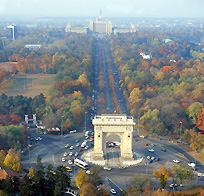
The next day I walked north of the city center along tranquil, tree-lined Soseaua Kiseleff Street, reminiscent of Paris and home to the city's mansion district. I passed through a 75-foot version of the Arc de Triomphe, erected in 1935, and made my way to two main, contrasting points of interest: the Village Museum and the Palace of Parliament.
A five-minute walk north of the arc is the outdoor Village Museum, which was established in 1936 to preserve a record of Romania's village life. It is an off-kilter, forested collection of more than 50 structures from different regions of the country, including Wallachia, Transylvania and Moldavia. Starting in 1935, many of the stone and wooden houses, workshops and churches were transported piece by piece to the site.
Por outro lado, o Palácio do Parlamento é um símbolo dos dias mais sombrios de Bucareste e, em todos os sentidos, é o lugar mais atraente da cidade. O projeto, que começou a ser construído em 1984, é muitas vezes chamado de Palácio do Povo, cheio de mármore, cristais e salas ornamentadas. Cobrindo mais de 3,7 milhões de pés quadrados, é o segundo maior edifício de escritórios do mundo (depois do Pentágono) e coincide com a queda do regime de Ceausescu e a destruição de algumas das áreas mais antigas da cidade - quase mil acres, maior que o Central Park - e milhares de casas foram destruídas.
During my 45-minute guided tour of the palace (in which I saw roughly 5 percent of the building and its 1,000 rooms), I was told that the people of Bucharest starved while Ceausescu spent billions on a structure he never got to enjoy. Meant to be a living monument to the dictator, it was never truly completed.
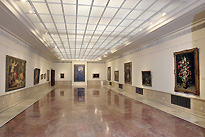
Back in the city center that afternoon, I decided to see how much I could do in one night for $40. My first stop was the National Art Museum, where a traveling exhibition called "Ombre et Lumières" from several French museums was in its last days in Romania. Housed in the 19th-century Royal Palace, the museum displays thousands of pieces by Romanians and masters like Rubens, Rembrandt and Monet.
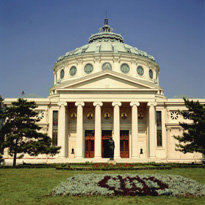
The Romanian Athenaeum, home to the George Enescu Philharmonic Orchestra since 1888, was next. Inside this magnificent concert hall, with its interior of swirling marble and a giant fresco depicting Romanian history, I took in a concert of Strauss, Bach, Mozart and Brahms.
With about $30 left, I dined at Restaurant Balthazar, which combines French and Asian cuisines. It is wedged into a beautiful old villa and is a favorite of diplomats and the jet set. After a dinner of duck with caramelized pineapple and wild berry sauce, and a glass of Cotes du Rhône, I had $10 left, and set off for Green Hours 22 Club Jazz Cafe, for some music and a trio of dark Silva beers.
Isso me deixou com lei suficiente para uma bebida nocturna no Laptaria Enache, um bar no topo do Teatro Nacional. O bar e seu vizinho na cobertura, La Motor, estavam lotados de estudantes universitários, artistas, músicos e jovens profissionais.
I wandered back onto Calea Victoriei just as the night seemed to be revving up: neon lights backlit hip young crowds and French-inspired Belle Époque buildings. A convoy with a Porsche Cayenne, a BMW X5 and a Mercedes S600 roared past Revolution Square, where Ceausescu was booed off the balcony of the Central Committee of the Communist Party building in 1989.
Squeezing between scaffoldings and party-going crowds on temporary wooden sidewalks, a statement I'd heard over and over again in describing Bucharest - "Europe as it used to be" - came to mind. At that moment, a European city in the making seemed more appropriate.
COMO CHEGAR
Muitas companhias aéreas vão para Bucareste dos Estados Unidos através de outras cidades europeias, mas não sem escalas. Em meados de dezembro, uma pesquisa na Web encontrou tarifas para meados de janeiro a partir de US$ 566.
ONDE FICAR
Os códigos de discagem são 40 para Romênia e 21 para Bucareste.
O Hotel Rembrandt, in the historic center at 11 Smardan Street, 313-9315, www.rembrandt.ro, has 15 homey rooms - leather armchairs and Tiffany-style desk lamps - that, with tax, range from 85 to 135 euros (about $102 to $162, at $1.20 to the euro). High-speed Internet, a bar and bistro, and 24-hour room service are among the amenities.
Com vista para a Praça da Revolução, Athénée Palace Hilton, 1-3 Episcopiei Street, is the grande dame of Bucharest hotels. Built in 1914, the hotel is swathed in marble, has 272 rooms that range from 340 to 830 euros, five restaurants, wireless Internet and a health club. Information: 303-3777; www.hilton.com.
ONDE JANTAR
Grande Café de Amsterdã, Rua Covaci 6, 313-7581, serve de tudo, desde quesadillas a satay de frango, e tem uma carta de vinhos variada. Uma refeição para dois, com bebidas, custa cerca de US$ 25.
Baltazar, 2 Dumbrava Rosie, 212-1460, oferece almoços e jantares de inspiração franco-asiática e é um exemplo perfeito de quanta qualidade você pode obter em Bucareste por quase nada. O jantar com vinho me custou menos de US$ 15.
O QUE VER E FAZER
O Museu da Aldeia, no norte de Bucareste, em 28-30 Soseaua Kiseleff, exibe a história bucólica da Romênia com 50 casas, lojas e igrejas de todo o país. Aberto de terça a domingo. A entrada custa 5 novos lei. Informações: 222-9110, www.muzeul-satului.ro.
O Palácio do Parlamento, 1 Calea 13 Septembrie, 311-3611, considerado um erro catastrófico tanto do ponto de vista da arquitetura quanto do tecido social, de alguma forma se transformou em um motivo de orgulho, em vez de um monumento a um ditador com mão de ferro. Aberto diariamente; 20 novos lei.
Instalado no Palácio Real em 49-53 Calea Victoriei, o Museu Nacional de Arte is full of great works by the likes of Rubens, Monet, Rembrandt and El Greco. It is open Wednesday through Sunday, and entry is 12 new lei. Information: 314-8119 and online at art.museum.ro/museum.html.
Cristian Florea corre Passeios CRIF, 444-0164, www.discoverromania.ro, e lidera indivíduos e grupos através de Bucareste ou em outros lugares da Romênia. Ele fala inglês extremamente bem e é versado na história romena.
Para mais informações sobre Bucareste, visite:RomêniaTourism.com/Bucareste.html
Leia mais artigos sobre a Romênia em RomêniaTourism.com/Romania-in-the-Press.html