

Year 2026 marks 150 years since the birth of sculptor Constantin Brâncuși,
an inovative artist that created his own style.
Often called "Patriarch of Modern Sculpture",
Brâncuși is regarded as a trailblazer in contemporary art,
a personality that laid the path for future generations of artists.
Brâncuși’s works bridge Romanian folk art and motifs and universal modernism.
| 2026 institutional Constantin Brancusi exhibitions worldwide | ||
|---|---|---|
| Exhibition Dates | Venue | |
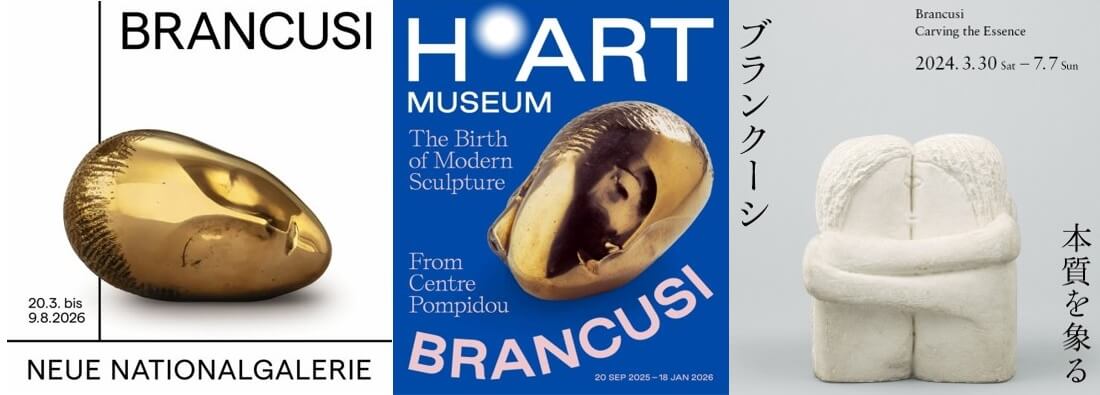
September 20, 2025 -- January 18, 2026 | Brancusi, The Birth of Modern Sculpture H'ART Museum, Amsterdam | |
January 13 -- March 31, 2026 |
Constantin Brancusi Photographs Ely House - Thaddaeus Ropac, London | |
February 19 -- December 31, 2026 |
Brancusi: The Origins of Infinity Mercati di Traiano - Museo dei Fori Imperiali, Rome | |
March 1 -- December 31, 2026 |
Brancusi - the Syndrome Romania National Art Museum, Bucharest | |
March 20 -- August 9, 2026 |
Brancusi Neue Galerie - Staatliche Museen zu Berlin, Berlin | |
January 1 -- December 31, 2026 |
Brancusi permanent exposition Philadelphia Museum of Art, Philadelphia | |
January 1 -- December 31, 2026 |
Brancusi and Abstraction MoMA, The Museum of Modern Art, New York City | |
January 1 -- December 31, 2026 |
Constantin Brancusi City of Craiova Museum of Art, Bucharest | |
Brancusi - The Birth of Modern Sculpture
H'ART Museum, Amsterdam
A landmark presentation that brings to Amsterdam an exceptional collection of works by Constantin Brancusi,
who is widely regarded as the father of modern sculpture.
Exploring the different facets of his art, the exhibition displays more than 31 sculptural masterpieces,
accompanied by the original pedestals created by the artist, as well as his photographs and films.
Constantin Brancusi Photographs
Ely House, London
The Ely House exhibition brings together three decades of the Romanian artist’s photographic work.
Photography formed an integral part of Brancusi’s practice,
as both a documentary tool for his sculptural works, and an artistic medium in its own right.
Some of Brancusi’s sculptures survive only through photographs, including Woman Looking into a Mirror (1909–14).
Brancusi - the Syndrome
Romania National Museum of Art, Bucharest
'Brâncuşi - the Syndrome' explores the formative influence
of Brâncuşi's personality and work on modern and contemporary Romanian art,
and how it has shaped the minds of creators and the experiences of the public.
Brancusi
Staatliche Museen zu Berlin - Neue Galerie, Berlin
The most extensive, 2026, survey of Constantin Brancusi’s (1876-1957) multifaceted work:
more than 150 sculptures, photographs, drawings, films, and rarely seen archival materials.
In addition to well-known works such as Le Baiser (The Kiss), L'Oiseau dans l'espace (Bird in Space),
La Muse endormie (Sleeping Muse), and La Colonne sans fin (Endless Column),
the exhibition also features a partial reconstruction of Brancusi’s legendary studio—shown outside of Paris.
His organic forms, reduced to their essence, established him as a pioneer of sculptural abstraction in the early 20th century.
Source: Centre Pompidou
Brancusi - permanent exhibition
Philadelphia Museum of Art, Philadelphia
Philadelphia Museum of Art's collection of Constantin Brancusi is home to the largest assemblage of sculptures by Constantin Brancusi in the USA.
Gallery 188 – a chapel-like space, on the first floor - displays an elegant grouping of sculptures selected from among the museum's 20 Brancusi,
including masterworks such as "The Kiss" and "Fish",
as well as two pieces from his iconic "Bird in Space" series, a microcosm of the modern master's repertoire.

Brancusi was known to be reluctant to sell his work.
Although he reached critical and financial success in his lifetime,
his sculptures became even much, much more sought after after he died in 1957.
In May 2018, his La Jeune Fille Sophistiquée (Portrait de Nancy Cunard),
a small bronze sculpture set on a marble base,
was bought for $71 million, making it
one of the most expensive sculptures
ever sold.
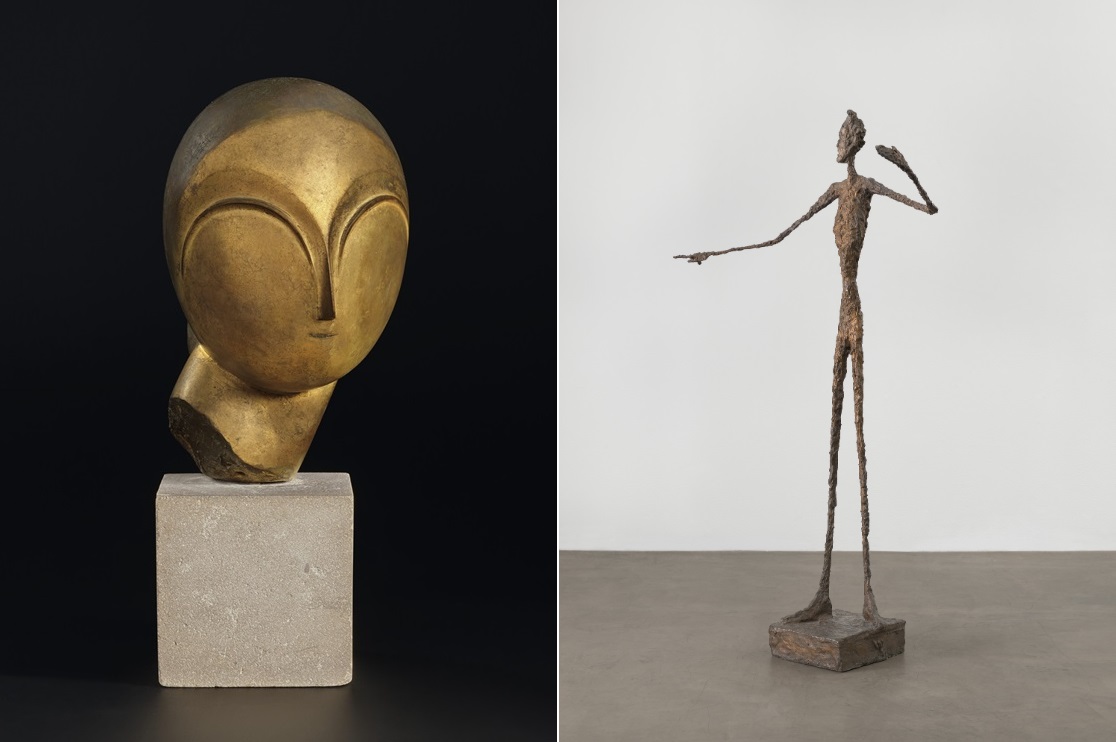
However, in May 2026 Brancusi's bronze head,
Danaïde
(1913) was purchased for $107.6 million,
the second most expensive sculpture after Alberto Giacometti's Pointing Man.
Today Brancusi's work can be found in prestigious museums and art collections in every continent: Museum of Modern Art (MoMA) - New York City, Centre Pompidou - Paris, Tate Gallery - London, Solomon R. Guggenheim Museum - New York City, The Metropolitan Museum of Art - New York City, National Gallery of Art - Washington, D.C., San Francisco Museum of Modern Art (SFMOMA), Hirshhorn Museum and Sculpture Garden - Washington, D.C., Dallas Museum of Art, Art Institute of Chicago, Norton Simon - Pasadena, Nasher Sculpture Center - Dallas, Moderna Museet - Stockholm, Artizon Museum - Tokyo, Kunsthaus Zürich, National Gallery of Australia - Canberra.
...
12 Defining Moments in the Life of Constantin Brâncuşi
1876: Brâncuşi was born in Hobiţa, an isolated village in the foothills of the Southern Carpathian Mountains in Oltenia region (southern Romania). He grew up one of seven children in a wealthy peasant household in an area with a tradition of woodworking. He taught himself to read and write while tending sheep.
1887: Limited opportunities led Brancusi to run away from home at the age of 11.
He enrolled in a school in the town of
Târgu Jiu
and supported himself by working menial jobs.
A half a century later, Târgu Jiu became the site of Brancusi’s largest creations/ensemble:
The Table of Silence, the Gate of the Kiss and the
Endless Column.
In 1893, Brâncuşi moves to
Craiova,
the largest town in the region,
70 miles south of Targu Jiu
and gets a job in a tavern
(a carpentry workshop according to other sources).
His talent for carving was innate and largely self-taught.
In his spare time, he had crafted a violin from an orange crate.
In 1894, he gains acceptance to Craiova School of Arts and Craft.
While studying in Craiova,
Brancusi gets scholarships from Madona Dudu Church in Craiova and the Dolj County Prefecture.
1898: Constantin Brancusi arranged an apprenticeship with a local cabinetmaker in Bucharest. From 1898 until 1902, he studies sculpture at the Bucharest School of Fine Arts (Școala Națională de Arte Frumoase - București ). To support himself and be able to attend classes, Brancusi sells his share share of inheritance from their parents to one of his brothers.
Although intended for the study of the anatomy of muscles, vessels, and nerves by students of medicine and fine arts, the work is equally a work of art.
1903: Brancusi decides to leave Bucharest for Paris.
The artist traveled most of the 1,500-mile-long journey, from Romania to France, on foot.
The journey took him well over a year and entailed sleeping outdoors and relying on the generosity of strangers.
His itinerary across Europe included Budapest, Vienna, Munich (where he took a break and worked as a stone carver),
Zurich, Basel, Alsace, and finally Langres, from where he boarded a train thanks to funds wired to him by a friend.
In 1904, at age 28, Brancusi arrived in Paris, where he lived until his death at 81.
1905: Brancusi obtains a scholarship from the Romanian Ministry of Religions and Public Instruction and enrolls in the École Nationale des Beaux-Arts in Paris. He works in the studio of sculptor Antoine Mercié and, in order to earn a living, he also does odd jobs. Orders for portraits from a few compatriots helped him helped him during his first years in France.
1907: Brancusi is invited to work in the studio of Auguste Rodin,
the French sculptor of sumptuous bronze and marble figures,
considered by some critics to be the greatest portraitist in the history of sculpture.
After just less than two months in Rodin's atelier Brancusi leaves.
He bids farewell to representational realism and
Rodin’s style of impressionistic sculpture
and moves towards representational abstraction.
"Nothing can grow in the shade of a great tree", the tree being Rodin,
is the pharse Brancusi used to
explain that he couldn’t have developed had he stuck around any longer.
Reflecting on this time later, Brancusi said:
"These were the hardest years of all, the years of searches when I had to find my own path;
I left Rodin; I must’ve angered him but I had to discover my own way". (MoMA)
Brancusi left Rodin's studio explicitly because he did not want his work to be redundant, even if the person he wanted to avoid imitating — Rodin — was the “father of modern sculpture.” The result is that Brancusi is today considered the “patriarch of modern sculpture.” (Tessa Augsberger, In Defense of Brancusi)
radical simplification of forms, implied movement, sculptural luminosity.
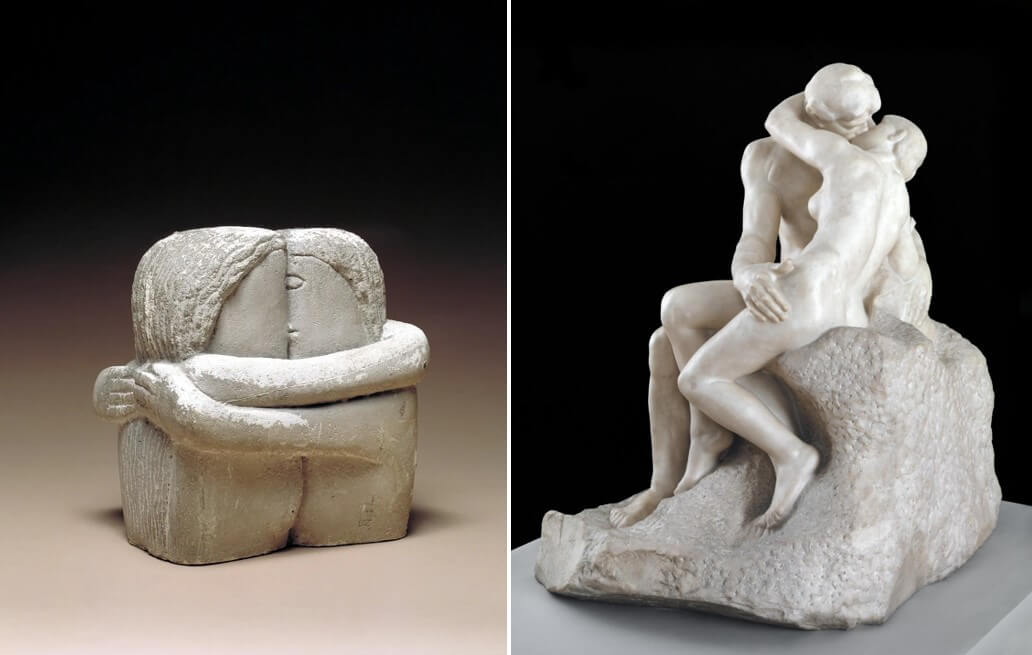
1907 - 1908: Constantin Brâncuşi creates The Kiss, arguably his first truly original work: the vertical figures of two entwined adolescents form a closed volume with symmetrical lines. The Kiss affirmed the pure, organic use of form that was to become Brancusi' trademark and that would influence the work of numerous artists, most immediately a series of sculptures executed by his friend Amedeo Modigliani starting in 1910. By simplifying and clarifying the human form into near abstraction with his works The Kiss and The Prayer, Constantin Brancusi fundamentally transformed sculpture, just as Pablo Picasso revolutionized painting that year with his Demoiselles d’Avignon — together perhaps the two most radical disruptions in the history of Western art.
1913: The International Exhibition of Modern Art Armory Show took place.
Over 1,600 works by: Ingres, Delacroix, Courbet, Cezanne, Gauguin, Manet, Degas, Lautrec,
Matisse, Kandinsky, Rodin, Bourdelle, Duchamp, Brâncuși were exhibited.
The Armory Show has an extraordinary echo and will reopen at The Art Institute Chicago,
where students take to the streets to protest and want to burn the portraits of Brâncuși, Matisse and Walter Pach,
considered exponents of the decadent avant-garde.
Brâncuși works displayed at Armory Show were: The Kiss, Muse, Sleeping Muse, Miss Pogany and Torso.
After debuting his work in the Armory Show, followed by a solo show in Alfred Stieglitz’s Photo-Secession Gallery,
Brancusi achieved commercial success stateside.
1917: Brancusi meets John Quinn - a prominent New York finance lawyer, a tireless friend and patron of the arts and one of the most important collectors of modern and avant-garde art of his generation. Quinn would become one of Brancusi's most prominent collectors and, crucially, acquired most of his sculptures from photographs sent to him from Paris, by Brancusi. This relationship initiated a shift in Brancusi’s photographic practice from a spontaneous to a more systematic creative endeavour. Quinn - Brancusi’s greatest single patron - buit-up by far the largest collection of Brancusi’s works in either private or public hands.
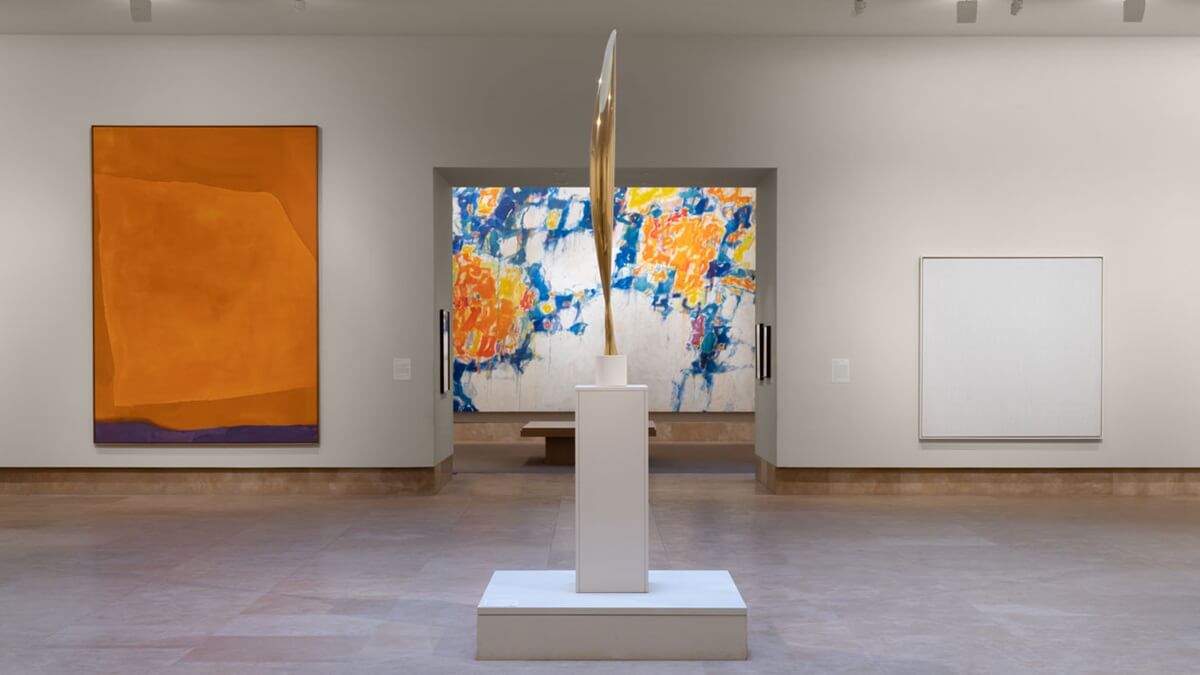
1923: Brancusi creates the first version of
Bird in Space,
a towering sculpture over seven feet tall featuring a sleek,
abstracted marble form focusing on movement, on the essence of flight,
rather than a literal bird with its physical attributes.
The base a tripartite limestone structure
was initially conceived as an independent sculpture in its own right.
One of the versions of Maiastra, shipped by Brancusi from Paris to New York, in 1926,
determined the US authorities to accept that the (US) definition of what constituted art was out of date
(more).
1951: Brancusi offers to donate the Romanian state all his works and belongings: 230 sculptures, 41 drawings, 1,600 photographs - many documenting his work and, furniture pieces. However - on March 7, 1951 - the representatives of the Comunist authorities held a meeting during which they decided not to accept Brancusi's offer. "Brancusi's works do nothing to help build socialism in Romania, we refuse" was the resolution of Romania's Communist Party leader Gheorghe Gheorghiu Dej. Perplexed and disappointed Brancusi applies for - and in 1952 gets - French citizenship.
“I am dying with an unsettled soul, knowing that I will be buried in foreign land, far from the person I loved most—my mother”. (Brâncuși deathbed confession).
1956: On April 12, Brâncuşi, now in his eighties, dictates his last will to French notary Claude Burthe-Mique: his Paris studio, with all his masterpieces, would go to the Museum of Modern Art in Paris. Less than one year later, on March 16, 1957, the great artist pases away and is buried in Paris Montparnasse Cemetery.
That tells you what you need to know about fame.
...» Quotes from Brancusi » Quotes on Brancusi
Quotes from Constantin Brâncuși
400 years before the birth of the great Romanian sculptor?
The following quote is often attributed to Michelangelo:
"The best way to judge the essential elements of a sculpture is to throw it down a hill,
and the unimportant pieces will break away".
(the above may not be the exact words of Michelangelo).
Constantin Brâncuși was an extraordinary sculptor and photographer and his personality was equally memorable and bold. He was a man far ahead of his time, which probably made him irresistible. He played golf, was passionate about photography, and was fascinated by flying. He bought a telephone, but also a vacuum cleaner. He played violin and Romanian folk music, but he also liked to listen to jazz. He was known for speaking in short aphorisms. These quotes offer a glimpse into his philosophy:
Bracusi often carved in oak or in chestnut objects that he would later treat in bronze or marble.
variation: In art, one does not aim for simplicity; one achieves it unintentionally as one gets closer to the real meaning of things.
variations: Nothing is truly hard to do; the real struggle is awakening the will to act. /
It is not the task that resists us, but the inner moment when we finally step into action.
it is impossible for anyone to express anything essentially real by imitating its exterior surface.
I am trying to get a spiritual effect.
(Sources: thehistoryofart.org, artnet.com, artsy.net)
Brancusi and Picasso
Though Brancusi was never a member of any organized art movement,
he got fervent support within the artistic and intellectual community in Paris.
He became close friends with
Henri Matisse, Amedeo Modigliani, Marcel Duchamp, Fernand Léger, Erik Satie and, Henri Rousseau among others.
A few sources indicate that Brancusi and Picasso were friends.
Both are considered geniuses who revolutionized the way we see the world.
However, their philosophies of life and creation were opposed,
making friendship between them rather improbable.
Picasso was the undisputed star of Paris.
A boisterous extrovert, wealthy, who loved fame and was always the center of attention;
he changed his artistic style every few years.
Brâncuși, on the other hand, was a "Saint of Montparnasse."
He lived modestly, dressed like a Romanian peasant,
obsessed with perfection and refining the same form until he reached absolute essence.
It is said that Picasso,
curious and perhaps a little envious of the Romanian's aura of mystery,
insisted on visiting Brâncuși's studio in Impasse Ronsin.
Picasso was fashionably late.
When he knocked at the door,
Brancusi opened it and asked him:
"Who are you"?
When Picasso replied: "Picasso",
Brancusi answered "I do not know you".
Once in Brancusi's studio, the Spaniard tried to be friendly
and began praising the sculptures, using critical terms specific to the art world.
Brâncuși listened to him for a while, then interrupted him saying:
"You make art, I create something else".
This was a profound truth.
Brâncuși despised the term "art" in the Western sense: dramatic and decorative.
He sought the spirit, the "cosmic essence" hidden in matter and,
did not want to represent reality, but eliminate it to achieve purity.
Picasso left irritated.
Several sources indicate that the two avoided each other for the rest of their lives.
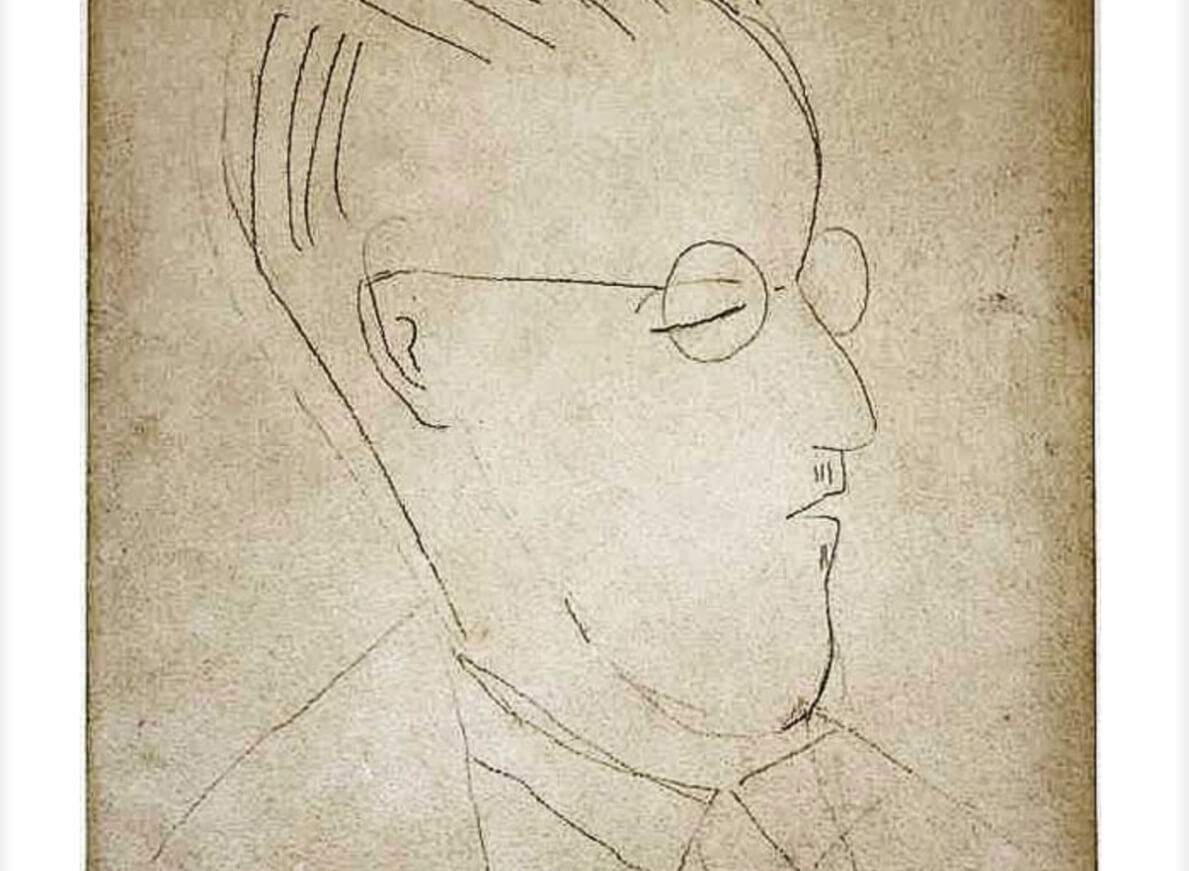
After Pablo Picasso declined, American publishers Harry and Caresse Crosby of Black Sun Press commissioned Constantin Brancusi to draw images of James Joyce, for their limited edition of Finnegans Wake. Brancusi drew six sketches of James Joyce, for Black Sun Press then he added one more drawing: a clockwise spiral symbol, called “Portrait of the Author” (1930) but in effect, it was not a portrait at all.
According to The Morgan Library & Museum in New York, Brancusi said: “Joyce is like that: he departs from one point, and you’ll never meet him again.” In 1954, Brancusi changed the title to “Joyce’s Symbol.”
...
Quotes, by artists and critics, on Constantin Brâncuși
Since the Gothic, European sculpture had become overgrown with moss, weeds – all sorts of surface excrescences which completely concealed shape. It has been Brancusi's special mission to get rid of this overgrowth and make us once more shape-conscious. … (Henry Spencer Moore, English visual artist)
Whether or not a viewer can get behind Brancusi’s version of reality or representation, the artist opens up a dialogue that multiple subjective viewpoints exist and are worth our consideration. That recognition in itself can be a beautiful thing. (American Judge J. Waite who ruled on whether Brancus’s Bird in Space was really “art”)
There’s hardly a way to compare the two sculptures; they appear to hail from entirely different worlds. “Beside the Rodin, the Brancusi looks absurd; absurdly crude and inarticulate. And beside the Brancusi, the Rodin looks absurd; absurdly grandiose and explicit. Which is sublime, and which is ridiculous, is a matter of taste.” [Tom Lubbock - Art Critic and Illustrator - about how the Kiss theme in Brancusi’s (1916) sculpture Rodin’s (1882) works, considered in tandem, expose the flaws in trying to define “good” sculpture, or to pin down a single representation of an idea.]
With his sculptures, Brancusi shattered the paradigm of abstraction in sculpture and radicalized the idea of purity in form. Simply stated, “Brancusi changed the way art was made.” (Jérôme Neutres, Director of Development and Strategy of the Réunion des Musées Nationaux-Grand Palais).
Whatever is said, whatever is done, Brâncuși's work remains the only solid pivot for the near future. Brâncuși's work is not a local expression, it is the essence of the highest expression of universal purity and will remain over the coming centuries the only obstacle that can be overcome. (Doina Lemny - art historian)
The essence of Brancusi’s greatness is his ability to balance opposites, to find equal measure between seemingly irreconcilable factors: male and female, organic and machine-like, ancient and modern, smooth and rough, dense and “weightless.” With his sculptures, Brancusi shattered the paradigm of abstraction in sculpture. (William C. Agee, Brancusi and America).
Brancusi Makes the Modern World Look Stale
... we still haven’t matched the sculptor’s grace, humor, and clear-eyed brilliance.
More than a hundred years ago, though,
he perfected a kind of earthy sleekness that still looks embarrassingly contemporary,
so fresh that it makes the actual present taste stale.
A Brancusi has the tranquillity of a crescent moon.
His sculptures can’t be caught, only waved to as they soar grinningly by.
They are gracious but better than you, whoever you are.
(Jackson Arn,
"The Perfectionist",
June 3, 2024 issue of The New Yorker).
...
Modernism on Trial: Brâncuşi vs U.S. Customs
Brancusi was the protagonist of one of the most significant clashes of art and law in history,
a case that determined U.S. court to accept that its definition of what constituted art was out of date.
In October 1926,
20 sculptures crafted by the pioneering modern artist Constantin Brancusi arrived in the Port of New York
for an exhibition of his work, curated by his great friend and advocate Marcel Duchamp,
at the Brummer Gallery in Manhattan.
Among the 20 sculptures was the Bird in Space, now in the collection of the Seattle Art Museum.
There was, however, one snafu:
While contemporary law exempted artworks, including sculpture, from an import tax,
Brancusi's abstract work didn't look like "art" to port officials
who labeled them as industrial products and seized them for tax purposes.
To qualify as “sculpture,” works had to be
“reproductions by carving or casting, imitations of natural objects, chiefly the human form” (source: Rowell).
Confused and irritated by this assessment,
Brancusi launched a complaint in court in defense of the 'Bird in Space' sculpture.
The initial question before the court was whether Brancusi’s work
adequately resembled that which it was supposed to “imitate”, as indicated by its title.
Passing that test would make it a sculpture (and therefore art) and exempt it from customs duties.
The task of the trial became, however, how to define “sculpture” — and, for that matter, “art”.
Testimony was provided by a number of experts, including the sculpture’s owner, Edward Steichen,
an artist and future director of MoMA’s Department of Photography,
as well as British sculptor Jacob Epstein and Brooklyn Museum Director William Henry Fox.
During his testimony, the art critic Frank Crowninshield was asked by the court
what it was about the object which would lead him to believe it was a bird.
He responded: “It has the suggestion of flight, it suggests grace, aspiration, vigour,
coupled with speed in the spirit of strength, potency, beauty, just as a bird does.
But just the name, the title, of this work, why, really, it does not mean much” (Rowell).
The court ruled in Brancusi’s favor in Brancusi v. United States Customs a year later, in 1928:
his sculptures were indeed art — not a utilitarian objects that came with import duties.
The court also admitted that its definition of what constituted art was out of date,
that times were indeed a-changin’
and, that not all works of art could be defined by what they strove to imitate.
The decision of Judge J. Waite read,
“In the meanwhile there has been developing a so-called new school of art,
whose exponents attempt to portray abstract ideas rather than imitate natural objects.
Whether or not we are in sympathy with these newer ideas and the schools which represent them,
we think the facts of their existence and their influence upon the art worlds
as recognized by the courts must be considered” (Rowell).
Year 1928, forever changed the legal definition of art in America and signaled the dawn of modern art.
(MoMA | Artists, Collection & Exhibitions).
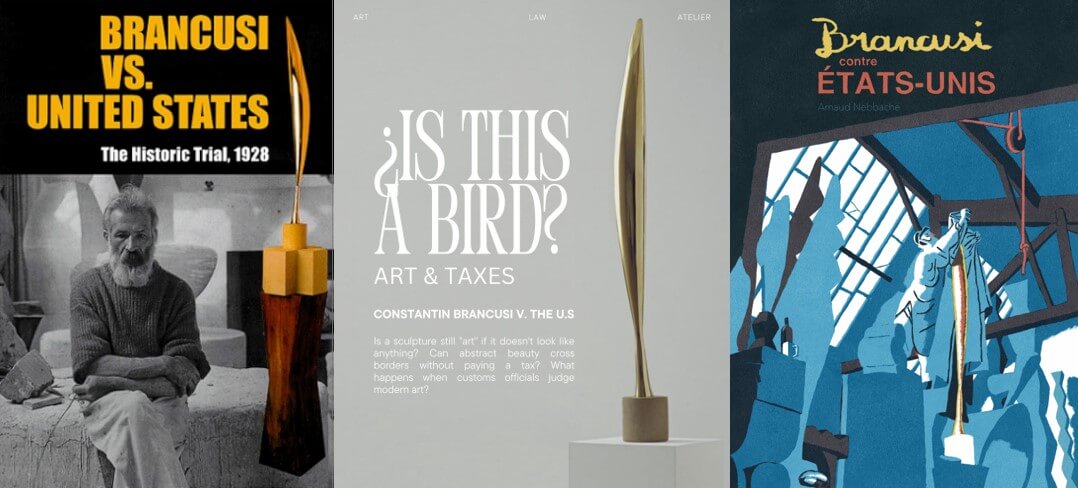
The trial that pitted Brâncuși against U.S. Customs, in 1927-28 over the import taxes,
is the subject of several books.
Brancusi’s second Guggenheim retrospective occurred in 1969, and was held in the museum’s Frank Lloyd Wright rotunda.
MoMA included works by Brancusi in more than ten group exhibitions between 1934 and his death in 1957. It took until 1967 for a French museum to have a show dedicated to his work (Tribute to Brancusi, at the Musee National d’Art Moderne in Paris) and until 1995 for the first full-scale exhibition in his adopted country at the Pompidou Center. (Kasmin Gallery)