

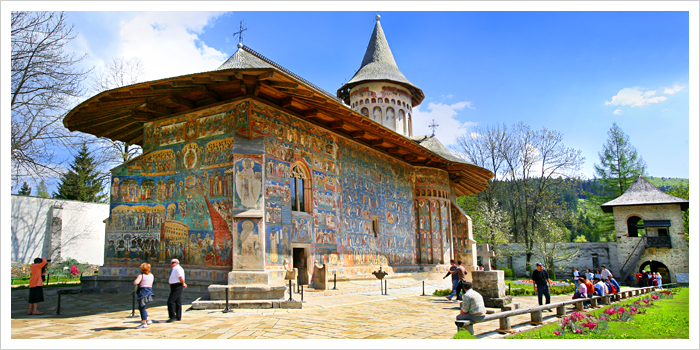
When the Moldavian prince Stephen the Great won his first decisive victory against the Turks five and a half centuries ago, he decided to mark the occasion with a grand monastery and adorn its walls with the colorful work of artisans of the day. With his second victory came another monastery. With the third, yet another.
O resultado de suas vitórias — 46 ao todo — foi uma expansão sem precedentes no terreno densamente arborizado da região de Bucovina, na Romênia moderna. A tradição foi abraçada por seu filho e sucessor, Petru Rares, e seus vassalos. Muitos dos mosteiros e igrejas cobertas de mural sobrevivem, aninhados em um vale, tendo resistido ao murcho sol de verão e ventos de inverno durante séculos. O que começou como troféus de guerra de Stephen, o Grande, tornou-se uma das obras de arte mais impressionantes do mundo.
They exist now as the present-day Monastery of Voronet, about three miles south of the Romanian village of Gura Humorului, and its sister sanctuaries, scattered within a radius of some 25 miles and collectively recognized as Unesco World Heritage sites.
Apontar a área que contém este trove não é fácil. A região, que se tornou o posto avançado oriental do Império Austro-Húngaro, é atualmente dividida entre Bucovina, no nordeste da Romênia, e Chernivtsi, na atual Ucrânia. Para complicar ainda mais as coisas, alguns romenos referem-se também a esta questão como sendo o norte da Moldávia, não confundindo-a com a República da Moldávia independente, que faz fronteira com o nordeste da Roménia. Mas há boas razões para fazer a caminhada, confusão geográfica e estradas com buracos, não obstante, como fiz no verão passado.
Driving through Prislop Pass on the northern slopes of the Carpathian Mountains in Romania's Muntii Rodnei National Park,
I caught my first glimpse of the area, a dizzying green expanse thick with virgin forests.
The trees gave no clue of the treasure they hid. I had chosen a room at Casa Felicia, a guesthouse next to a monastery in the village of Sucevita, as my base.
From there I embarked on a self-guided tour of the monasteries and their murals.

Architectural historians have described the monastery churches, some shaped like gnomes in slouch hats, as Byzantine churches built with Gothic hands. At the monastery church of Voronet, I found that no labels do justice to the images that ring the exterior. Like an open picture book, its pages fluttering in the breeze, every surface is covered with tableaux from the Old and New Testaments as well as local legends and the lives of saints.
Voronet permaneceu um mosteiro até o século XVIII, quando os ocupantes de Habsburgo expulsaram os monges, e foi desabitado posteriormente até 1991, quando uma comunidade de freiras dedicadas à Ordem de São Jorge tomou residência. Há passeios regulares, embora principalmente em romeno. Durante minha visita, uma irmã insípida de idade indeterminada e certa severidade fizeram uma visita guiada em inglês. "Perguntas, não!" ela meio desafiada, meio ameaçada em intervalos regulares, brandindo um ponteiro que poderia ter dobrado como um interruptor; ninguém se atreveu a levantar a mão.
But you don't have to speak Romanian to grasp the meaning of these painted parables. The famous "Voronet blue" base of the color scheme, obtained from crushed lapis lazuli, has an overpowering effect, as if the sky had descended to saturate the surface. Byzantine-inspired scenes, astoundingly expressive, illustrate the Book of Genesis on the northern wall, and include a bewildered-looking Eve, fresh-formed from Adam's rib.
A soaring, azure Tree of Jesse climbs the southern wall, tracing Jesus' terrestrial genealogy back to King David, framed by a ring of classical philosophers. In juxtaposing Old and New Testament themes with portrayals of Greek philosophers, the painting strongly affirms a cultural affiliation with the Occidental tradition, as distinct from the tradition of the Ottoman invaders.
Built in 1488, at a time of relative peace, the walled monastery doubled as a military stronghold, just in case. Its frescoes were painted a half-century later, mostly by anonymous masters, except for a certain Marcu, who inscribed his name to the left of the entrance. The images in this and other Bucovina monasteries were intended to instruct, entertain and enlighten illiterate soldiers and peasants and to underline their loyalties.
The sprawling Last Judgment, known as the "Sistine Chapel of the East," covers the entire western wall and hammers home the message. Moses strives to lead the call to salvation at the throne of Christ Pantocrator (Christ Almighty), while the skeptical Jews linger among the Turks and Tatars, waiting to tumble into hell. It's a frightening, albeit fabulously entertaining, epic depiction, the D. W. Griffith silent-screen extravaganza of its day.
No Mosteiro de Humor, na aldeia de Manastirea Humorului, cerca de quatro milhas ao norte, a tonalidade dominante dos afrescos exteriores é um vermelho acastanhado à base de mais loucos que realça o fascínio da igreja, como se fosse um cogumelo mágico gigante brotando da terra. Construído em 1530 no local das ruínas de um mosteiro mais velho, pelo nobre Teodor Bubuiog, um fiel vassalo de Stephen o Grande e Petru Rares, Humor tem afrescos exteriores, não tão bem preservado, mas semelhante em estilo e motivo para aqueles em Voronet, pintado em 1535 por artista Toma de Suceava.
Plundered by the Cossacks and other invaders and closed by the Hapsburgs, Humor, like Voronet, was re-established as a monastic community in 1991. The ramparts are still intact. I climbed the stairs of the watchtower for a glimpse of the church huddled within and a sweeping view of the hills without.
The sulfur-based yellow background lends a sun-drenched appearance to the church in the Monastery of Moldovita, built in 1532 by Petru Rares in the village of Vatra Moldovitei, some 20 miles to the west. Its anonymously painted exterior frescoes of varying styles, indicating the likelihood of multiple artists, date from 1537.
Uma lição de história e aviso apontados aos fiéis na fachada sul retrata o cerco turco de 1453 de Constantinopla cristã, e está entre as pinturas ao ar livre mais dramáticas da região. Como eu me concentrei com um prazer infantil na cena de batalha, um espetáculo de soldados montados em volta da cidade fortificada, eu estava despertado de meu devaneio decididamente secular por uma freira que parecia ver através de mim, golpeando uma toaca, ou conselho de oração, usado aqui em vez de um sino.
Romenos afluem ao Mosteiro de Putna, não muito longe do norte, para adorar no túmulo de Estêvão, o Grande, canonizado como O Voivod de Direito (príncipe) Estêvão o Grande e o Santo pela Igreja Ortodoxa Romena. Ele erigiu a estrutura de 1466 a 1469 como seu último lugar de descanso. Assaltado por cossacos, a igreja foi reconstruída de 1653 a 1662. As paredes exteriores estão desnudas, dando-lhe uma austeridade diferente do lirismo espiritual de seus santuários irmãs.
Stephen likewise had a hand in preserving the beautiful Biserica Dragos Voda, said to be Romania's oldest standing wooden church, built in 1346. It was moved, beam by beam, in 1468 to a less-visible location, behind a graveyard just outside the monastery walls, to protect it from the marauding Tatars.
My heart did not beat faster at Stephen's sepulcher, but nearby it leapt at the primal allure of Chilia lui Daniil Sihastrul, the cave of the prince's spiritual adviser, the ascetic mystic Daniel the Hermit, which he carved out of the cliff and inhabited for 14 years.
Perhaps it was the lingering effect of the homemade palinca, the twice-distilled, 60-proof plum brandy that Trandafir and Felicia Cazac served at supper at their guesthouse, Casa Felicia. After a few days of monastery hopping, my spiritual faculty was primed.
Eu não podia deixar de ser agitada pelo forte contraste entre a falange harmoniosa dos anjos pairando em fileiras acima e o caos dos condenados abaixo na representação surreal de "A Escada das Virtudes" na fachada norte do Mosteiro Sucevita, ao lado da pousada. Olhei para a minha fotografia dela muito depois do jantar. Embora os visitantes se identifiquem com os virtuosos, o meu olhar ficou fascinado com a tormentada queda dos demônios e dos condenados. Dada a história sombria do século XX, esta cena Bosch-como parecia estranhamente presciente.
Refletindo sobre os títulos, incluindo "Mohn und Gedächtnis" ("Poppy and Memory") de Paul Celan, um poeta de Bucovina, Pensei em “A Escada das Virtudes” e naqueles que não sobreviveram à subida.
Chegando aos Mosteiros Pintados
Cidades mais próximas: Gura Humorului e Suceava
Companhia aérea nacional da Romênia Tarô, voa de Bucareste para Suceava (região de Bucovina) e para Iasi.
Viagem de trem de Bucareste para Suceava leva 5 horas e 30 minutos.