

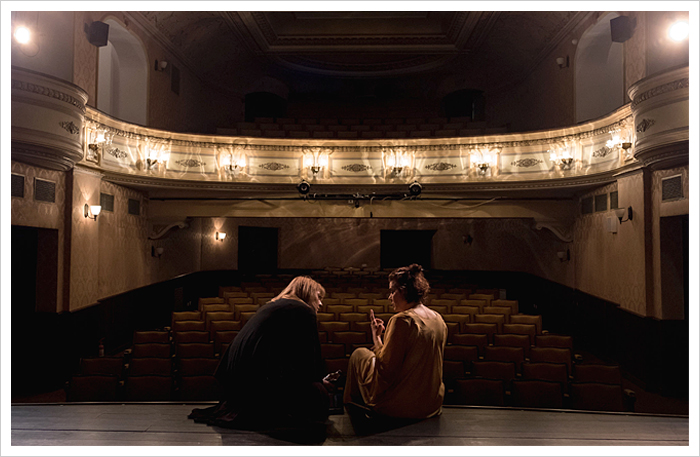
BUCARESTE, Roménia – A poucos minutos a pé da agitação do centro de Bucareste, o Teatro Estatal Judaico, numa pequena rua lateral da capital romena, apresenta uma figura desamparada.
No entanto, o teatro é um dos poucos vestígios do que já foi uma grande comunidade judaica na Roménia, e um dos poucos teatros profissionais de língua iídiche que restam na Europa.
Em 2014, uma forte nevasca literalmente derrubou o telhado, fazendo com que o teatro fechasse por dois anos. Reabriu ao público em novembro, com o telhado consertado, o interior recém-pintado e a fiação de décadas finalmente substituída.
“Nos últimos dois anos foi difícil sobreviver”, disse Maia Morgenstern, gerente do teatro e atriz que interpretou Mary em “A Paixão de Cristo”, de Mel Gibson. "Nós nos apresentamos aqui e ali. Outros teatros, bibliotecas públicas."
In early January, the theater staged "Warsaw: Tourist Guide," a tragicomedy set in the period after World War II, when Jewish families returned to Poland to try to reclaim their property. Despite thick snow blanketing the city, there was a full house.
The first Jewish theater in Romania was founded in the 1870s in the eastern city of Iasi. The current theater in Bucharest was established in 1940 and remained open throughout the war even as Romania was in the grip of anti-Semitism and many Romanian Jews were sent to labor camps. Romania was an ally of Nazi Germany until it switched sides in 1944.
Durante os anos de guerra, atores e dramaturgos judeus que foram proibidos de atuar em outros lugares passaram a exercer seu ofício, embora não tivessem permissão para atuar em iídiche.
Later, during the Communist period, Nicolae Ceausescu, the authoritarian leader who governed Romania from the mid-1960s to 1989, tore down much of the old Jewish neighborhood to make way for his grand, Soviet-style architectural vision for the city.
 "
"
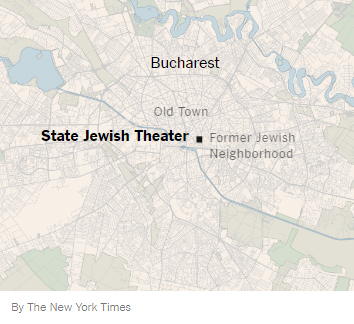
Ceausescu demoliu todo este bairro”, disse Morgenstern, recentemente, em seu escritório nos bastidores. “Nada além deste teatro permaneceu. Outra casa, outra rua, demolida, demolida. Era um oceano de ruínas."
Ela acrescentou: "Não demoliram o teatro, mas estava em péssimo estado. Sem aquecimento, eletricidade improvisada. Estava quase uma ruína. Foi difícil chegar aqui, para nós e para o público."
Embora as autoridades comunistas permitissem apresentações em iídiche, os atores aproveitaram o fato de que muitos membros do público dependiam de traduções para contornar parte da censura rígida.
"Because we were talking Yiddish on stage, we could say things that weren't allowed to be said in Romania," said Rudi Rosenfeld, 75, a Jewish actor who has been involved in the theater since the late 1940s. "The audience had headphones on and our colleagues were translating into Romanian, but they would skip the sensitive parts," he added.
Agora as legendas são disponibilizadas em telas portáteis.
By the late 1980s, most of the city's Jewish population was gone. The area around the theater, once a bustling Jewish neighborhood, had gradually lost its Jewish ties. The war years and, later, the country's decision to allow large number of Jews to emigrate en masse to Israel in exchange for Israeli money and assistance, depleted the local Jewish population. Most who had remained left after 1989, when the regime fell.
It is estimated that the Jewish population in Romania today is less than 11,000, down from around 800,000 before World War II. In Bucharest there are just a few thousand Jews left.
“Agora não existe nenhum bairro judeu, apenas desenhos num mapa”, disse Gilbert Saim, funcionário do Templo Coral, um dos poucos locais de culto judaicos que restam na cidade.
Vagando pelo bairro, é fácil perder os poucos sinais remanescentes da história judaica da região: apenas um punhado de edifícios religiosos, muitas vezes escondidos atrás de feios blocos de apartamentos, e o próprio teatro.
From the outside, the theater, which became an official state institution in 1948, barely hints at its legacy or, beyond "Teatrul Evreiesc", ou Teatro Judaico, escrito em letras verticais vermelhas, seu papel atual. É improvável que apareça com destaque em qualquer lista de institutos culturais de Bucareste. No entanto, por dentro, o salão de 250 lugares oferece decoração clássica e acústica rica.
"I've played on Broadway and regional theaters all over the States but this theater, the proportions and acoustics are fantastic," said Allen Lewis Rickman, an American actor who performed at the hall during an international Yiddish festival held in late November.
Ms. Morgenstern said she did not want the building to just be a monument to the past, but rather a place of active cultural engagement and creativity, bringing in all types of audiences to view the predominantly Yiddish-language performances. (The theater also stages some Romanian-language plays.)
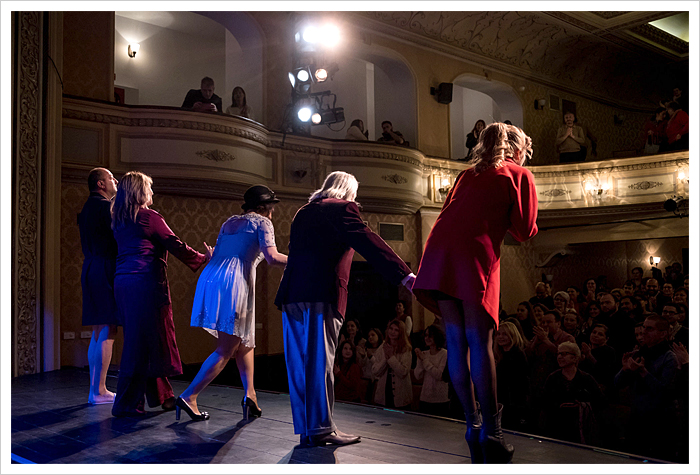
"I worry about the survival of professional Yiddish theaters," she said, noting that Bucharest, Warsaw and Moscow probably have the last remaining professional Yiddish theaters in Eastern Europe. "We want to continue our tradition of speaking and performing in Yiddish. I don't want to transform this theater into a museum; it is very much alive."
Com poucos falantes de iídiche no país, o público tem relutado em ver apresentações que parecem tão estranhas à Romênia de hoje.
Ms. Morgenstern admits that there have been times when there were more actors on stage than people in the audience. "We have performed for two people," she said. But in recent years, before the roof collapsed, they had been playing to much fuller houses.
Most of the actors had to learn the language before taking the stage.
“Foi um grande desafio aprender iídiche”, disse Anka Levana, 32 anos, que atua no teatro há uma década. "Demorou dois ou três anos até que eu me sentisse realmente confortável."
Apesar desses desafios, há uma determinação em continuar o legado do teatro.
Quando o telhado desabou, os atores, não querendo admitir a derrota, colocaram uma plataforma em frente ao teatro, acenderam algumas luzes e atuaram rodeados de neve.
“Não tenho certeza se foi um protesto ou não, mas estávamos dizendo que não temos lugar para nos apresentar. Queremos nos apresentar, temos algo para mostrar, mas não temos lugar”, disse Morgenstern.
Local officials listened, finding the money needed to repair the building.
Agora o desafio é manter vivas as tradições, ao mesmo tempo que nos envolvemos com uma nova geração de espectadores.
“Quando comecei neste lugar, eu tinha 18 anos”, disse a Sra. Morgenstern. “Agora tenho 55 anos. Sempre pensei que mais dois anos e este teatro morreria”.
Ela acrescentou com um sorriso: "Esse pensamento já dura 36 anos."
Uma versão deste artigo aparece impressa em 16 de janeiro de 2017, na página A4 da edição de Nova York com o título: Mantendo vivo um refúgio romeno da cultura iídiche.
Leia mais artigos sobre a Romênia em RomêniaTourism.com/Romania-in-the-Press.html